Raising the dead
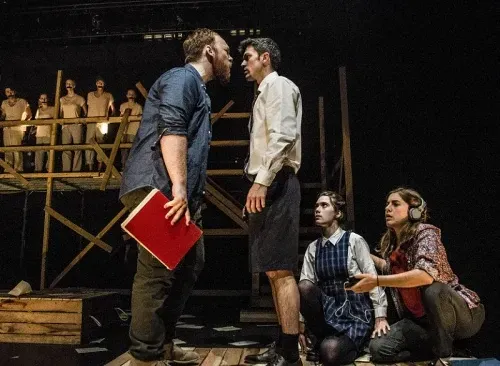
Dead Men's Wars, this year's STAB commission at BATS, breaks new ground by being an ANZAC collaboration... about the ANZACs. Featuring young performers from Long Cloud Youth Theatre (NZ) and Canberra Youth Theatre (Australia), the play challenges the mythology of the past and takes a hard look at how we engage with the stories of war. Renee Liang interviews playwright Ralph McCubbin Howell.
* * *
Where have you been with your shows this year?
All over the place. The only way we can make this sustainable is to take our work to new audiences - this year Hannah and I have been to Australia and the Edinburgh Fringe as well as around NZ. It's great to have had so much pick up on our shows, but at the same time I'm looking forward to being back home over summer, and getting stuck into one project rather than juggling a few.
How long does it take you to 'work' a play, and do you rework between seasons?
It varies wildly. I first wrote The Bookbinder over a fortnight, whereas Dead Men's Wars has been bubbling away for a year. I believe that the work on a play's just starting when you put it in front of an audience - until you've brought in that element there's only so much you know about what makes it tick. We've pushed this furthest with The Bookbinder, because it's a one-person play we've made changes not only between seasons but also night to night. One of the best things about staging works multiple times is the opportunity to have another crack at choices you made early on.
I enjoy the fine line you tread in your work between enchantment and discomfort - is this deliberate, and how do you do it?
I think all stories are about the extraordinary, so to some extent they're walking a line between offering escapism and unsettling the audience. There's been a mythic quality to some of my writing - drawing upon folktales or structures like the hero's quest (in works like The Bookbinder or Second Afterlife) - and I think these elements are heightened in that genre. I don't know - I want my works to affect the audience so if they go aaaw or laugh or get a fright, that's one way of achieving that.
Have you worked in other genres?
I think that it's more of a spectrum rather than strict divisions, so some elements have carried across all of my works and others are distinct. I'm interested in telling stories, so there's always a strong narrative element. In some of my plays, there's been a fantastical element, but then this wasn't a feature at all in The Engine Room or in Who's Neat? You! Some have been cross-over works, for children and adults, but there's also been grown-up political pieces, The Engine Room, Broken River and this new work Dead Men's Wars.
Tell me about your working relationship with your producer, Hannah.
Hannah and I are co-directors of Trick of the Light Theatre, and generally we produce our own work. We've taken on different roles in different shows, and whilst frequently I write and Hannah directs, it's much more collaborative than these binary divisions. Usually we'll develop the broader story outline together, then while I'm writing the script, Hannah acts as a editor and dramaturge. Because we're a small team it means we're able to work in quite an organic way and refine our process depending on the project.
How did you get involved in Dead Men's Wars?
Stella Reid approached me about it when she was directing Long Cloud, and put me in touch with Karla Conway who was the director of Canberra Youth Theatre. I was in Sydney for the Fringe Festival so had a chance to meet up with Karla in person, then the project grew from there.
Has the process gone smoothly? Any Trans-tasman rivalries/misunderstandings?
This has been an ambitious project - working across two countries, two companies, and occasionally several time zones. It's also my first time I've been commissioned to write on a particular theme. For me it's been a challenge not to work with my usual collaborators - not only Hannah but people such as Tane Upjohn-Beatson who regularly designs sound for our shows as Trick of the Light. It's meant I've had to actively communicate things that I'm used to putting in shorthand. This has been good - it's meant that I've had to consider more what I think is essential, and at the same time been quite liberating. It's allowed me to let my imagination run riot and write these audacious onstage directions that might have been culled if I was factoring in staging them myself. It's meant they become provocations for the company to realise. I hadn't met Brett before the second workshop in Canberra, but immediately felt confident in him as a director. This is the least I've been involved in the rehearsal process for one of my scripts, but it's nice to know it's in good hands.
Is the work mostly for young people?
No. But it is about young people. The play follows a group of students on a field trip to Gallipoli for the Anzac Day centenary, and the backlash they come up against when one of them goes off script. I was commissioned to make a piece to be performed by two youth companies, and I was only interested in writing something about Anzac if the focus was contemporary rather than a period piece. In the initial pitch I had imagined a second timeline - about an artist's apprentice traveling with the 1919 Australian Historical Mission back to the Gallipoli battlefields. Once I got into writing the thing, I realised this was distracting from the heart of the story, and distancing the work from its contemporary audience.
What are you working on next?
I'm writing a show for Trick of the Light which we're putting on as part of the NZ Festival. The programme's just been launched which means it's all very new and exciting at the same time as slightly terrifying. The play's called The Devil's Half-Acre which was the name given to the slums in Dunedin during the goldrush. The story follows two petty con-artists, commissioned by a mysterious stranger to put their underhand skills towards a series of dangerous tasks. I'm pretty excited about it - Hannah and I first talked about the concept years ago, and it's going to see us bring the dark magic of The Road and The Bookbinder into the grittier political stuff of The Engine Room and Broken River. We've got an amazing team working on it - it's a pretty exciting time.
- Dead Men's Wars is on at BATS Theatre 28 - 31 October.