Rachel Shearer
Written by
Hold Still - a video installation at The Film Archive by sound and visual artist Rachel Shearer - points a sharp light on the work of amateur female film makers during the Depression in 1930s New Zealand.
Shearer says she approached the exhibition as a collaboration with the women almost 80 years later and decided not to work from a documentary point of view.
"Rather I have been drawn to their artistic images but of course, the films can’t help bring in aspects of their lives and experiences.”
Ethel Garden, Violet Winstone and Lucy Mills were all upper middle class women making “home movies” in the 1930s. Shearer's installation reminds us of the intimacy of home movie making, and leaves us to wonder at the mystery of films that outlive their makers.
Shearer describes Hold Still as "An installation of fragments. Three women in 1930's New Zealand use 16mm film cameras to document their lives and surroundings.”
During what hours of the day do you feel most inspired?
6am - 45 minutes before my youngest child wakes up. I'm usually rested and am not distracted by the needs of the household. Before children it was about 11pm.
How would a good friend describe your aesthetic or style?
Looking through a veil.
What aspect of your creative practice gives you the biggest thrill?
When the sounds I'm playing with start to become 'something'.
How does your environment affect your work?
Working at home, family duties are never far away so work needs to be done efficiently and creative decisions made relatively quickly.
In your upcoming exhibition at the Film Archive mediagallery in Wellington you've chosen 1930s amateur film shot by women to work with, how did you come across this?
I was invited by Mark Williams from the NZFA to make an installation work with the films. I had worked with some of Ethel Garden's images (one of the 1930's women amateur film makers) as part of a previous commission from the Film Archive (Soundtracks 2006) and found them very striking and evocative, so I welcomed the opportunity to expand on that.
What can archival footage bring to contemporary artwork?
To call to mind an existing history, the transience/timelessness of our presence and contributions, reduction,reusing and recycling by selection and insertion of culture into new contexts.
Is anyone able to access such footage for use?
Better ask the Film Archive: information@nzfa.org.nz
1930s life was hampered by the Great Depression yet these female film makers seem somewhat cushioned from economic turmoil. How do you think that translates to today's "Credit Crunch"?
No doubt there are women out there of considerable means and creative talent who are out there experimenting cushioned from the current economic turmoil.
Do you like to look at the big picture or focus on the details?
Both - but have heard myself saying 'the beauty is in the details' a few times.
What's your number one business tip for surviving (and thriving) in the creative industries?
Separate your work from your ego.
Which of your projects to date has given you the most satisfaction?
Making music and performing live with the band Xe - Dean Roberts, Sean O'Reilly, Guy Treadgold and myself.
Who or what has inspired you recently?
The Ink Dark Moon: Love Poems by Onono Komachi and Izumi Shikibu, Women of the Ancient Court of Japan, Pimmon (australian musician) performing live, Installation by Fiona Connor 'Something Transparent (please Go Round The Back) at Michael Lett's gallery in Ak, Michael Morley's record cover for 'the dead c's' secret earth album.
If you could go back and choose a completely different career path to the one you've chosen, what would it be?
Literature or geology
What place is always with you, wherever you go?
Aotearoa
What's the best way to listen to music, and why?
I could say live but that would depend on the music and situation - if it all comes together then it would be the best for being part of a living fresh creative experience.
Reliably sitting in my studio - no distractions, good sound reproduction and focus.
You are given a piece of string, a stick and some fabric. What do you make?
A flag
What's the best stress relief advice you've ever been given?
Hot pools
What's great about today?
Best time of my life so far.
What’s your big idea for 2009?
Do my best and accept the absence of perfection.
- Hold Still
In 2006 Shearer performed at the annual Film Archive event SoundTracks. She created a live soundtrack for a film shot by Ethel Garden entitled Paritai Drive (1937). Moody, dark and filled with David Lynch-like psychic energy, Paritai Drive was an unusual film for a home movie maker.
Two years later NZFA researcher Kathy Dudding presented a paper at the 2008 FHAANZ (Film and History Association of Australian and New Zealand) conference entitled Tracing the Flaneuse: On early women amateur cinematographers. Dudding noted a number of female home movie makers whose films she observed “depict a female psychic space” and “add a moving visual voice to women’s social history”.
When Shearer subsequently took up an offer by Film Archive Exhibitions Project Developer Mark Williams’ offer to turn her SoundTracks piece into an installation, she also embraced the opportunity to incorporate Duddings’ discovery of films shot by women of the era.
None of the three film-makers who created the original images in Hold Still are still alive. Outside of Duddings conference presentation their films have only previously screened as silent movies for friends and family.
- Ethel Garden, Violet Winstone and Lucy Mills
"The three women have styles of film making that are distinctly different. Ethel Garden has the most extensive writing about her and was the most experienced. She used in-camera editing and was from quite a creative family of strong women. Creative experimentation encouraged in the family although once she got married she seems to have made less films," says Shearer.
Lucy Mills was born profoundly deaf. She immigrated to New Zealand in the 1920s from England with her 'companion' (she never married) who was paid a stipend. She bought a sheep station at Lake Tekapo with no prior knowledge on how to run such a business. Her films depict herself and her companion working on the farm and engaging in leisure activities such as ice skating.
"She was very adventurous" says Shearer. "Her films include aerial footage from planes, car races and life on the farm."
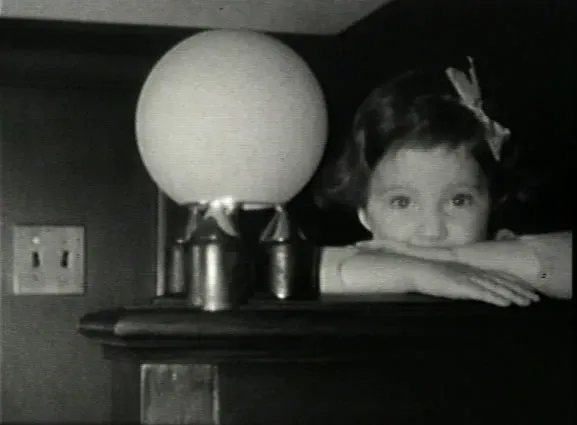
By contrast Garden’s Paritai Drive (1937) features domestic images that would not be out of place in Stanley Kubrick’s The Shining (1980); a large empty house, a suit of armour, a sudden cut to an image of a small child shaking her head - eerie images of emptiness amidst luxury.
"So much of the footage is really beautiful and inspired me in some way," Shearer explains.
"There is a definitive quality and texture that 16mm allows. Some of the footage is slightly degraded, but not only because of the actual images, the films document the experiences and history of this country. These women were able to put themselves in these landscapes in their own unique way."
In the course of her research Dudding discovered that like Garden, Violet Winstone also filmed images in Paritai Drive, a remarkable co-incidence that pointed to the possibility of Garden and Winstone exchanging thoughts about film-making. If so, Winstone’s films in Hold Still are remarkably different to Garden’s, revealing a sunny vision of family life on the lawn with baby and family.
- Rachel Shearer
Rachel Shearer has previously worked as a sound designer on a number of short films. She has also recorded and released a number of records under the name Lovely Midget. Her music has been described as "a transcendent world of shivering ambient sounds, distant ruptures and warm washes of analog sheen".
Her 2006 SoundTracks performance reworked a number of amateur films from the New Zealand Film Archive collection into a single unbroken 20 minute moving image presentation that used footage by a number of amateur film makers from the collection of the New Zealand Film Archive.
Shearer quotes Duddings' observation that “a psychic tracery is drawn” and adds “the installation touches on this fine and broken line to feel out a network of simultaneous moments".
- Hold Still
Opening Function 5:30pm Wednesday 24 June at the Film Archive mediagallery.
Hold Still runs until Saturday 1 August.
Rachel Shearer will be giving an Artists' Talk at the New Zealand Film Archive, Wellington on Thursday June 25 at 12.15pm. Free entry.
The New Zealand Film Archive
The New Zealand Film Archive has an extensive collection of home movies or "amateur footage" with over 30,000 individual titles collected since the Archive was established in 1981. The Archive is always interested to hear from anyone with material available for deposit. Items are stored in secure, climate controlled vaults and are preserved with a duplicated master if the material enters the collection. All material deposited with the Archive remains the property of the depositor. Please contact deposits@nzfa.org.nz for more information.