Preserving nature with culture
Written by
by Jacquie Clarke 01/11/06
Prime Minister Helen Clark said earlier this week that she would be using the carrot or stick approach to achieving sustainability in New Zealand. We congratulate her on her presence of mind on the matter and would like to suggest she throw another tool in her toolbox called 'innovation'. Many feisty inspired Kiwis have been innovating and advocating sustainability through products, enterprise and planning for some time. by Jacquie Clarke 01/11/06
Prime Minister Helen Clark said earlier this week that she would be using the carrot or stick approach to achieving sustainability in New Zealand. We congratulate her on her presence of mind on the matter and would like to suggest she throw another tool in her toolbox called 'innovation'. Many feisty inspired Kiwis have been innovating and advocating sustainability through products, enterprise and planning for some time.The real challenge for sustainability lies in our ability and commitment to involve creative and innovative solutions to become part of the nation's future scoping project. That means that in dialogue we address a dynamic notion of an ecosystem at work and that we continually create networks of potential. In many instances that will mean creating alternative forms of relationship and communication structures. After all we only have culture to preserve nature.
Here though the question is how can the government get behind the incentives that are already in play. Here's just some starters....
As a lot of waste material in our methane emitting landfills consists of domestic grocery packaging it's great to know that companies such as Friendly Pak in Auckland are busy exploring green alternatives such as the product Biofilm a biodegradable alternative to gladwrap. That same company produces biodegradable and sustainable packaging while also exploring and experimenting on an eco alternative to fibre glass. That's incredibly useful research and development for the manufacturing industry's bid for sustainability.
Equally interesting and inspiring is the bid to make fuel from trees by The Lake Taupo Development Company who are exploring the production of a species of Willow that produces three byproducts that can all be utilised. "Ethanol can be used as a fuel replacement, while lignin can be turned into a biodegradable form of plastic and xyoe used as a type of sugar." Once cropped the trees send up more shoots so there is no big replanting programme either. "If all goes to plan, the country could have a new fuel source capable of replacing oil by 2012," according to Company Director Barry Delaney. That may be a big dream but worth exploring. At the beginning of the year they were looking for $5 million investment to set up their pilot bio refinery.
Perhaps the New Zealand Super Fund ($2 billion a year) could divert some investment funds they have currently in US petroleum ($43+ million) and Australian uranium mining ($30.3 million) (yes we agree - a little strange for a country opposed to nuclear power at home). Al Gore's bound to have some smart, green and ethical investment pointers for the good folk at NZ Super this month. Gore is coming due to their kind invitation.
New Zealand has invested generously into the boat design industry through the research & development, much of it publicly funded, channelled into Team New Zealand's Americas Cup design strategy. With pressure on our economy looming from the 'food miles' issue there has never been a better time to divert some of that IP into international food transportation issues, perhaps looking at solar-powered water vessels to allow our goods to travel overseas in a less carbon-emitting fashion.
The government has already invested proactively in raising the environmental awareness of the film industry. Greening the Screen developed by the Ministry for the Environment, Landcare Research, South Pacific Pictures, Waitakere City Council and the Screen Development and Production Council as an incentive aims to reduce the impact of screen production on the environment by addressing production resource issues.
Perhaps the government could also apply some pressure (the stick approach) on the retail sector especially The Warehouse to reduce its Chinese imports systems. Around 84% of sales at The Warehouse are from China and our trade balance is around $1000 million+ in deficit. We know many New Zealand manufacturers have been forced to move offshore because of this free trade policy. Buying and making locally is a key sustainability driver as outlined in the Stern report. Also see I See Red published by Awa Publishing for a detailed and gripping analysis of the impact of free trade on the New Zealand economy and specifically on New Zealand innovators.
There's a whole lot of small businesses in New Zealand aiming for sustainability every day such as Miranda Brown's fashion label Conscious Cloth, Alto Design's employee-management sustainable practice and today Jasmax in Auckland held their Green Day Out to address climate change. The Jasmax Green Day Out was created by head of the Jasmax 'Green Group' Marko den Breems. He says, "delegates will gain greater understanding of current climate change issues and look at how innovative design can make positive, long-term change".
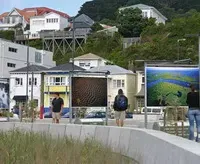
Many of the stand-out urban design projects changing the nature of our cities use ecology as a creative agent. Waitangi Park in Wellington has recreated a wetland as a beginning, a wind garden in the making and promoted not just a nature space but have designed an ecosystem which includes human happiness, a place where people mingle, meet, pass through. In Waitakere City the Twin Streams Project employed artists to design bridges and bring the community together to restore waterways. There are further incentives to build more bicycle routes in Waitakere City especially along train routes.
The stadium on the waterfront idea proposed by the government and being discussed behind closed doors (for commercial reasons) smacks of old brain unsustainable process. For true sustainability to happen the dialogue needs to get a whole lot more creative. All this means that we need designers, architects, ecologists, artists and innovators in the urban design forum. Auckland doesn't need another poorly thought through urban design process.
As James Corner American landscape designer writes.
"How may the pulsing flow and flux of wild life, its autonomous status as "other," and its reflective and moral sense be channeled, liberated, and expressed through an ecology and landscape of creative agents? The answers I believe, lie within the powers of both natural and cultural agencies in the evolving of landscapes that precipitate (and are caught within) processes of indetermination and diversification: landscapes that engage, enable, diversify, trick, emancipate, and elude - put simply, landscapes that function as actants, as continual transformations and encounters that actively resist closure and representation."
So what is the alternative...
"On dead planets such as Venus and Mars carbon dioxide makes up most of the atmosphere, and it would do so here if living things and Earth's processes did not keep it within bounds" - Tim Flannery in The Weather Makers.
Sustainability is much more than reducing carbon emissions. It's about creating a culture that engages with nature in its chaotic and organic presenting, and about finding creative agency in that relationship.
Oh and picking the brains of Dave, organic vegetable gardener of Kaipara Harbour, who runs his own car on vegetable oil.
Image: Waitangi Park in Wellington - people and nature friendly
********************************************************
Readers' Feedback:
From Leea
Regarding Gordon Moller's article in the NZ Herald on 1 November 2006 regarding waterfront stadium and Eden Park.
I totally agree to what he says in this article, particularly to that where transport to and from the venue is concerned.
To build a stadium on prime Auckland Waterfront is ludicrous, stupid, and a total disregard for what Auckland has represented itself as "The City of Sails". What are you thinking about Auckland City Council" Get a grip!!!!
********************************************************
From David Trubridge
I am returning from California where i have been working for two months. It made me realise that our "clean green" motto is such a lie – individually we are just as polluting as anyone else, but so far there are not enough of us to make such a mess as elsewhere.
There is so much more awareness in San Francisco than here, and (despite the federal government) some people are really trying to do something, while we smugly remain relatively inactive! Bikes usually have priority over cars and there are dedicated 'bike boulevards' everywhere. In Berkeley many traffic 'stop' signs have 'driving' stencilled in underneath (or occasionally 'bush'!)
keep up the good work!
best wishes
david