Presenting the Archive: Kim Paton and the history of German Video art
Written by
By Mark Amery Courtesy of The Dominion Post
By Mark Amery Courtesy of The Dominion Post
It's an age of information overload and ever increasing ways of linking one piece of data and territory to another - the world is coming to resemble an ever more woven spider web. Increasingly contemporary artists are responding by making work that provides journeys through archives. In doing so they assert the need for individuals and communities to develop their own navigation systems - rather than just employ the Google-method and take the path most travelled.
Adam Art Gallery is a university-based gallery, with an art collection to consider and a library close by. Smartly, they have followed up last year's group show Archiving Fever with another exhibition programme that sees artists exploring the acts of researching, archiving, collecting and preserving. Collection/Project brings together two exhibitions. The first sees the gallery present three recent acquisitions to the university collection by Ann Shelton, John Reynolds and Mark Adams, together with an audio archive drawn from the collection of sounds compiled by ethnomusicologist Allan Thomas. Each of these major artworks (all of which have appeared in this column previously) provide ways in to collections of information and ask you to consider the structure of those collections.
The second exhibition 40yearsvideoart.de is a touring archive of video art from 1963 to 2003. Five major German museums and galleries worked together to create a chronological survey of video art practise, with 59 works by 59 German and international artists, ranging from Samuel Beckett and Joseph Beuys to Nam June Paik and Rebecca Horn. 1963 saw the introduction of the video camera, and with it portable and accessible equipment for artists to employ. As video art becomes central to contemporary art this exhibition provides some vital context.
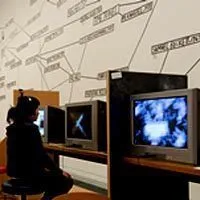
How best however to present 27 hours of video footage? The beauty of this fantastic exhibition is that you'll spend as much time considering the way the archive has been mapped and presented as watching the work. The gallery invited artist Kim Paton to organise the archive. It's a step reminiscent of Auckland Artspace's treatment of an archive of independent contemporary art publishing projects, where they invited Ri Williamson to develop a reading room, for which he created a library, which had what resembled a series of airport transit lounges. Paton is known for her reconfiguration of buildings materials and furniture into new mobile hybrids that encourage you to consider other ways they might best be used. Here she creates 12 viewing stations out of worn desks and office furniture usually found in use elsewhere on campus.
Sitting down at a viewing station and confronted by a twink tattooed desk top ("Peaches I Luv You", "Kath is so ugly" etc.) turned to provide a dividing wall, I'm left to consider how classification systems create architectures. And while each station asserts a chronology by providing a programme focussing on specific years, the stations are jumbled in order and reading material is provided nearby that doesn't necessarily relate to what you're watching. Reading a catalogue on early Phil Dadson New Zealand video work whilst watching a German performance of Beckett encourages you to make leaps and bounds of your own.
What really kicks this project into conceptual life for me however is Paton's a mind map, a drawing on the high gallery wall as if it were a gargantuan whiteboard. Entitled 'Imagining Victories' this map links the names of artists (identified by a specific year) through a web of lines, interspersed by labels pronouncing provocative themes like 'Futile Progress', ' Herd Behaviour' and 'In Search of the Truth', as if they were from a student's study notes, parroted criticisms scrawled in the margins of books. There is no indication of why she has selected a certain artist to represent a specific year, nor of their connection to each other. Together with the intervention of the notes encourages you to disregard them entirely and instead find your own.
Meanwhile some artist labels are given letters that relate to a key on the side - akin to the warnings of traps provided on a treasure map of quicksand and sea serpents. They providet a series of video art helpful hints: R stands for 'Repetitive', W for 'Watch the whole thing', E for 'An excerpt will do, and NS for 'No subtitle'. The point is of course that one person's treasure is another's flotsam and jetsam. Paton's mind map is brilliant because it completely undermines any curation and opens the archive out to your reinterpretation, but still provides you with access points in. It's akin to visiting an exhibition with an annoying friend who having forced on you a sweeping, highly subjective tour, thereby provokes you in to developing a mind map of your own.
Its also worth noting that 40YEARSVIDEOART.DE was created in Germany as a response to the concern that this work needed to be preserved and all electronic data has a limited life span (with digital data the issue has shifted to being one about secure backing up). That was a fact raised by the gallery's exhibition of early video art by Darcy Lange, and it's hoped that full attention is now being paid to the archiving of New Zealand video art.
Collect/Project, until 13 July, Adam Art Gallery 11/06/08