Power of potential
Written by
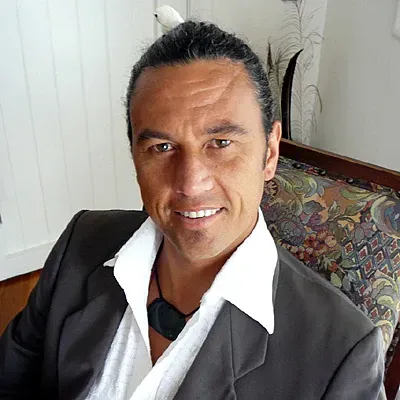
Survive & Thrive speaker Paora Joseph tells us how his experiences as a psychologist and youth worker led to his creative path as a story teller and filmmaker.
“Everything I do is centered around my interest in humanity, understanding our human experience and relationship to each other and the world. Everybody has something to contribute.”
Paora, Harry Silver, Kim Newall and Grace Taylor were part of the Survive & Thrive Site Pacific sessions. They discussed how we stand in relation to the past, how that shapes our different personal and professional identities, and influences the way we face the future.
"Sometimes I feel like the whenua owns me. It’s part of my responsibility - it goes into my creativity, it’s part of who I am, my identity. Aotearoa - this whenua is my potential, it’s not something that is separate from myself."
* * *
Tell us a bit about what you do and what drives you?
‘I rere kau mai te awa nui Mai I te kahui maunga ki Tangaroa, Ko au te awa ko te awa ko au’ - ‘From the mountain to the river to the sea I am the river and the river is me’
Ko Ruapehu te maunga Ko Whanganui te awa Ko Ati Haunui Apaapaarangi, Ngaa Rauru ngaa iwi
I’m passionate about helping others to discover their potential and have come to realise in myself that if you have a vision you can make that vision a reality. I also realise everyone has a different capacity, and that all of us have something to contribute. In whatever I do, as a youth worker, film-maker, speaker, business person – I work from that perspective.
What I do changes all the time. As a youth worker and psychologist I was fortunate to hear and be inspired by other people’s stories. I felt that peoples experiences were of value and deserving of having a platform to be heard by others. I became a story teller in the medium of film in order to help facilitate this platform. Everything I do is centered around my interest in humanity, understanding our human experience and relationship to each other and the world. Everybody has something to contribute. The magic that occurs is when others embrace their own potential and you are privileged enough to witness that.
Tell us about your recent or upcoming projects?
Hiding Behind The Green Screen - a documentary aimed at heightening awareness around the marijuana culture amongst youth in New Zealand. Four young men were mentored by two New Zealand musicians - Frances Kora from the band Kora and Rio Hemopo from the bands Trinity Roots and Fat Freddy's Drop.
I felt a real connection with the four boys - I wanted them to realise their own potential and glimpse what they had to offer the world. It has really transformed one of them - who has become a youth worker and has his own family.
I’m working on a film project about suicide. I'm interested in facilitating discussion about this topic and addressing the stigma a lot of whanau face as a result of losing a loved one to suicide. I'm also interested in young people discovering a future filled with endless creative possibilities as opposed to killing that possibility.
Do you like to look at the big picture or focus on the details?
I look at the big picture, but probably need to focus on the details more. As a creative person you need to do both.
What's your number one business tip for surviving (and thriving) in the creative industries?
Once you discover your own potential and tasted that your vision can become reality. Do not doubt your own experience. Have 100 per cent belief and conviction that it is not only a possibility but it is your reality and that it truly exists.
‘So it’s the future already, all ready?’ What does this mean for you and what you do? Are you ready?
It’s about having no doubt in your creative vision and potential, then you are already in the future.
Do you think people realise they are in the future and are prepared for that reality?
There is no future in that sense. The future is created moment to moment. If you discover something in the moment and are able to remain in that - then you are already there - it’s not necessary to create a whole lot of plans of the future. What’s important is being present to where you are at already.
What are you doing now (in business or practice) that you couldn’t imagine doing a year ago?
A few years ago I couldn’t imagine I would have sense of faith and conviction in terms of my creative path. Stepping into the creative involves taking risks and having the confidence in your vision. So it’s a matter of going through that process of having a dream, tasting it for yourself, remaining there and coming out the other end. I am able to look back and say that ‘yes that is possible’ and that’s is potentially a mirror of whats possible for other people and their own creative journey.
What keeps you working and creating in New Zealand?
I don’t think I have a choice. Sometimes I feel like the whenua owns me. It’s part of my responsibility - it goes into my creativity, it’s part of who I am, my identity. Aotearoa - this whenua is my potential, it’s not something that is separate from myself.
How do your cultural identities influence how you stand in the present, in relation to the past and the future?
We all have potential as human beings. If you are born into another culture that gives you capacity and potential from within that perspective or world-view, it’s about how that can contribute to the world community we live in. In that sense it doesn’t matter where you’ve come from or what culture you belong to - it is about how will it contribute to furthering our humanity, understanding and connection.
How does this shape your creative practice and the stories you choose to tell?
The world is a smaller place now and our potential to be in communion is a lot more apparent, we don’t live in isolation. So for me it’s a two way thing. Smaller culturally and spiritually rich communities can feed the modern world, and the modern world can feed smaller spiritually culturally rich communities.
So that’s what I try to do in terms of sharing people's human stories. I believe indigenous ways of being and stories can feed the rest of the world that needs those stories, so the rest of world can discover their stories and connection within themselves and have more depth - be aware of its indigenous roots it may have become dormant or forgotten about.
The rate and pace of change is constantly increasing. What challenges and opportunities does this present for creatives?
Change is the only constant thing that is reliable, or death. If change is in front of one’s nose it’s great, it’s a creative challenge. Change is the nature of reality, it’s like food, it’s something that you welcome and can feed off. Most of us are scared of change, as human beings we don’t embrace change very well, yet out of those very things that we are afraid of comes our real experience and appreciation for life. The creative journey is one of change. It’s natural to the creative person to embrace change that’s what makes a creative person different from others.
With all the information and noise, how do you scan and decide what is important to you?
Always check with your gut, wairua, intuition, that little voice inside yourself. It’s like the Tibetan saying ‘the longest journey is from the head to the heart.’ Check down not up. Information is quite heady, it hasn’t found its root or ground yet, it needs to find the ground first and move from that way. There are so many ways to communicate something, it’s not about information it’s about connection. You can connect though one word or a thousand. Which is easiest?
It’s been a rocky few years, how have you rolled with the punches (in business or practice)?
The greatest teachings from life come from when it’s tough or hard, it’s a reminder that it’s a part of life and something could be understood from that. Instead of running away or being scared of that - it’s trying to discover what it’s trying to show us.
We’re talking about resilience at Survive & Thrive, what’s your top tip for bouncing back?
Try to work closely with your dream or vision and have faith in that, and along the way be gentle on oneself and try not load it with too much expectation.
What’s your top tip for creating a work / life balance?
It goes back to a person’s essence. The world feeds us in different ways. What feeds me is being out in the ocean - so that balance comes about by being honest about our own essence and how the world feeds us. And for everyone that’s different.
What excites you about the opportunity to be at Survive & Thrive?
To meet new people, to connect. Connecting with people is very important and it's opportunity to inspire and support one another. Because that’s what the world needs, whether the world believes that or not.
What’s your big idea for 2014?
Developing a stronger appreciation of each other. Connection to each other and connection with the whenua, the earth. Presently, the modern world appears to be in disconnection with the whenua, the earth. Whenua ki te whenua is a Maori proverb that explains when you are born your placenta goes back to the earth to maintain that connection and relationship. Learn how to listen again to what the whenua is saying to strengthen this connection. This is a small idea but a big one.
* * *
- Survive & Thrive is a smart-thinking event for artists, creators, innovators and entrepreneurs on September 13 & 14 in Auckland. Brought to you by The Big Idea and Arts Regional Trust.
From growing up in the wild-west Kumara Country of Ruawai to studying Psychoanalysis in London at the Klein Institute…attending mass with Mother Teresa to sharing tea with His Holiness the Dalai Lama…being Princess Diana’s personal steward while in the RNZAF, to falling flat on his face in front of 100 Whanganui Iwi, Paora Joseph has lived through many extraordinary and colorful life experiences that are all grist to this film-maker's mill.
His first job was as a youth worker on the streets of South Auckland led him train as a clinical psychologist, a profession he still works in when not making films. His path to filmmaking runs in parallel with his path to Parihaka, via Whanganui, where he lived for 10 years.