Politics and Healing in Charlotte Graham's Ngaa Karetao
Written by
No Strings Attached: Puppet Politics in Charlotte Graham's Ngaa Karetao Exhibition
Oedipus Rex Gallery until December 3
By Shelley Jahnke
Evidence of puppetry as a form of entertainment and an aid to story telling has long been observed by humankind throughout the globe. Not just reserved for children, puppet plays incorporated adult subtexts, the puppets acting surreptitiously as agents and facilitators of dialogue that explored and exposed polemic issues of the day.
NZ Herald review
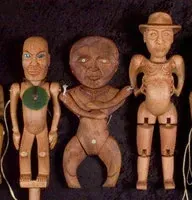
Image: Charlotte Graham creates karetao based on the seven Maori seats in parliament. From left: Mahara Okeroa - carved by Te Ratahi Ratahi, Turiana Turia - carved by Darrin Pivac, Dover Samuuels - carved by Te Ratahi Ratahi No Strings Attached: Puppet Politics in Charlotte Graham's Ngaa Karetao Exhibition
Oedipus Rex Gallery until December 3
By Shelley Jahnke
Evidence of puppetry as a form of entertainment and an aid to story telling has long been observed by humankind throughout the globe. Not just reserved for children, puppet plays incorporated adult subtexts, the puppets acting surreptitiously as agents and facilitators of dialogue that explored and exposed polemic issues of the day.
NZ Herald review
Image: Charlotte Graham creates karetao based on the seven Maori seats in parliament. From left: Mahara Okeroa - carved by Te Ratahi Ratahi, Turiana Turia - carved by Darrin Pivac, Dover Samuuels - carved by Te Ratahi RatahiAotearoa is not without its puppeteering precedents.Maaori marionettes or 'karetao' were also fashioned from wood and featured mobile arms and legs that were manipulated via muka fibre cords attached to limbs. The lower end of the karetao was sculpted into a short shaft that functioned as a handgrip.
Akin to its European counterpart the 'marionette', karetao were recruited for educational purposes as well as entertainment for children. Oriori and waiata accompanied the puppet performances which served to enrich and embellish the narratives relayed. While much of the customary practices associated with karetao have since been lost, many of the puppets themselves have survived in various museum collections throughout New Zealand, Europe and the United States. These remaining karetao and the silent legacy they retain has been a source of inspiration for artist Charlotte Graham and is the subject of her current solo exhibition, Ngaa Karetao.
Graham rejuvenates this endangered art form by creating karetao based on the seven Maaori seats in parliament. This engaging exhibition seeks to promote karetao as vital and dynamic cultural treasures, to revive and restore their popularity and, with the puppets as conduits of culture, to provide an active forum for the artist and viewer to participate and engage with current political discourse. Seven karetao are strategically positioned within the gallery space and represent current and former Maaori MPs including Dover Samuels, John Tamihere, Nanaia Mahuta, Tariana Turia, Mahara Okeroa, Parekura Horomia and Mita Ririnui. Carved from native timber, each of the puppets exhibits features that resemble those of their political model whether it be Dover Samuel's trademark moustache and drover's hat, or a reference to John Tamihere's controversial 'golden handshake' with a single arm carved from honey coloured 'kauri'.
Along with physical traits Graham has incorporated tribal signifiers consistent with regional whakairo raakau patterns to denote the various electorates with which the ministers are affiliated. As former MP for Te Taitokerau, the Dover Samuels karetao exhibits the sinuous form of the Northern carving style adorned with distinctive paakura and unaunahi pattern and characteristic tapered finger detail, while the Tamihere puppet references his position as MP for Taamaki Makaurau with an idiosyncratic tilted head prescribed by Northern regions. Through the karetao, Graham considers the debate on the political framework within which Maaori politicians operate in Aotearoa, New Zealand.
While Maaori representation is imperative in ensuring Maaori interests are realized, Graham attests that the foundation of government in this country by its very nature regulates any Maaori presence engaged within it. Based on a Westminster system of government and formed by colonial rule, any process or institution generated from this administration limits the ability of Maaori politicians to effectively 'perform' and serve the people's interests.
Four of the karetao have steel cable attached to their bodies, a metaphoric reference to the democratic system. The cable is by nature, stiff and rigid and inhibits the puppets ability to move freely. However, the puppet's own limbs are attached using customary muka fibre allowing them a greater degree of mobility. Essentially, the karetao are only able to be manipulated by their muka cords which demonstrates the notion that it is Maaori who should be in control of the strings, since the 'puppets' (or MP's) stand as elected representatives chosen by and for the people. The Tariana Turia karetao stands unsupported, her steel cable strings, although still attached, are no longer taut and rigid but loose in recognition of her 'crossing the floor' in defiance of the government's policy on the controversial foreshore and seabed debate.
The architectural and ideological dynamics within the wharenui address notions of Mana Whenua, Mana Tangata and Mana Atua, aspects which resonate as integral to notions of the collective and which form the foundation of a Maaori cultural framework. Utilising this model, Graham juxtaposes her recent painting which explore the dynamics of tukutuku construction and design alongside the carved karetao. The paintings are executed using red, sealing wax, bitumen, beeswax, paraffin and oil applied in veiled layers upon canvas with smaller works encased in stainless steel frames. Customarily, red sealing wax acted as an adhesive for fragments of paaua shell applied to carvings to depict the eyes of the ancestor. Graham reinterprets the function of sealing wax as an aid to convey what she refers to as 'the eyes of the people' or the 'vision of the people' and the 'collective'. The malleability of wax and its function as a preserving material encompasses shifting notions of time; present, past and future, which Graham draws upon to convey the preservation of Maaori representation.
Drawing from the art of tukutuku design, Graham intuitively invokes the female element within the wharenui which serves to balance the male element expressed by the carved karetao. Incorporating both male and female elements connotes procreation thereby reinforcing the significance of genealogy (whakapapa) and the collective. Vertical lines skimming the edge of the canvases allude to 'tuumatakahukii', a procedure which binds the tukutuku rods in position and requires group participation. The vertical and horizontal thatching process bound by the interweaving of muka fibre further strengthens individual rods. Tukutuku therefore not only articulates notions of the collective but it significantly demonstrates the integrity of Maaori frameworks which rely on the collective for stability. Without the binding elements each individual component would disintegrate.
Graham acknowledges the significance of karetao as agents of spiritual and physical healing as they were customarily regarded. Maaori have witnessed countless forms of legislation imposed upon them that have facilitated the continued dispossession of lands and resources over successive generations. Through the karetao, Graham offers a voice for the Maaori community and the opportunity to restore spiritual and physical well-being to both the people and the land.
Essentially Graham's Ngaa Karetao is an expression of Maaori self-determination and the empowerment that it provides for the benefit of all New Zealanders. It is about recovering a lost art form, the recovery of mana and the recovery of cultural and political freedom. As a vehicle for enlightenment, healing or entertainment, Graham's Ngaa Karetao should inspire, challenge, provoke and create dialogue. If the exhibition achieves even a fraction of this it will have been a success.
He aha te mea nui o te ao?
He Tangata
He Tangata
He Tangata
Tihei mauri ora!
Shelley Jahnke