Panic by Improbable
Written by
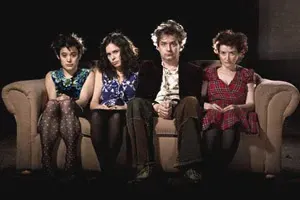
Improbable are the theatre company who regularly use the Open Space format (a democratic forum derived from the coffee breaks where all the useful discussions take place at a traditional conference) which NZ creative producer Briar Munro introduced to Wellington's independent theatre practitioners in 2007 (and Auckland's in 2008).
That's how I first became aware of the company.
They use Open Space on a monthly basis for their 'Devoted and Disgruntled' gatherings - (check out the link for some exciting provocations that were posted for some of their recent gatherings). The idea is that anyone from the local theatre industry who has issues they want to debate turns up and they express what they want to discuss to sub-groups who care about the same issue - sometimes wonderful action groups emerge, sometimes there are epiphanies, sometimes it's just great networking.
On the company's website there's an interesting article about their principles, which include a valuing of true ensemble working, and of the performer and the audience as the heart of the thing, and a frequent use of improvisation and play to develop their shows. Both of these are very much in evidence in their latest show 'Panic'.
It's clear that the content has been generated through devising. There's a lively sense of active imagination and playfulness throughout. At the start, Improbable's Artistic Director Phelim McDermott and the three female actors introduce themselves with a little bit of personal information, and this sets up the dynamic of seemingly autobiographical anecdotes and engaging direct address that's to follow. The piece is a musing around the Ancient Greek god Pan, with Phelim playing several versions of this figure, including a version where he gyrates around in his underwear describing the medical symptoms that led him to believe he had been possessed by Pan, and another version where he stalks around on stilts in full goatee beard, horns and phallus. The three female performers are his nymphs, though these performers too have anecdotes of affiliation with the god of nature, masturbation, pagan revelry and bees.
It's an eclectic mix of material, which makes for a lively hour and forty minutes. The set of brown paper curtains rigged from a metal skeleton of a proscenium arch is wonderfully versatile, transforming into a forest, skyscrapers, a living room full of self-help books, and a ship in a storm - with a bit of help from excellent projections. At one point projections of the curtains being lifted precede the curtains actually being lifted, and this pattern is repeated on a second layer of curtains beyond. At another point, a version of the Pan character lies back-lit behind a brown paper curtain so that we see him in silhouette, lying in bed. For a moment it looks like he has an erection. Then the phallus is revealed to be a tiny silhouette figure of one of the nymphs, seemingly walking over his body. As we realise this is a projection, further silhouetted nymphs appear to dance and cavort over Pan's silhouetted body. It's both a humorous image and one that taps into a primitive magic, and this mix is the show's greatest achievement. There are many laughter points, but also moments where you feel the performers have been possessed by the anarchic energy of Pan.
The brown paper aesthetic continues in the use of brown paper bags as masks over the heads of the performers at one point, sometimes with faces projected onto them, sometimes with papier-mache faces in relief on the fronts as the performers dance pagan gigs. And a wonderful brown paper puppet of Pan wanders through the show on several occassions, including to explore a table piled high with the self-help books that obsess the show's protagonist.
There's no through narrative; instead certain themes and obsessions are woven through with a stream of consciousness sort of dream logic. We're never sure whether the stories which performers tell us at various points in the show are actually true or not - they're all equally owned as if shared life stories of lost loves, Pan-ic episodes and encounters with manifestations of Pan. Of course, it doesn't matter if anything we're told actually happened - we're in a half-dream world of imaginative possibilities due to the creative energy which exhudes from the stage.
More information: Improbable