Out of the box
Written by
By Mark Amery
Time was when the only proper home for professional theatre was considered to be a theatre; for art a gallery. Public art? That’s something on a pedestal. Everything had its frame and box. Anything else was likely to be written off as an amateur Sunday painters club, a revue or protest.
Art however has never really been that easily contained. Today increasing numbers of artists are again working with specific locations and in dialogue with what’s around them. Increasingly there’s also a blurring of boundaries between art disciplines. Wellington is a crucible for this, and arts festival and Fringe have a strong history of providing platforms for their wider public appreciation.
As a prelude to the excellent programme of cross-media art the Performance Arcade (running in a different kind of box, containers, outside of Te Papa from tonight), last week’s performance art series Circadian as part of the Fringe was conceived to work directly in relation to its environment in a way we don’t see enough.
Three performance works curated by Toi Whakaari Masters of Directing student Isobel Mebus considered what was described neatly as ‘mindfulness in a work environment’ in the foyer of corporate tower Asteron House. It was interesting to see this work coming from a performing arts root, when the approach and concerns could just as easily have come out of visual arts training.
Circadian worked smartly with the rhythms and dynamics of the building, a generous rather than jarring presence. Looking into the glass frontage from outside an area was screened off as a boardroom, with visual aids indicating an important workshop in progress. A scrawled whiteboard note indicated presentations at noon. A delicious sense of anticipation was built. As the Dominion Post reported, artist Hannah McDougall undertook a number of publicly arresting actions. Rather than a protest, the actions were a more ambiguous play with the language of protest, expressive of the complexities of the apathy, frustrations and aspirations of the young.
Inside the lobby for her gentle work Roseann McKie manned a help desk, which smartly looked like it had always been there. McKie apparently was able to offer much help to visitors and workers in the building over the week, including probably explaining why another performer Veronica Butturini was at regular intervals dancing all over her nice corporate suit laid out on the floor.
In the pedestrian tunnel under the Terrace at the end of Woodward Street, meanwhile, Kedron Parker as part of the Fringe has installed an aural representation of what the Kumutoto Stream might have sounded like before it got put into pipes. It’s a very simple artwork, if technically well executed, but it does something that more public art in the city should in connecting us to this place. Even better would be to see projects like Circadian and the Kumutoto Stream project installed for longer periods, developing relationships with the city’s workers, and becoming valued as part of the urban fabric.
At the other end of town is excellent Mt Victoria villa based gallery The Young, open Friday and Saturday afternoons. I say gallery but it feels like the well-loved wood-paneled historic home it is, with the furnishings cleared out for a party.
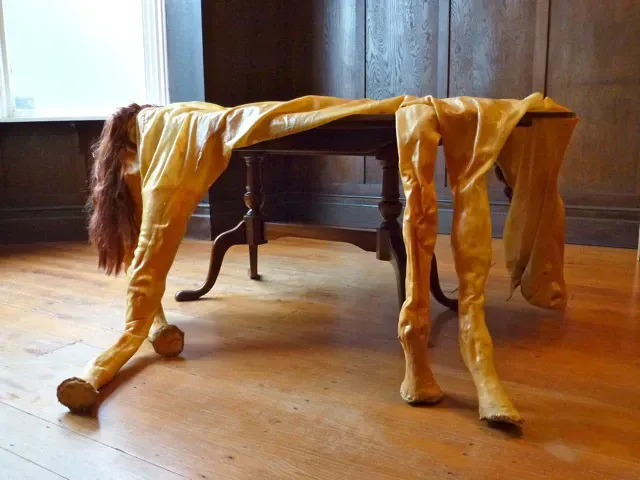
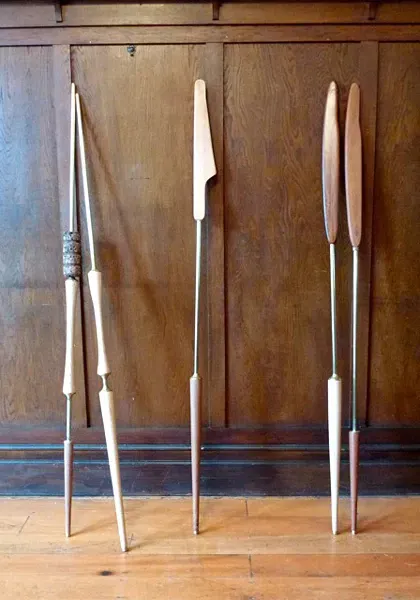
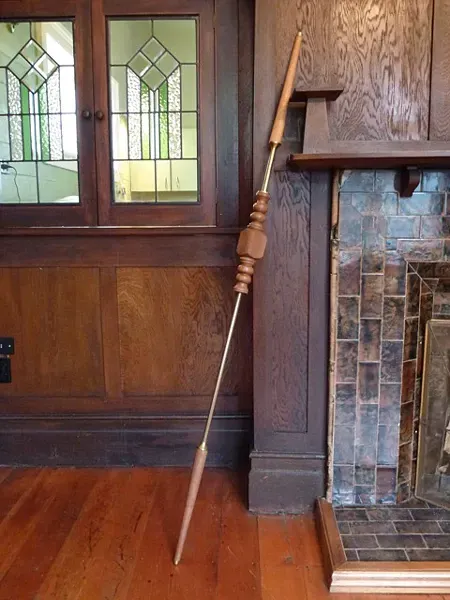
Group exhibition Odd Peer Nexus works beautifully to the Gothic romantic edge that comes with the site. Giant, black Brit Bunkley insects are frozen scurrying across the walls, text starting to erupt from their skin. Beguiling, wizard staff-like instruments made out of an eclectic array of wooden pieces of furnishing by Natalie Guy are propped up in animated figurative groupings against the walls. They suggest some arcane Masonic ritual is underway. A resin skin cast off a horse of the dimensions of that of Lady Godiva’s Aethenoth lies limp over an antique table. Created by Francesca Heinz, it is both macabre in its pale wrinkled life likeness and pantomime in its rough stitching and the employment of womens’ wigs for horse’s hair. For these works a white cube gallery would be far less effective.
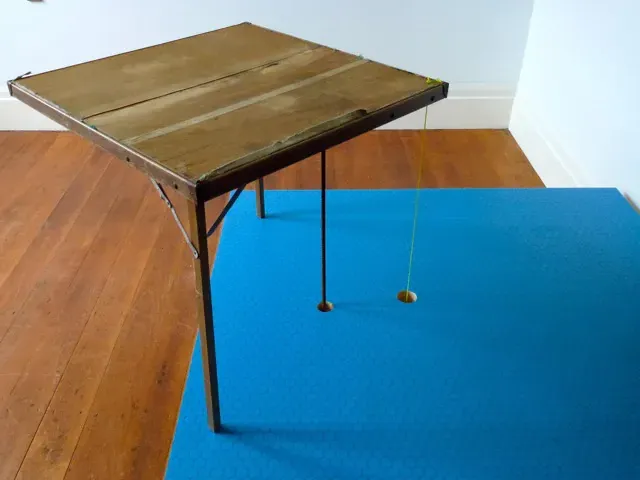
Paul Cullen boldly inserts into the architecture an area of raised vinyl flooring. It creeps out of a doorway, with a two-legged card table balanced by weights planted oddly into it at an angle. Cullen provides the exhibition with a strong almost magnetic absurd tension, like an off-centre counterweight. Playing off it, but working, ironically, less well within the group is the curator James R Ford own work, including a child’s seesaw held in balance by the placing on each seat of a glass half full (or empty) of water. By contrast its conceptual lightness of touch is lost in the front room of this grand house.
- Odd Peer Nexus, The Young, until 8 March
MUST SEE
- Internationally Renowned Photographs, 30Upstairs, until 15 March
An exquisite festival treat. This nicely paced exhibition of photographs from NZ collections features everyone from Cartier Bresson and Ansel Adams to Leipzig and Steichen, with only a room of OK Desiree Dolron images out of place within this chamber of greatness.