Orientalism and butterflies
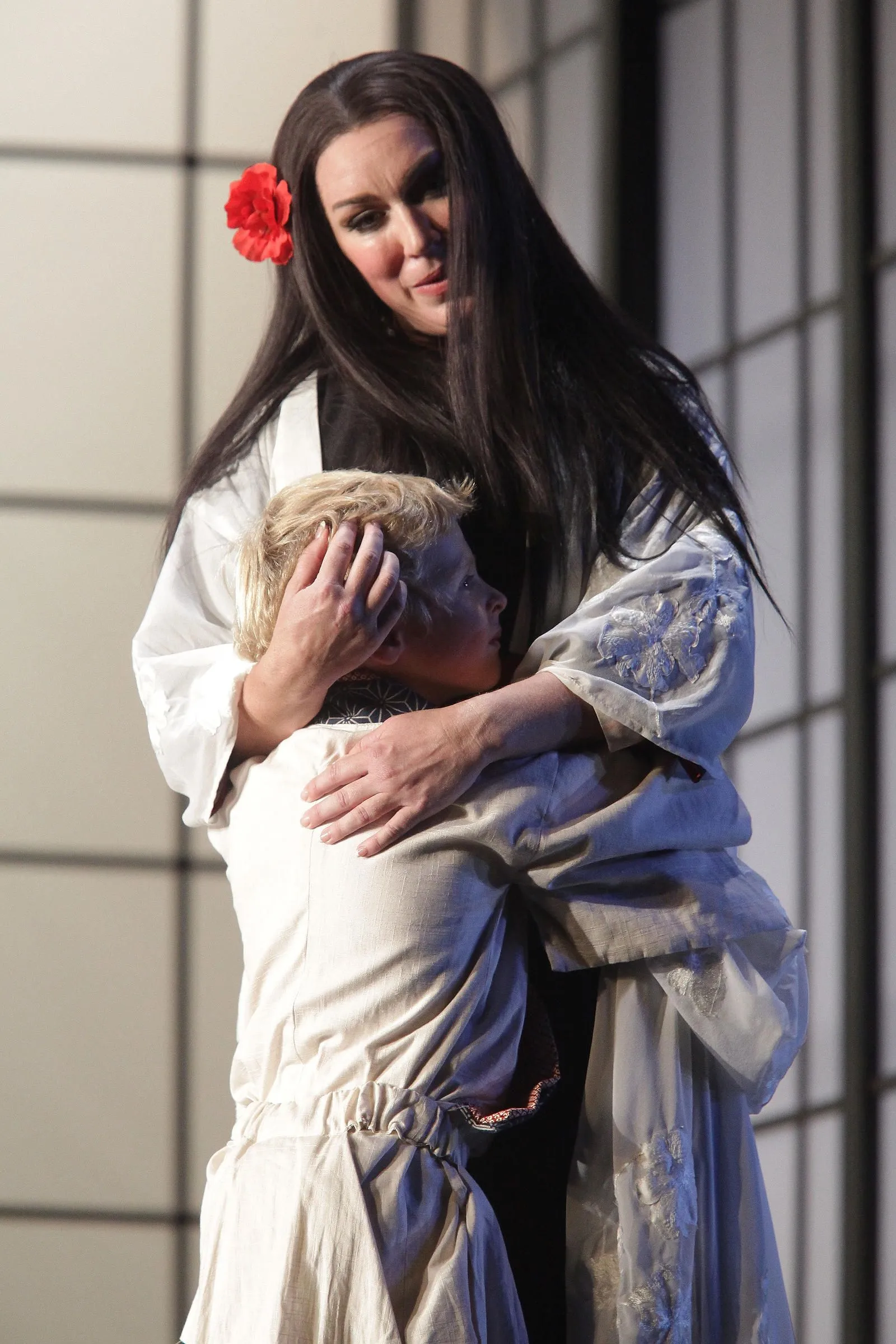
Renee Liang wonders if Madame Butterfly is "orientalist" and if this matters in today's world.
* * *
I recently went to NZ Opera’s production of Madame Butterfly – an opera I’ve been curious to see for some time. It was stunning. A gorgeous, understated yet ambitious set (inspired by designer Christina Smith’s visit to Japan); detailed costumes; excellent acting and of course the stunning music rendered in technicolour by the live orchestra.
Best of all, the story – much tighter than the waffling narrative of most operas – had me in tears from the second act. But although caught up in the tragedy of Cio-cio San and the unthinking Pinkerton, I couldn’t help thinking about why I was responding to the story so much. Madame Butterfly is, after all, the poster child for Western Orientalism. I’ve read much over the years – in mostly Asian-American articles and blogs - about how it perpetuates the myth of the ‘helpless Asian female’, as well as Eastern exoticism and inscrutability. (Plenty of more contemporary plays and films also get the rap.)
The NZ Opera production, like most, uses European singers in ‘yellowface’ for the roles, making for a slightly weird effect at times – and this, too, has been criticized by activists, who advocate for Asians to be cast in Asian roles. (But it’s the opera. People dress up and pretend all the time, right?)
I was surprised, therefore, by how ‘modern’ the libretto seemed. Although there are plenty of archetypes – among them the fawning, money-grubbing matchmaker and the dutiful maidservant – these were hardly ‘eastern’ archetypes. Indeed, they are found through plays and operas of all periods and settings. Furthermore, although Cio-cio San has a degree of coquettish innocence through the opera, this seemed to me to be appropriate, given she’s 15 at the start and only 18 at the end. I thought Antoinette Halloran, the much older Australian soprano playing the role, did a good job of portraying a teenager who’s been isolated and objectified her whole life.
Cio-cio and her maidservant Suzuki (Lucy Schaufer, with her gestures and bowing but inner steeliness, made a convincing older Japanese woman) drive most of the emotional action in Madame Butterfly. Puccini’s libretto seems to point out that cultural misunderstanding is at the heart of the tragedy, and points the blame mostly at the foreigners. (Ironically Puccini never left Europe, as far as I can discover from my intensive research on Wikipedia.)
As a modern audience, we don’t have any trouble believing in American bullishness. That being said, the ‘good’ and ‘bad’ characters seem to be evenly spread between the Japanese and American roles. The NZ Opera production apparently aimed to be ‘traditional’, sticking to period and to romantic Japanese garden scenery and flowery kimono. But even so, the fact they were performing to a modern-day Kiwi audience – rather than a European audience at the turn of last century – must have influenced their interpretation. Were the main characters of Pinkerton and Cio-cio San performed with more nuance and sensitivity than how Puccini wrote them, or has Madame Butterfly been unfairly vilified all along? Does it even matter that it’s non PC – shouldn’t we look at all such works in the context of the period they were written, as well as performed? (Otherwise many classic works, or for that matter The Bible, would be judged to be grossly inappropriate.)
The most horrific aspect of the story now seems to me to be the paedophilia – a 15 year old girl from a poor background ‘marrying’ a much older naval officer who treats her as an object or toy to be owned and then discarded. Again, this is hardly orientalist, at least not against the canvas of today’s current affairs. Yes, there are Australian boofheads who go to Bali or Thailand for cheap ‘action’, the modern equivalent of the services Pinkerton apparently took advantage of in colonial Japan. That parallel has already been pointed out in a Butterfly revision called Miss Saigon. Yes, Westerners go to Asia for cheap exotic experiences full stop. But it’s behavior that is hardly confined to Asian countries, more driven by economic inequalities – as it seems to be in Madame Butterfly, or at least the modern interpretation of the storyline.
Of course, I could be merely trying to justify my response to the production. I do after all come from a strange in-between place: a Kiwi of Chinese descent writing in NZ, who for various reasons has become known for works about identity and culture. Are my works, too, exploiting audience appetite for Eastern exoticism? Even if I don’t plan it that way the disturbing thought does cross my mind, and I get butterflies in my stomach (see what I did there?)
After all, exploitation can go both ways. I deal with this question every time I make a new work, and there’s no easy answer, or even a good test. On the matter of casting non-Asian actors for Asian roles, I must say I've been tempted in the past, because of the small pool of Asian actors. I'm proud that I resisted this urge, and instead concentrated on writing strong roles and casting the best person both in background and ability - and so far, there has always been someone perfect for the role.
And on the subject of authenticity versus titillation: my advisers say that if the writing comes from a true and real place, then it will touch a similar true place in the audience. Madame Butterfly seemed to touch a place in me. It’s imperfect, yes, and perhaps propagates stereotypes. But on a story and emotional level, it's satisfying. We’ll leave it at that for now.