'Orgy of Tolerance'
Written by
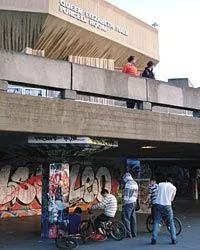
James Hadley in London talks about “contenders for the most shocking thing I've seen on a theatre stage so far this year” from Orgy of Tolerance by Jan Fabre.
“Was this what I came to London to experience? Well, it was certainly horizon expanding."
"In New Zealand our opportunities to see highly developed experimental theatre are very limited, and in the past I'd only really read about this kind of work.”
Presented at the Southbank Centre within the SPILL Festival of experimental performance, the show also provided the biggest display of walkouts Hadley has ever seen - so readers, consider this a warning that the content is intended to offend.
Hadley says it was clear that offending the audience was a key objective of the piece. "It seemed to be commenting on how we've become so apathetic that the extremes to which people must go should they seek to shock are just absurd. And this becomes seen as a symptom, or metaphor, of the fact that many in Western society are so materially indulged as consumers that they resort to extreme experiences just to feel anything."
* * *
Three heavily pregnant naked women straddle supermarket trolleys, reaching up inside themselves to give birth to a succession of packaged food and cleaning products. A vaguely Middle Eastern looking man strips and penetrates his backside with a rifle. A woman makes extremely racist comments as she changes her clothes, talking about endowing the dust within her house as representing ethnic minorities in order to motivate her cleaning; her costume change complete, we realise she's dressed as a klu klux klan member, as she moonwalks under a UV light to The Beatles' 'Come Together'.
The contenders for the most shocking thing I've seen on a theatre stage so far this year are all from the same show. It was called 'Orgy of Tolerance' by Jan Fabre, and was presented at the Southbank Centre within the SPILL Festival of experimental performance. Was this what I came to London to experience? Well, it was certainly horizon expanding. In New Zealand our opportunities to see highly developed experimental theatre are very limited, and in the past I'd only really read about this kind of work. Jan Fabre has a reputation for being the leading experimental theatre maker in Belgium, and this was the first time he'd presented work in the UK in seventeen years. A colleague of mine told me this would likely be the most talked about show within the SPILL Festival, so I duly booked my ticket.
One of the exciting things about the SPILL Festival was that the kudos of a Festival which had attracted a selection of leading international experimental performance artists had the profile to persuade mainstream venues to take a risk on presenting extremely controversial work. Ordinarily you expect to see this kind of material in a more Fringe-style venue. Here was sex, violence, nudity and bigotry on the big stage of Queen Elizabeth Hall (think mainstage Aotea Centre). It would have been disappointing had some of the audience not walked out, but in this day and age I think it takes quite a lot to persuade someone to make such a public spectacle of their disapproval. Nevertheless, seventeen audience members walked out during the performance I watched. That's far more than I've ever experienced walking out of a show before, which makes me think this must make it the most offensive show I've experienced.
It was clear that offending the audience was a key objective of the piece. On an ironic level, at least. It seemed to be commenting on how we've become so apathetic that the extremes to which people must go should they seek to shock are just absurd. And this becomes seen as a symptom, or metaphor, of the fact that many in Western society are so materially indulged as consumers that they resort to extreme experiences just to feel anything.
The performance is like a variety show of unrelated scene sketches performed by an ensemble of about ten. There's a Monty Pythonesque quality to the free-form association that leaps from one tangent to another. The overriding theme seems to be critiquing the mixed up value systems of our society. And it soon becomes very clear that no-one is beyond reproach. We can laugh at the black humour, but it's us - the mostly liberal-minded, cullturally-engaged audience - who are being critiqued as much as anyone. This is made explicit within an extended sequence where the ensemble line up across the stage and shout a long list of insults. To begin with it's all 'F*** you political dictators!' or 'F*** you rapists!' but gradually it moves on to similarly insulting various different religious and cultural identities, in a way that is absolutely taboo within a multicultural melting pot like London. Eventually - by way of all sorts of different groups and identities - it comes round to us and them: 'F*** you arts patrons who only came to see us naked!', 'F*** you festival artistic director who programmed this show.', 'F*%k you performance artists.' This probably sounds quite banal or childish. But it generated a sort of euphoria in the audience, as it was both audacious, offensive and cathartic at the same time. There was such an atmosphere of anarchic rebellion to this sequence that you felt like you were at a rock concert where the star had just smashed up their instrument onstage.
But I don't think this was meant to be a cathartic experience on the whole. It was troubling; to agree with the absurdity of the value systems exposed by such scenes as an aerobics class where people try to stretch their money and physically bond with it so they can attract more money to them, yet at the same time to know that you constantly buy into these values. This was a disturbing picture of a society which has lost perspective, mislaid its value systems, and been hoodwinked into thinking that purchasing merchandise is a replacement reason for living. So much of this is being said time and again in contemporary culture. This piece particularly got under your skin as capturing the unease and disorientation of the zeitgeist due to the variety and number of ways it seemed to be shouting about it.
Another scene had a Jesus Christ figure walk across the stage, labouring under a huge crucifix. Some fashion magazine stylists (who could just as easily be spin doctors for any other industry) give him a makeover; sunglasses and a more Calvin Klein posterboy image. They reposition the crucifix so that he's balancing it on his palm: a more showy, circus spectacle. The next time we see him, he's moving as if still balancing the crucifix, but it's disappeared. Or been forgotten. Theatrical images as complex as this follow each other in a long procession of disturbance. Like walking through a gallery of the atrocities of contemporary life. Some people loathed the show (as the walk out numbers show), others felt it pretentious and derivative, but I think I was with the audience majority in experiencing a sort of relief to experience such an articulate critique of so many of our society's anxieties, psychotic tendencies and neuroses.