One Day Sculpture: Billy Apple
Written by
By Mark Amery
From the extravagance of goldfish in bowls given seats on a flight above Auckland to an enormous barricade made out of junk across Wellington’s Stout Street, since last year temporary artworks have been unveiled across the country as part of One Day Sculpture.
Like urban legends, they have received the full range of reactions from those hearing about them (and the few to actually witness them): horror, boredom, bemusement, fascination and joy.
There have been those for me, like Maddy Leach’s weather forecasting and viewing from a Breaker Bay boathouse, that have continued to reveal strong ideas long after finishing. And others, like Roman Ondak’s Camouflaged Building that haven’t lived strongly enough in my head beyond their initial proposition.
Any exhibition usually provides such a mixed bag of reactions, and most of us will only see an artwork in reproduction or consider it at a glance. Art thrives on particularity rather than universality, on failure as much as it does success, and on the perspective it is looked at from.
For both artist and viewer art is as much about a process of understanding as it is a product. Or as Andy Goldsworthy said of his temporary sculptures in nature, “the real work is the change”.
One Day Sculpture has been good at exploring widely what art can look like today, and our relationship to it. An artist in the programme who over five decades has vigorously explored art as a process is Billy Apple.
Adam Art Gallery has an excellent parallel exhibition illustrating Apple’s art practice in New York between 1969 and 1973, when he used a first floor space intensively to create temporary works and events. For a new generation of artists exploring the politics of relationships, place and time Apple is an inspiration, and this New York rental a strong example of an artist-run space.
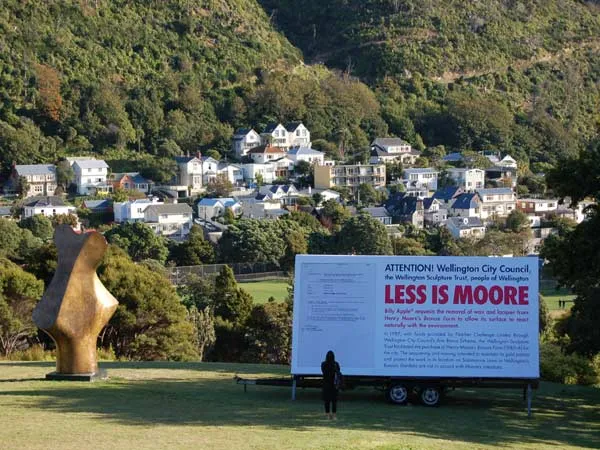
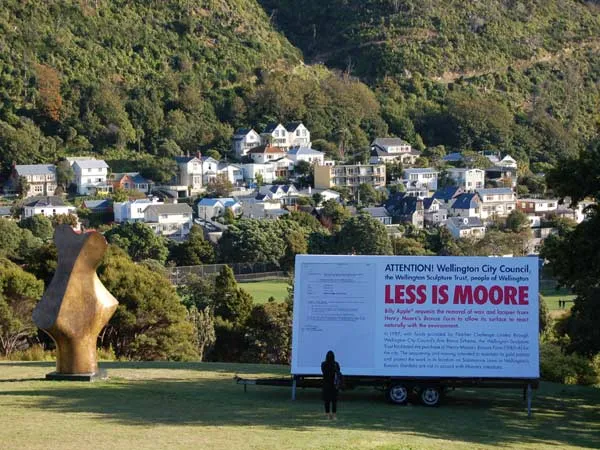
Apple’s one day sculpture physically comprised of a billboard placed next to Henry Moore’s Organic Form No.1 in the Botanic Gardens. It requested from the people of Wellington the removal of the layers of wax and lacquer that have been applied to protect the sculpture, and reproduced a memo from the 1980s from sponsors Fletcher Challenge noting Moore’s wish that his work be allowed to weather naturally. Rather than just protest, Apple’s best work often sees an unusual negotiation completed, leading to an alteration in existing business practice. Let’s then see this patina, at least temporarily, removed.
Less is Moore (the work’s beautiful title) recalls Apple’s work of the late 1970s when he worked with art institutions to alter their buildings and highlight how important their systems were to the creation of art. This interest in the context for artwork had clear beginnings in having his own space to play with in New York.
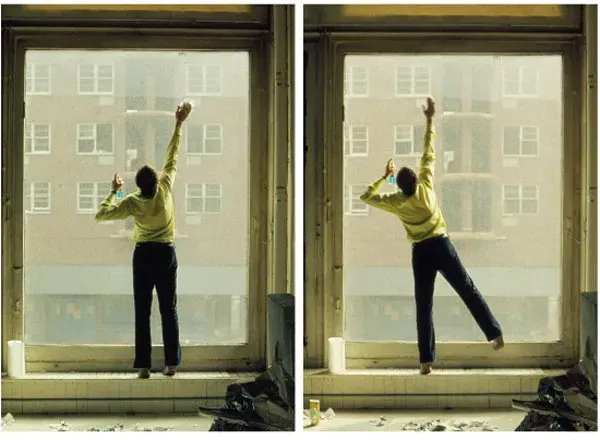
While now he looks to remove a patina, in New York he also looked to create work by removing rather than adding to the world. Cleaning patches in the gallery (windows and floors) and outside (sweeping the street) he emphasised that all work is about an exchange. “Wipe a dirty spot off the wall,” he wrote, “you haven’t eliminated it, you’re stuck with a dirty rag you didn’t have before.” Apple went about collecting broken glass from the streets and (Goldsworthy-like) making sculptural configurations out of it. Increasingly conscious as we are today of our build up of ‘more stuff’ and what happens to our glass bottles Apple’s actions feel extremely timely.
Apple experimented with how all activity or processes might be part of his art and he might, like a true minimalist reduce things down to get to the essence of things. “I want to strip down for living,” he wrote. He collected and catalogued his own bodily discharges (the bagged swabs and pads, incredibly still able to be seen), and went about monitoring and cleaning a collection offluorescent tubes from previous neon sculptures, as if to remark on how life and art in its essence is just a movement of a thing from one place to the next. These processes are far more interesting to me than the 1968 film screened here he made previously with Nam June Paik, playing with the effects of neon light.
One of the delights of the exhibition is its resistance of over-explaining the conceptual through wall texts. Instead, the stop-motion reanimation of Apple’s activity through photographs, slides, film, and folders of exhibition invitations, notes and mailing lists (credit is due to Apple’s meticulous documentation) slowly build up an understanding for the visitor that might not have been so easy 35 years ago.
I found props like a bucket and old can of Ajax unnecessary ornamentation. Yet the laying out of neon tubes and tools in the bottom gallery in a design that represents a body-like system being reordered and tested, is a brave, strong visual way of re-representing what Apple was doing. An assertion that art is to be found in ways of living, is always at its best collaborative and is never completely finished.
- Billy Apple New York 1969-1973, Adam Art Gallery, until 17 May 2009
Is Less More? Debating Apple on Moore, Museum of Wellington 23 April, 5pm