NZ's Community Piano
Written by
By Mark Amery
Every hall needs a piano. It is the Pakeha community instrument. The vessel with a rich, varied culture stashed under its lid, transported to New Zealand. As Jane Campion’s film The Piano portrayed, it was brought here against the odds. The prized colonial object; the closest in richness they had to Maori sculpture.
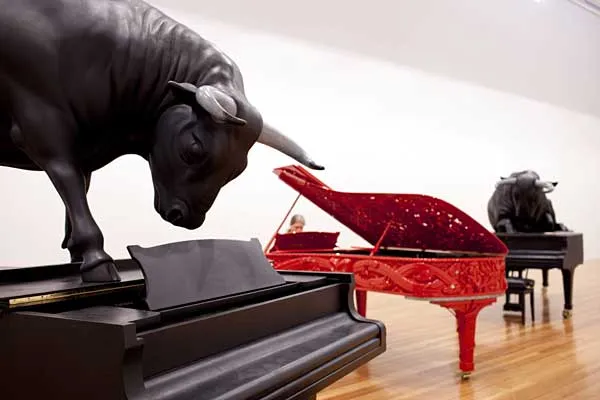
Our largest community hall, Te Papa has a new one: Michael Parekowhai’s extraordinary Steinway, He Korero Purakau mo te Awanui o Te Motu: story of a New Zealand river. You should head down and play it. Not only (at a cost of $1.5 million) do you now own it, one of this artwork’s great strengths is that you can.
Parekowhai’s paua inlaid Ten Guitars (the guitar the Maori community instrument) sat mute on plinths. Here there’s a stronger tension: do you feel you deserve to touch it and fill our national museum with your sounds? When I visited, the piano was being criminally underplayed. That much money spent, it’s an insult for Te Papa not to have done the outreach to ensure young and old, beginners and professionals aren’t lining up to play it. Put it on permanent display I say – let people tickle the ivories on the marae, or by the Colossal Squid.
It is beautifully arranged in the museum’s upper reaches, joined by other components from its Venice Biennale installation, On First Looking Into Chapman’s Homer, in an effective reconfiguration.
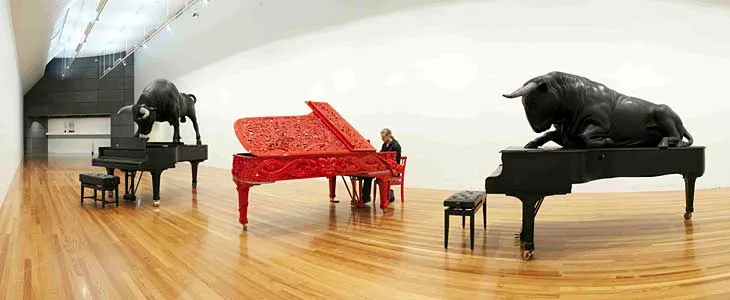
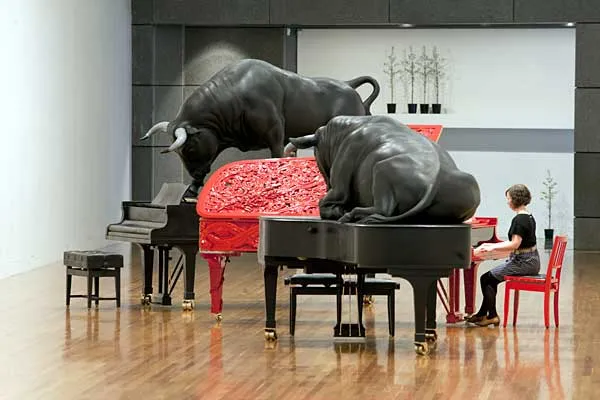
The red wooden piano is flanked, as if by shepherding battleships, by two silenced stainless steel pianos with fearsome bronze bulls performing on their tops.
With typical Parekowhai boldness and aplomb they are almost the only things in a huge gallery, choreographing your movement through it. An impressiveness of approach is provided for - rare inside a New Zealand gallery. From the south end the pianos appear like islands, their shape moving with your approach. The bulls’ backs could be New Zealand’s landforms from the water. Moving down the long space also feels like gliding down a river, helping realise Parekowhai’s references to the piano as a waka (its lid its sail), and the piano’s early transportation down our waterways.
This is a work about travel and cultural traffic. It’s fitting that it should already have traveled so much. Before Parekowhai the piano was owned by two famous imports: Jaz Coleman of Killing Joke, and Hungarian pianist Lili Kraus, who toured the country with it. There is the travel in the Keats’ poem of the installation’s title (from ancient Greece to the Pacific) and the piano’s many visual allusions to carved waka. Then there’s the paint job - the instrument the Italian invented has been turned into a red Ferrari.
What impresses is how tough and beautifully made these objects are. They are like very fine weapons. Their materiality is complex: from the wear on the piano seats to the way the bronze bulls horn resemble marble. Then there is the red piano’s exquisite carving, and the astonishing restoration it has undergone.
Parekowhai reverses cultural traffic flow, taking a European instrument and making it an emblem of Maori strength, mobility and adaptation. Representation of native clematis climbs up the piano, as morning glory in the wild does a cabbage tree. With this one work Parekowhai ensures Maori tradition remains at the pinnacle of contemporary art.
With Te Papa buying only the red piano there’s been concern about the installation being broken up. This shows little appreciation of Parekowhai’s practice. His work has often thrived on its ability, like Maori, to go off independently into the world and then come back together. In the bosom of the national institution the piano won’t need its bullish bodyguards.
The security guard figure that accompanied the Venice installation, Officer Taumaha was last week to be found at Page Blackie Gallery, guarding the work of Maori sculptor Hemi McGregor. Given McGregor was showing bronze readymades of the security system better favoured in the 21st century, the CCTV camera, placed on stands with Victorian wrought iron ornamentation, this couldn’t have been more apt.
- On First Looking into Chapman’s Homer, Michael Parekowhai, Te Papa, until 23 September. Free concerts are given daily between 12.30 and 1.30pm.