Not Enough Food for Thought
Written by
By Mark Amery
Visual art was once dominated by two subject matters: the still life and the nude. Today food and sex are the subject of countless magazines and television programmes, while in contemporary art they are mostly avoided.
It’s as if they are now considered too base, or as having had the creative juice sucked out of them, to use a turn of phrase.
I don’t buy that for a minute. Artists need every seductive tactic they can lay their hands on to open up deeper issues. Yet two exhibitions in Wellington that deal with food and sex respectively didn’t leave me much food for thought.
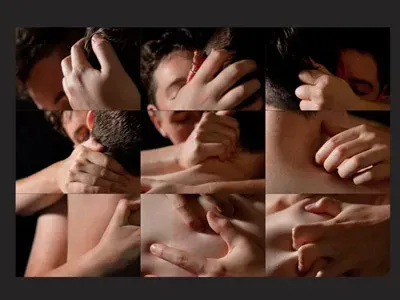
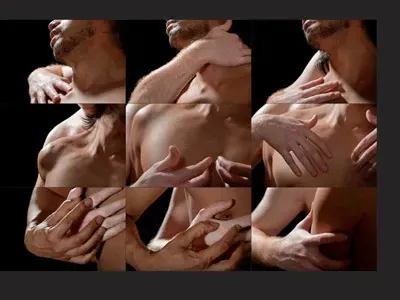
Photographer Rebecca Swan’s Sweat deals with the latter in no uncertain terms, although it’s ever tasteful. In a patchwork of glossy, beautifully lit stills of close-up intimate moments involving touch and taste between people, flesh on flesh, the work is all about the senses - communication through means other than gesture and talk. It’s also a celebration of differences in taste in another use of the word - of different colour and different sexuality, with the closely cropped images often leaving the sex of the participants relatively ambiguous.
Yet the work leaves me feeling curiously cold. Its intention doesn’t appear to be to turn me on, yet neither am I moved or repulsed. We are told “voyeurism is the entry point to the exhibition”, yet I don’t feel any of this sexual tension. Perhaps our culture of overexposure is making me numb to the shock of nudity.
Despite the warm beatific glow of the photographic prints, the use of this high tech media and its fragmentation in these works into collages of juxtaposed stills turns the mysterious electricity of human contact into a clinical, distant experience, as if I’m being forced to be part of a pseudo-scientific experiment testing my reactions.
All the dramatic tension is sliced and squeezed out of the frame by its compression. Far more sensuality is to be found in a Fiona Pardington image, or an abstract Gretchen Albrecht canvas for that matter.
In a central installation ‘Personal Taste’ Swan invites us to put on gloves and move around a large piece of sticky fabric 108 of her photographic squares. To create a collage of what our personal taste might be. We are then asked to write down our impressions and the combination we chose. Yes, it was interesting to consider what images I found most pleasing, but it was a rather clunky physical experience shuffling around somebody else’s subjective personal taste, the artist’s.
And in this is where my biggest issue with the exhibition lay. I wanted a less compromised expression of the artist’s taste. Alongside the installation were eight works made up of three rows and three columns each of these images, yet there was with too few exceptions a frustrating lack of visual rhythm or melody within these works.
Stronger is a work of nine silver gelatin prints, and a video work made with sound artist Charlotte Rose. In these the sensuality and dramatic tension of the camera media are played with strongly. In the video ‘Falling’ one by one different chins and mouths reach into black space from the right hand side of the frame. The action is hopeful and expectant, a smile playing on saliva wet lips. This is intercut effectively but a flash to their mouth in deep kissing action with another. This work rather effectively plays with the beautiful tension between thought and action.
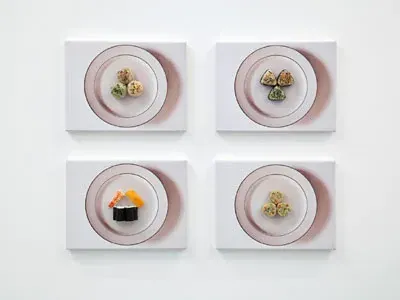
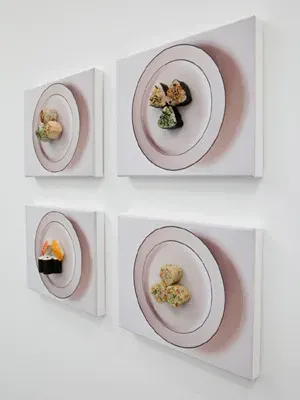
Jae Hoon Lee is something of a photographic master at complicating a viewer’s perspective through digital manipulation, messing up our sensual expectations of a photograph. Even so, I find two works at Robert Heald Gallery rather hard to stomach. They present actual fabricated Asian food (such as might be found in eatery display cases) attached to digitally printed painted illusions of plates on canvas. Like Swan’s photographs these are presented in grids.
The work is all about illusion – playing with different perspectives, dimensions and media. How it’s hard to trust that even the food you see is real anymore. Yet the works feel like briefly-clever jokes, pushing ideas about illusion one step further.
The first work ‘Chinese-Korean’ is sloppily painted. Whether this is part of its ploy to question representation I find myself not really caring. The second, ‘Japanese-Korean’ with its clever play with the shadow of the plates on a white background is more visually satisfying, but as with Swan’s work I find myself looking for more abstract satisfaction in the way the different items of food behave together than I’m given.
Lee’s exhibition title Code Unknown, promises a play with pattern that this work doesn’t go nearly far enough towards providing. Likewise the titles of these two works ask interesting questions about authenticity. Lee can push these ideas much further.
In the meantime I figure I’m better off paying good money round the corner at Logan Brown for a beautifully presented dish of food I can actually eat.
- Code Unknown, Jae Hoon Lee, Robert Heald Gallery, until 2 April 2011
Sweat, Rebecca Swan, Mark Hutchins Gallery, until 2 April 2011