Nelson Arts Fest Digest
Renee Liang reports from the Nelson Arts Festival where she'll be bringing us interviews from creatives and presenters plus blogs about her experiences, with some help from local poets and artists.
* * *
The relaxation hits as soon as I step off the plane. It was grey in Auckland when we left – now it’s sunny, the gentle radiant heat enfolding us as we load the kids and luggage into our gas-guzzler of a rental car. Seagulls circle overhead and it’s not long before we are driving along a coastal stretch of suburban road. Nelson is like that. It’s almost aggressively laid-back here. The people are well-dressed, albeit with a touch of hippy, and gracious. It’s not surprising that they would be into creative fixes, along with their coffee.
I’m in Nelson for the Arts Festival (well, actually for a completely unrelated job, but rather conveniently this coincides). The Nelson Arts Festival is special for a number of reasons. Firstly, it is celebrating its 20th anniversary this year, with an extra-large programme of writers, performers and arts practitioners – more than 150 are hitting town during a twelve-day period. Secondly, the programme is surprisingly broad for an arts festival in a smaller centre – lots of overseas shows, and along with the usual best sellers (circus, well known musicians and NZ literary heroes) there are lots of shows which fit into the ‘experimental’ or ‘indie’ category. Finally, the Nelson festival is annual, evidence to me that its formula is successful, both financially and in the eyes of local ratepayers.
I am now a working mum with two young kids, so going to shows is an indulgence, one that I’ll enjoy for the coming week. I’ll be focussing on two strands: international shows with a local link, and shows and activities for families. I’m also very interested in how an Arts Festival such as Nelson’s fits in with the local creative economy, and how local audiences respond.
So I’ll be bringing you interviews from creatives and presenters as well as a couple of blogs about my experiences (I’m inviting local poets and artists along with me to the shows).
First up, an interview with UK artist and theatremaker Nic Rawlings of the Paper Cinema about Odyssey, a show that’s touring to Auckland after Nelson and has already been enjoyed by Dunedin audiences.
* * *
Summer is already here in Nelson and with it, the people. The beaches and streets are busy with backpackers (many busking to raise money for onward travels) and tourists ready to whip out a camera at the slightest whisper of anything picturesque (such as my daughter with her face covered in ice cream). There’s no doubt that the festival adds to the general buzz, with banners fluttering everywhere announcing the Festival, and local shop fronts housing visual art. The central city ‘Stage One’, an all-day showcase for local emerging performers, is busy with excited students. The Festival has plenty of free and community events on offer, including the two big family festivals which bookend the festival. But more on that in another blog. For now there’s a wallet full of tickets burning a hole in my pocket.
The first performance I attend starts half an hour late due to a peculiar local condition: the Cook Strait Ferry has been delayed yet again, meaning the show’s performers have been stuck en route from Wellington. When we finally see the stage with its profusion of cardboard boxes I can’t get the image out of my head of the stricken ferry piled high with boxes, the bearded actors perched on top perhaps.
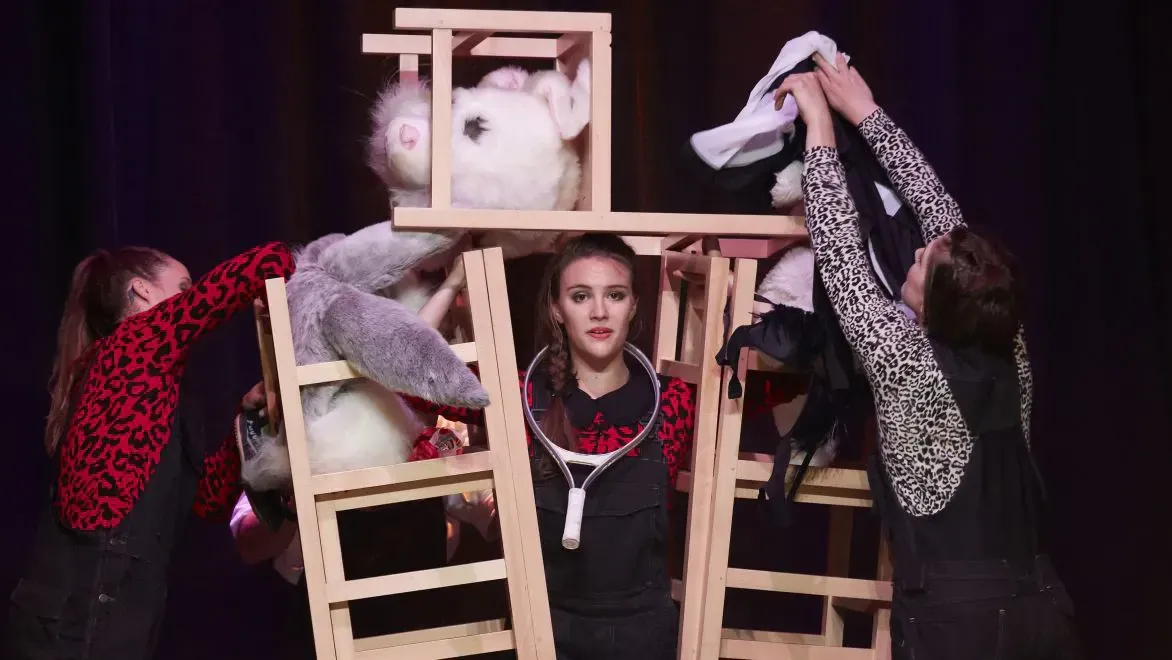
But then The Road That Wasn’t There starts and I am transfixed. It’s a ‘tall tale’ as the programme tells us, but the performers believe in the magic and gradually they draw us in. Told with live actors, puppets and shadow screens, it mixes Maori and European legends (as well as a few modern legends-in-the-making: Wellington’s Blanket Man features). The children in the audience were transfixed and didn't seem put off by the scary bits, and the adults (well this one at least) cried. The story of The Girl Who Followed A Map Off The Edge Of The World reminded me of my grandmother, who has had dementia for decades and now wanders very much in a world of her own – but seems very happy with this.
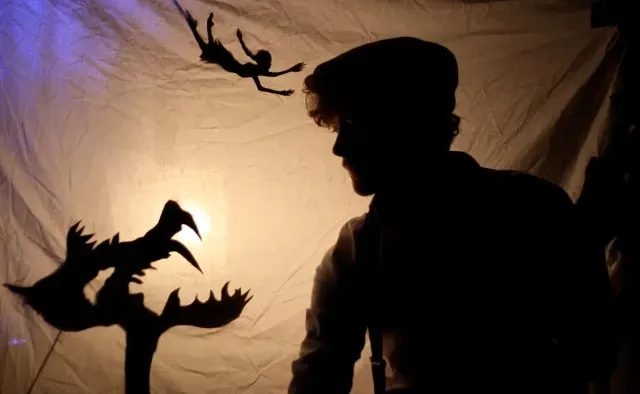
The next two shows are at Nelson’s Theatre Royal, an old wooden building filled with gorgeous gilt-edged chairs, high ceilings, and antique chandeliers. The venue would be a jewel in any city. At festival time it’s filled with patrons, and the performance of Paper Cinema’s Odyssey I attend is nearly sold out. Half the stage resembles an artist’s studio – cameras, desk lamps, a tall table with drawing tools and sheets of paper – and the other half looks like a recording studio. What follows is both technically precise and magical. The best I can describe it is a graphic novel brought to life in front of us. All the techniques are laid bare, but still we’re drawn in to the story and its underlying emotions.
Paper Cinema has chosen to highlight the relationship between Odysseus and Penelope in their version of the classic tale told by Homer. With an audience tuned in to the storytelling shortcuts used by filmmakers – close shots, ‘mind’s-eye’ windows, jump cuts – technology becomes very much a tool to the ancient art of storytelling. From the beginning, where we watch a simple cartoon hand drawn in front of us, the pictures grow in sophistication until we are watching 3-D, still hand drawn, models being manipulated in front of the cameras. Meanwhile the musicians score every moment, taking every opportunity to sneak in some sly humour. It’s an impressive achievement, one which succeeds I think because it never loses its connection to the human.
Gao Shan Liu Shui blends the ancient and the modern, once again appropriately staged in the Theatre Royal. Two instruments, a modern concert grand piano and a gu qin (an ancient 7-stringed table harp associated with the Chinese Imperial Court) are the focus of a sparsely arranged stage. Behind them seems to be a scroll with a Chinese brush painting, but if you watch this carefully the image moves – it's a digital projection that acts as both visual response to the music and subtitle screen. The show is a collaboration between pianist-composer Gao Ping, gu qin player Wu Na, designer Jon He and opera singer and Kunqu opera star Dong Fei. These artists are directed by NZ director Sara Brodie.
The music flows and collides between the two instruments, evoking water and mountains. It’s rhythmic and melodic without being overly structured and I find myself being lulled into a contemplative state. But then a dancer enters, a human element directing the flow of ideas with his movements and recitations of Tang Dynasty poetry, while the projections – like moving Chinese ink paintings, but at one stage becoming Len Lye-like – provide detail. Dong Fei is beautifully androgynous, the flowing white garments he wears contrasting with the formal black of the musicians, his limbs both graceful and somehow alien. His voice is otherworldly, but very beautiful.
The piece is inspired by the ancient story of the gu qin player whose most ardent listener is a humble fisherman, and the player’s vow to break his instrument when he finds his friend dead. But really it’s a contemplation on friendship and how this is negotiated through a meeting of minds. In its last two parts, Gao Ping also deals with the subject of grief and its gradual resolution – friendship remains in the memories, the music and poetry created and enjoyed together: never think that after/High mountain Flowing Water/all bosom friends must part, the dancer sings in the closing moments.
The poets and musicians I am sitting with are enthralled. This is less due to ‘exoticism’ than interest in the way the subject matter has been tackled and the theatricality of the staging. (I find there is a lot more knowledge about Chinese music and poetry these days, not least because of Arts Festivals like this one which make a point of bringing over Chinese works both traditional and modern.) One of my new friends points out that the pre and post show music is Benjamin Britten, that most English of composers – who uses half-tones in his music, thus to my ears the music sounds Chinese. It’s all too easy to forget that the cultures of East and West have been mixing for a very, very long time.
The Labour weekend is ahead and I have more tickets and interviews – watch this space.
* * *
Festival fun for small people
Since I’ve had kids, I’ve become a lot more aware of what’s on offer for families. It’s not always easy to make it along to an arts event. For a start, even buying a ticket is a gamble because you never know when your kids are going to be having a nap/decide today is a ‘no’ day/suddenly develop the squirts making them unpleasant to have on your lap, etc (I can see all you parents out there nodding.) Luckily, Nelson Arts Festival has been there too and there were lots of free or non ticketed events on offer.
Some of them weren’t even labelled as ‘family friendly’, but were great nevertheless. I took Mr. Seven months to Anne Rush’s installation Lucent (Dad and Miss Two stayed in the car – she had, by the design of her wily parents, crashed out on the drive there.) We stayed in there for over 30 minutes, the little boy strapped to my front so I could see how enthralled he was. Lucent is the culmination of several years’ experimentation in movement and form, developing over a number of previous shows. Large soft sculptural forms hang like clouds in a white room, the only noise the whirring of small electric fans. At first glance, they seem random, but as your mind calms you start to see the patterns in the way glass spheres are woven into the work or in the way the forms echo each other. I navigated using the turn of the baby’s head, moving slowly among these clouds, observing as they spun and changed – becoming jellyfish or jewelled frocks or splashes of water. It was so quiet that I could hear the little caught breaths of excitement in my baby, although he was so absorbed he even forgot to coo.
If this was a serene experience, the Dia Del Los Muertos (Day of the Dead), on the final day of the festival, was the complete opposite. This is the Mexican tradition remembering dead loved ones with… a party of course. Dress-ups (cue lots of ghoulish Frida clones), food (yes there was a chilli-eating competition), music, a parade and pinatas. Both our kids loved it. Miss Two got down with boogieing to the mariachi band and got to be first to hit the pinata; Mr Seven Months sampled his first guacamole to the extent that his cardigan had taken on a distinct shade of green by the time we left. Even the cold wind blowing through Founder’s Park where it was held couldn’t dampen our enthusiasm.
We arrived in Nelson too late to experience the Masked Parade that traditionally opens the Festival, but there were several other family events during the time we were there. Alas competing activities (the beach) and sleep schedules meant we couldn’t make it to all of them – but I hear the Children’s cantata at the Cathedral was lovely, and we enjoyed in passing the many school bands at Stage One, the inner city stage which gave many their first taste of the limelight.
My kids were too young for any of the ticketed theatre events but I went to a few on their behalf. I’ve already mentioned the joyous and spooky The Road That Wasn’t There; the second festival offering from the same company, Trick of the Light Theatre, was The Bookbinder. Performed in the tiny St Michael’s Church in Founder’s Park, it's written and performed by Ralph McCubbin-Howell, with audience (only about 30 at a time) sitting at his feet or in pews arranged around his small desk. The experience is akin to having a scary story read to you (with extras). The lighting is just a desk lamp and a table lamp; the sound is a small ipod speaker. It’s a small scale work but with a depth and darkness to the story that belies its simple staging. It also features one of the most gorgeous handmade pop-up books ever. Like many of the best stories for kids, there’s no ‘message’ (unless it is to think twice before becoming a bookbinder’s apprentice) – it’s just about going on the adventure with the storyteller. Something my two year old understands completely.
* * *
Well, the Nelson Arts Festival has wrapped up for another year. The sun is shining (in between rain showers) and a cold wind is trying, and failing, to discourage my toddler from hitting the beach. Festival staff are tidying up loose ends and festival director Sophie Kelly has just wrapped her last festival – see my interview with her here.
Meanwhile I’ve continued to meet with some of the poets and writers who call this city home. It’s evident that even without a Festival in progress, Nelson has a vibrant arts scene, small enough so that everyone knows everyone else, but big enough to produce interesting work. The proximity to Wellington also makes it easy to collaborate and for other creatives to visit.
The final show I attended at the Arts Festival was White Cloud, a solo piece by Tim Finn (read my interview with him here.) A collaboration between Finn and playwright Ken Duncum, the show is an album’s worth of new songs, searingly introspective pieces linked by Finn’s commentary where he offhandedly reveals intimate things about his and Ken’s time growing up in New Zealand. A medley of super-8 film footage – home videos from Finn’s father Richard and filmmaker Sue Healey – is projected onto the back wall as Finn sings, adding a layer of pathos and humour.
As the title suggests, it’s also a musing on white identity in New Zealand. Finn sings: You have slippery identity/if you don’t know who you are/you must be Pakeha. My show date commented that after watching the show, she felt proud to be a white New Zealander for the first time: that she, too, had a history in NZ to be proud of. It's something I’ve heard before from my ‘no colour’ friends. In contrast to my experience of being constantly asked to ‘discuss’ my identity, and a sneaking feeling that people expect me to write ‘cultural’ pieces (as it turns out, self fulfilling), white Pakeha culture is the blank canvas that everyone else treats as background. Yet as Finn points out, the white cloud comes with a ‘black shadow’, one that is as interesting and complex as other stories.
The introspective role suits Finn. As he moved from piano to guitar to ukulele to flute, he also seemed to open up about his own vulnerability. The final part of the show is a memoir of his mother, and it is here that the words and images become the most poignant. His spoken word pieces were both powerful and personal, showcasing his skill with lyrics that more than anything, I think, has made his songs resonate: And for a moment we are one/like on the beach forever young/and in that moment we forget/ who we’ve become.
It seems fitting that it is in Nelson that I am reminded that we are all still looking for that kernel of self truth. The shows I’ve seen over the past week are expressions of this search; and the city is full of migrants and travellers, drawn to the beautiful landscape to look for something bigger than themselves, perhaps. Or maybe just for the sun and great food.