Natural Majesty: Contemporary gallery sculpture in Wellington
Written by
By Mark Amery Courtesy of The Dominion Post
Three exhibitions this month throw up challenges about how contemporary sculpture operate in the dealer gallery. While exhibitions at Peter McLeavey and Mary Newton Galleries gleefully undermine the rarefication of the art object, at Page Blackie Gallery the commonplace has been transformed and propped up gleaming on marble pedestals.By Mark Amery Courtesy of The Dominion Post
Three exhibitions this month throw up challenges about how contemporary sculpture operate in the dealer gallery. While exhibitions at Peter McLeavey and Mary Newton Galleries gleefully undermine the rarefication of the art object, at Page Blackie Gallery the commonplace has been transformed and propped up gleaming on marble pedestals.At McLeavey's, polystyrene has replaced marble and the pedestal has become the artwork itself, delightfully overdramatised and overblown. The bravest major collectors are dared to purchase Peter Robinson's Soft Rock Baroque, a sculpture that almost fills the gallery up to the ceiling, with only just enough room to walk around. It's overpoweringly toxic in theme and smell.
Comprised of huge white slabs of polystyrene balanced precariously on top of one another, decorated with cascades of polystyrene chains, it mimicks the OTT rock formations of Rome's baroque public sculptures (think for example of the Trevi Fountain). The whole is a sublime crumbling white, like a Caspar Frederick David iceberg.
While the high theatrics of Bernini's Baroque in 17th century Rome were designed in their outrageousness to inspire awe in the power of God and the Catholic Church, Robinson's recent work has engaged in a theatrical gigantism and abstraction which emphasises the vacuity of popular culture.
Here we are forced to get lost looking into the spaces created in between great polystyrene slabs, aware that there are no grottos within which provide the shelter of faith or meaning. For all their natural majesty these slabs are as artificial, light and inconsequential as the packaging for a new home entertainment system.
Robinson gives us the theatrics of the baroque pedestal without the humanity of the elegant figures usually to be found dramatically struggling on top. It's as if the figures have broken free from the chains of their struggle, leaving us to ponder what drama there is left for us to believe in when faith has left the building.
But let's not get to reverential. This work like Robinson's other recent twisted blow-ups is an exercise in well-directed flatulence; a witty blow out response to conceptualising every last thing. The link to the baroque is apt given how empty the excessive universal drama of 17th century work seemed to generations brought up on modernism's pursuit of some compact kernel of truth in abstraction.
The way this work plays up cultural politics by carting weighty European history back to New Zealand in as cheap a replica as a shop window display makes this classic Robinson. Yet the strength of recent Robinson work's is also that it's about the smelly, base business of getting mucky and playful with form for the sheer fun of it.
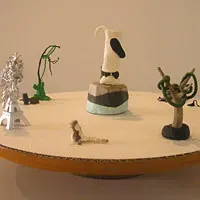
The employment of a cardboard Lazy Susan says it all in Rob Cherry's exhibition at Mary Newton. His is a banquet of many bite-sized abstract figures which banish preciousness and pompousness. They encourage you to be playful in weeding out what you find meaningful and beautiful from what you find forgettable and random.
With found flotsam and jetsam Cherry has created a multitude of hand-sized assemblages that constantly upset expectations and open out objects with a freewheeling sense of the absurd and the surreal to many associations. They evoke as well as challenge the magic of the talisman, willing us to enjoy the imaginative possibilities of the world around us.
Cherry delights in an intuitive play with materials in his hand, dispensing ideas one after another like a clown creating balloon shapes, some liable to fail, others to engage. At their best they demonstrate his great modeling instincts, creating wonderful tensions in the abstract. There's also (taking a leaf out the surrealists book) the dark and sinister in these shadowy tortured forms, like trees strangled by vines. They snare and prickle you beyond explanation, just like the plastic elephants Cherry here traps in boxthorn branches.
Andrew Drummond has long been interested in the alchemical potential of basic material to transform into the precious, and his elegant public sculpture works provide devices by which we might harness energy from nature. For an artist who was at the vanguard of post-object art however I struggle in this Page Blackie exhibition (formerly Tinakori Gallery) with the sleek objects and works on paper he has created for purchase.
Drummond continues to reference the potential of coal as an energy source, and here presents complex balanced arrangements of crystal forms which suggest transformation and movement, the sculptures burnished stainless steel on marble plinths. The wish to open up questions about the value and presentation of sculpture are clearly meant to be there, but in their referencing of modernist geometrics ultimately these austere sophisticated works don't for me transcend their decorative associations.
Image:
Idiot Monument
Rob Cherry
Found objects, fimo, wood, modelling clay,spray paint
2008
15/04/08