Monique Redmond's Inhabitants as part of the Litmus Research Initiative
Written by
Say it with flowers - Courtesy of The Dominion Post 2005-10-21
by Mark Amery
Currently poking up out of the floor of the Great Hall of the Old Museum Building at Massey University in Buckle Street, are the powder-coloured heads of 90 hydrangea flowers.
Disrupting your line of sight, and possibly your step as you walk through this grand, cavernous thoroughfare, this rectangular bed of a most common suburban flower - growing in pots in a sunken recess in the floor - is a beautiful imposter here of a strangely ordinary variety.
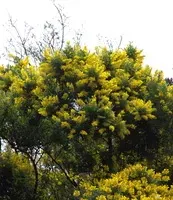
Image: The gorse blooms of Wellington hills feature in Monique Redmond's Inhabitants. Say it with flowers - Courtesy of The Dominion Post 2005-10-21
by Mark Amery
Currently poking up out of the floor of the Great Hall of the Old Museum Building at Massey University in Buckle Street, are the powder-coloured heads of 90 hydrangea flowers.
Disrupting your line of sight, and possibly your step as you walk through this grand, cavernous thoroughfare, this rectangular bed of a most common suburban flower - growing in pots in a sunken recess in the floor - is a beautiful imposter here of a strangely ordinary variety.
Image: The gorse blooms of Wellington hills feature in Monique Redmond's Inhabitants.The commonness of the flower and the rarefied place the flowers are positioned in work beautifully against each other. No one for long should surely confuse this art installation for a new student traffic island, ornamental pool or leftover garden show exhibit. Rather, its dual familiarity and strangeness is hopefully likely to stimulate many-layered discussion. The trick is that the work for all its oddity also fits the space, leading us to consider the current and past functions of the hall it is placed in. I end up ruminating on its relationship to the war memorial outside - a memorial to the known soldier?
This intervention is one of three by Auckland artist Monique Redmond in the Old Museum Building that form her installation Inhabitants, developed whilst a 2005 Massey/Rita Angus artist in residence. Now in its forth year, the residency provides an opportunity for New Zealand and international artists to live in Rita Angus's former Thorndon cottage whilst developing work as part of Massey's School of Fine Arts.
This year the residency has been aligned with a new contemporary art programme at Massey, the Litmus Research Initiative. Redmond's Inhabitants is the third and final Litmus project this year, following projects by artists Simon Morris and David Clegg.
The programme is significant as the first in a New Zealand university which, rather than being about providing exhibition, provides an opportunity for artists to research and experiment outside of the gallery context. Based in the former office of the Director of the National Art Gallery, it's as much about an artist being given the opportunity to experiment and develop their work as provide completed work. In this sense they present rather than exhibit, opening up their working process and areas of interest for discussion with students and the public.
Just as the Old Museum Building provides a strong context to work with, the programme favours artists who are interested in creating work which is about engaging with different sites - rather than just creating stand-alone saleable stand-alone pieces. Monique Redmond does exhibit with dealer galleries (Bartley Nees in Wellington), yet she's one of many contemporary artists who when encountered in a dealer gallery you feel you're only seeing purchasable souvenirs of a practice better realised in public installation.
One of the last big exhibitions in the Old Museum Building was 1994's Art Now -intended at the time by Te Papa to be the first in a series of biennial reviews of contemporary art. Many of the selected artists created work specifically for the exhibition and for particular spaces, both within the museum building and outside throughout Wellington city. In this way the exhibition posited that 'art now' was as concerned with space and the context of different sites as it was with the objects place within them.
That was eleven years ago. If anything interest now is even more pressing in how art can operate out in the world, outside the white walls of the gallery, providing us with new ways of thinking and looking at the world by disrupting our expectations and drawing us into re-examining situations.
Yet the opportunities for artists to present their work outside the gallery environment remain limited, making the Litmus initiative most welcome. While this year's Litmus projects have brought the city into the university and old museum space, it is hoped some future projects will move out into the city.
Redmond brings the city in by collecting and presenting data in images, pots and vases. Inhabitants plays with the value systems we place around different species of plant and arrangements of them, within a wider discussion of the hierarchies placed on different social activities.
In the Litmus office, Redmond has pasted up with common domestic stickers photographs taken of bushes in bloom out front of Wellington homes. Artfully arranged in tasteful black vases are the yellow blooms of the Broom bush. Considered a weed, Broom is shown as equally beautiful in a vase as on Wellington's hillsides.
Redmond's past work as here shows an interest in domestic creative activity - be it embroidery, jam-making or gardening - the use of ordinary domestic craft materials, and the operation of abstraction in our arrangements of all things. Played with are the tensions between low and high art, art and craft, and how context changes the hierarchy we place on things. Aesthetically her art revels in the tension between the straggly, shaggy nature of organic growth and the order we place on it.
The hydrangeas in the Great Hall for example are in rows yet aren't uniform in height or colour. Take a lift to a nearby rooftop and you'll find pot plants of different varieties untidily placed on or near an odd large makeshift shelf, as if in the process of removal or installation at a garden store.
Emphasising difference and commonness, and awkwardness yet desire to be within the grid, Redmond plays with these pot plants in a way that animates them as stand-ins for our own behaviour as social beings. In fact the awkward personality of these installations as communities of individuals feels reflective of the building's other inhabitants - students.
ENDS.