Michel Tuffery and the history of Pacific cultural contact at Pataka
Written by
By Mark Amery Courtesy of The Dominion Post 3/10/07
There's a terrific transpacific cultural experience at the heart of Pataka Museum's jam-packed Spring exhibition programme. All speak of the ebb and flow of exchange across the Pacific, and the enduring power of Pacific people to adapt and absorb whilst retaining their spirit. At the heart of the experience is a large multimedia work in a long darkened space by Michel Tuffery as part of his exhibition First Contact.
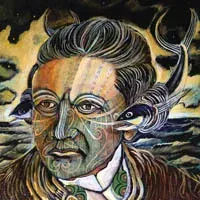
Image: New Zealand Man in Cook Strait by Michel Tuffery (2007).By Mark Amery Courtesy of The Dominion Post 3/10/07
There's a terrific transpacific cultural experience at the heart of Pataka Museum's jam-packed Spring exhibition programme. All speak of the ebb and flow of exchange across the Pacific, and the enduring power of Pacific people to adapt and absorb whilst retaining their spirit. At the heart of the experience is a large multimedia work in a long darkened space by Michel Tuffery as part of his exhibition First Contact.
Image: New Zealand Man in Cook Strait by Michel Tuffery (2007).Here, in the digital mesh, Tuffery plays with the weft and weave of culture as a pulp-like fabric, soaking the present in the past, and marking history (sourced from archival film and popular music representing key contact between Pacific and European peoples) with tattoo-like pattern that provide symbols or brandings for experiences across lineal and cultural boundaries. The work was created in collaboration with Anton Carter, Daimon Schwalger and Mike Bridgman.
The migratory and crosscultural experiences of the people of New Zealand and the Pacific are here like memories faded and burnt by the sun, distorted into rhythmic pulses, repeated over three screens. In the dub-like electric distortions of colour and Tivaevae-like pixelation of imagery there is a beautiful elemental play between the documentary and the abstract, reflecting mixed cultural traditions. It's as if the ridgeline where the traditional and contemporary meet is on fire.
It's a mash-up - in both the dance VJ and the old painting senses of the words. A performance driven on the energy of Tuffery and his collaborators playing during festival performances, there's a crushing and grinding together with the pestle of different elements in the mortar. But what lifts this work from the dance hall or the tapa cloth is the way the work calls on all of Tuffery's great experience with rhythm, line, colour, and performance to talk to his concerns. It's like a history painting you can swim in, through time, mapping the crosscurrent connections between these islands and others, secure in the strength of Tuffery's navigation.
Tuffery is a prolific artist who pours his energy into the widest variety of media to elucidate his ideas, and it's as if with this multimedia work Tuffery has found the perfect arena to meld his ideas together. Where other work sometimes feels disparate and lacking in something another media might provide (the painting the free graphic play of printmaking, the printmaking the heat of sculpture) here they mesh as one performative whole. It feels true to the lack of confinement to one media in both Pacific Island tradition and contemporary art.
The difficulty in how best to contain Tuffery's sparkish energy is clear from the abundant nature of the rest of this exhibition. It brings together recent painting, drawing, prints, bronze sculpture, and a herd of his much celebrated life-sized bulls riveted out of corn beef tins. A selection of half of what's here would have proved more effective.
First Contact considers the history of 18th century European and Pacific contact from a contemporary Polynesian perspective. It does this most effectively in the film and sculptural work and less successfully in the painting, where often the graphic and elemental energy is too tamed within the staginess of European storytelling pictorial conventions.
The familiar bust of Captain Cook is treated as a central icon - as worshipped and derided as an iconic piece of street graf art is susceptible to tagging. Through the defacement of Cook's face Tuffery plays with the complexity of Cook's position in the culture of the Pacific. The paintings rely on awkward illustrative modernist aesthetics whose time has past, but a set of small bronze busts (called 'Cookies') in their subtle play with form take traditional European sculpture and fiercely agitate it back into life. Cook's figure is animated as if it has become possessed, like one of the figures of the Kanak artists, the surface fiercely cut into as if by the cut of the blade of a paddle, or Cook's head and shoulders unnervingly taking on the keen movement of the bird and fish.
On canvas and tin plate Tuffery plays with the role of history painter, but he doesn't push through to new ideas beyond the costuming of what has come before. The introduction of cellphones into a reworking of an iconic John Webber image of a Tongan dance, for example, ends up feeling like a cheap shot. There are a number of fascinating narrative threads here - such as a series concerning Tahitian priest and navigator Tupaia who befriended and inspired Cook and was the first Pacific Island artist to use Western art materials - but they remain underdeveloped.
The bulls remind us that, on his third voyage, Cook brought cattle to the Pacific. They proceeded to destroy the local environment and today, ironically, many Pacific Islanders depend on tinned corned beef for their meat. The bull is a Pacific Trojan horse, a powerful loaded symbol for Tuffery. As with the small bronze sculpture, gathered here in their multitude they draw attention to the fluid eloquence of Tuffery's forms as a play with line in space. These big muscular balletic vessels are physically empty (originally created for festive performances to contain Christmas lights and fireworks) but their strong lines kick and bristle, ensuring the ideas contained within them are as fertile as their large, elegant testes might suggest.
First Contact, Michel Tuffery, Pataka, Porirua, until 25 November