Memories of an Earthquake
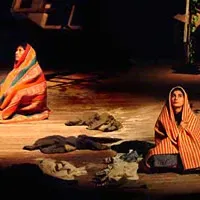
When Teatro de los Andes heard about the Christchurch earthquake, they wanted to perform En Un Sol Amarillo (Memorias De Un Tremblor) - In a Yellow Sun (Memories of an Earthquake) instead of the scheduled La Odisea at the Auckland Arts Festival. The short time scale to opening made this impossible.
When Teatro de los Andes heard about the Christchurch earthquake, they wanted to perform En Un Sol Amarillo (Memorias De Un Tremblor) - In a Yellow Sun (Memories of an Earthquake) instead of the scheduled La Odisea at the Auckland Arts Festival. The short time scale to opening made this impossible.
Renee Liang talked to company member Giampaolo Nalli about the piece and what artists can do to help after a natural disaster.
"When the TV cameras are turned off and the reporters have left, the survivors begin to realize what an earthquake truly is; they start to co-exist with the things needed to be rebuilt."
* * *
Bolivian theatre group, Teatro de Los Andes, has just concluded their Auckland Festival season of La Odisea, an adaptation of Homer’s Odyssey. Well received by both audience and critics, this piece is one of five works performed in repertory around the world.
Teatro de los Andes was founded in 1991 by César Brie and is located near Sucre, Bolivia. The company, according to a press release, "brings theatre to local communities, universities and job sites. With its distinctive fusion of western theatrical technique and the Andean tradition, the ensemble is rooted in improvisation, physical and vocal work and the belief in the actor as "actor-poet."
Another piece, En Un Sol Amarillo (Memorias De Un Tremblor) - In a Yellow Sun (Memories of an Earthquake), is a theatrical docudrama about the massive earthquake that rocked Bolivia in 1998. When they heard about the Christchurch earthquake, Teatro de Los Andes wanted to perform this piece instead. The short time scale to opening made this impossible, but I interviewed company member Giampaolo Nalli about the piece.
"With electrifying imagery, the piece sheds light on the victims and the survivors of the seismic disturbance, and also on damaging shockwaves of greed and corruption that followed."
What spurred you to write En Un Sol Amarillo (Memorias De Un Tremblor) ?
The night of May 22, 1998, there was an earthquake in Bolivia. The cities of Aiquile, Totora, Mizque; the farming communities of Antakawa, Loma Larga, Chijmuri, Hoyadas, Chakamayu as well as others, were struck by the earthquake: houses damaged irreparably, hundreds of people dead.
The international community sent all types of aid: blankets, money, electric generators, tents, food, clothes and crutches. The total amount of aid was calculated to almost 30 million dollars. The government of Bolivia, through its Civil Defence, (directed by the army) organized the distribution of the aid and the reconstruction of these towns.
At that time, voices began to circulate, turning into clamour about the theft of the aid, detour of funds, abuse. We travelled to Aiquile, Totora and to rural communities as well. We gathered dramatic, indignant, and desperate testimonies.
Furthermore, the Anti-corruption delegation sent us an investigation they did about the earthquake. We also studied the history of other earthquakes.
Detachment and egoism seem to co-exist in every earthquake. Stinginess and solidarity. Abuses and thefts have been a constant in the earthquakes of Latin America.
When the earthquake stops, the news begins.
When the TV cameras are turned off and the reporters have left, the survivors begin to realize what an earthquake truly is; they start to co-exist with the things needed to be rebuilt.
We have investigated the dynamics and the structure of catastrophes: the well-oiled mechanisms of power and politics. We have interviewed individuals in their community. Their experiences are universal thus we do not give names or surnames in our work.
In your experience, what can artists do to help after a natural disaster?
More than bringing our help to the catastrophe itself, what we did was give a voice to its victims. We transform their testimonies into poetry, so it does not remain unheard.
We had the chance to perform in the same town where the earthquake happened and we realized how important it was for the people of the community to be heard through the stage.
What was your process of working? You call it a "documentary drama" - why?
Initially, we went to Aiquile and to the communities affected by the earthquake and recorded testimonies from its inhabitants. We researched the causes, the dynamics and the structure of the catastrophic event. Then we worked with a official report from the Anti-corruption delegation. We discovered irregularities; crimes that went uncharged; authorities and military personnel whom have never been on trial.
With all this material, we started the process of creation.
We worked by creating images through the testimonies we recorded and through improvisations, trying to show everything we had seen and heard.
At the same time, the play's writer-director César Brie, began to write the script with the victims' testimonies.
The first version of our work consisted of two independent acts. The first act "The tragedy" dealt with the earthquake itself: the fortuitous and indifferent force that destroys cities, lives, and families in a matter of seconds.
The second act "The ridicule", analysed the daily life of the tremors, and the corruption surrounding the event. They are now joined into a single act, sacrificing certain information for the sake of a greater artistic power and a more coherent form.
"En un sol Amarillo" is a show which speaks about the history of Bolivia from today's standpoint.
It is an effective way to denounce what really happened because the media in our country did not give the true information about the events. But first and foremost, it is a theatrical play and that is why it has a very high artistic values.
Do you have any messages for the people affected by the Christchurch earthquake?
We believe what's important right now is solidarity. These kinds of catastrophes are very difficult to understand but it is even more difficult to return to normal life. The only thing that can give us strength is knowing that we are not alone, that we have to support to each other, and that we have to move on.