Melvin Day - out of time and about time
Written by
Courtesy of the Dominion Post - 17th February 2005
By Mark Amery
Senior Wellington painter Melvin Day (Continuum, City Gallery, until March 6) is an artist whose work has both been out of time and about time.
About time, because Day's canvases build up and scratch away at layers of art history. In his work you will find the spectre of the compositional architecture of the Renaissance, 18th century still life and early cubist fragmentation moving across flat modernist planes, floating lightly as ghostly veils or embedded and cut into heavy tablets.
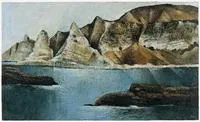
Image: Kaikoura No. 9 1992
Courtesy of the Dominion Post - 17th February 2005
By Mark Amery
Senior Wellington painter Melvin Day (Continuum, City Gallery, until March 6) is an artist whose work has both been out of time and about time.
About time, because Day's canvases build up and scratch away at layers of art history. In his work you will find the spectre of the compositional architecture of the Renaissance, 18th century still life and early cubist fragmentation moving across flat modernist planes, floating lightly as ghostly veils or embedded and cut into heavy tablets.
Image: Kaikoura No. 9 1992
Out of time, because Day's work looks dated. On first glance you might sense this is work whose time has past. Indeed in reproduction, Day's work can seem dead, flat rather dull - that these are crusty earthy relics with antique and modern historical references, brought to light from some dim basement where the other now unfashionable fragments of a potential Wellington permanent collection might lurk.
They appear dated however because they're meant to. These are surfaces patina-ed by time. These works are like weathered walls of history, the artist rubbing away at history revealing both the maps and scars beneath.
As the current City Gallery retrospective also stresses, Day is an artist who has often been out of time. As curator Gregory O'Brien writes: "Few of the developments in his art have coincided with or conformed to dominant art discourses of recent times.When nationalism and post-colonialism were widespread concerns, Day immersed himself in Shakespeare and Renaissance theory; while the rest of us were discussing the death of painting, he embarked upon realist still life compositions."
Perhaps as a consequence Day has often been excluded from accounts our own art history. As his dealer Mark Hutchins notes, his recent inclusion in the update of Michael Dunn's New Zealand Painting, suggests some redress, but even here he's treated as something of a footnote, with reference primarily to his early cubist-inspired still life and landscapes, under the influence of Cezanne and teacher John Weeks.
In Dunn's book Day's significant work from the late 60s into the early 1980s is given short shift. But it is this work which O'Brien sensibly gives much of the attention in Continuum. These large canvases are bold, significant works. While there are traces of conversations with the likes of McCahon and Hotere, there's talk in his etchings into the surface of the layered abstract surfaces of Reinaissance theory and Shakespeare. In their muted tonal range and tactile, torn planes recall the likes of Spanish modernist Antoni TÃ pies and the French painter Jean Dubuffet, outsiders all.
There's a meld of natural and cultural effects, Day having become interested as early as the late 50s in the forms and textures visible through the microscope. The artist balances organic and geometric forms, the work overlaid and underlaid by these competing principles.
I had mixed feelings about the exhibition as a whole however. While the large works are something of a revelation given time spent (as Alberti wrote of the Spanish painter Zurburan, 'Thought makes the painting bright.'), the work displayed on either side of this period feels patchy and disjointed in its concerns, as if to stress O'Brien's comment on Day's "profound and almost violent changes of direction" rather than his underlying statement that there is a continuum of concerns worked through. Conversely, a continuum is better seen in Mark Hutchins companion exhibition at his gallery, A Modernist View (until March 24),
While the early work in Continuum was of limited interest to me in isolation from its contemporaries, there is small attention to Day's work since the 1980s. This left me unconvinced a show of this size was warranted, particularly given Day was previously given a retrospective at Wellington City Art Gallery in 1984, and again at Tinakori Gallery in 2000. I wondered if his bold great work of the 1960s and 70s might have been better served in the context of a group exhibition, which might finally give the work a sense of its place, rather (as solo retrospectives can have a tendency to do) isolating the artist out even further.
At their best, the large works in Continuum have a sense of continuous action and working of the surface that gives life to the past through its unearthing of its layers. They are bright with thought. In both exhibitions forms are in movement across the surface, your perception of two and three dimensions changing in relation to your position to them. Day slowly reveals how his experimentation with cubism and theories of perspective have become veins in the clay-like bedrock of his work. Once he's encouraged us to look down like archeologists, there's movement in the strongest work that makes you look in and then out.
In these large midcareer paintings the inscriptions of line and texts from the surface of pedestals and memorials float allusively, untethered from precise meaning, subject to the erosion and appropriation of thought. They are as valuable for their abstract poetic potential as their mapping of references. The forms playfully reward different readings, as Day plots new directions across the planes with faint lines. But it's also no bad thing that they send you scurrying back to your books to consider lessons to be gained from art history.
A Modernist View is a less intellectually dour and visually more cohesive show. While three beautiful works from the 1970s structurally centre the exhibition with their rhythmic musicality, as well as underlying mathematical and philosophical concerns, a large panelled screen from 2004 sees Day revisit with a fresh luminosity the abstract architecture of his oeuvre. Orange balls of energy, like thoughts burn within the branches of bitumen black tree structures, and a Pacific blue wash provides us a way of looking out.
The early works too here felt fresher and more illustrative of Day's consistent concerns. Here the possibilities for discovery in the still life are well demonstrated. 'Cubist Still Life with Bottle, Glass and Fruit' circa 1947 provides an early example of Day's adventurousness in a kaleidoscope of interlocking planes of juicy colour and texture, successfully cohering at the same time as they splinter apart.
In both these exhibitions there is a sense of an artist for whom each work is a bold study towards the next, a restless energy pulling us forward as he strings out ideas across the picture plane. Day encourages us to engage with life as something that is always being rewritten, the patterns changing each time a new bed of leaves settles. His is am engaging constantly shifting enquiry into the structure of things.