Max Gimblett returns to Wellington for Everlastingness show
Written by
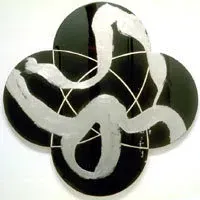
Artist Max Gimblett is one of New Zealand's most internationally prominent and successful artists who has succeeded in raising the bar once more. He is currently in New Zealand on the eve of an announcement he will be showing at the Guggenheim Museum in New York, the first time any New Zealand artist has exhibited there.
Gimblett will be in Wellington to open his first showing in the capital for some time with 'Everlastingness' an exhibition at the Page Blackie Gallery on 27 May 2008. Artist Max Gimblett is one of New Zealand's most internationally prominent and successful artists who has succeeded in raising the bar once more. He is currently in New Zealand on the eve of an announcement he will be showing at the Guggenheim Museum in New York, the first time any New Zealand artist has exhibited there.
Gimblett will be in Wellington to open his first showing in the capital for some time with 'Everlastingness' an exhibition at the Page Blackie Gallery on 27 May 2008.Page Blackie co-Directors Marcia Page and James Blackie say, "'Everlastingness' creates an opportunity for the people of Wellington to be able to view a remarkable body of new Max Gimblett paintings, in his home country, before showing at the Guggenheim in 2009. We are delighted as it will be a huge honour to have Max in Wellington to accompany and further illuminate this stunning body of new work."
This year marks an exciting point in the 72-year old artists' career. The group show at the Guggenheim 'Contemplating the East: Asian Ideas and American Art is the centerpiece for the Museum's 50th Anniversary of the Frank Lloyd building's construction. It is a masterpiece exhibition featuring works by canonical figures of the 20th century, which will travel to the West Coast of America, Asia and Europe through 2010.
Saatchi and Saatchi will sponsor a corporate reception in February for the exhibition, celebrating in particular the work of Max Gimblett.
Gimblett has been at the forefront of New Zealand painting for the past forty years and has lived and worked on the Bowery in New York City for over thirty years. Art writer Wystan Curnow writes, "Max is emotional - the work embodies a mighty spectrum of feeling and he doesn't shy from big themes. Violence, sacrifice and death; fear and awe; beauty, pleasure, peace and joy - all play a role. His works engage both ends of the sublime, the negative (terror, fear and awe) and the positive (beauty and uplift)."
Gimblett contributed to the development of New Zealand painting through the exhibition of early abstractions and his much-admired quatrefoil paintings, which emerged in the early 1980s and now feature in most public collections in New Zealand. The show at the Page Blackie Gallery in Wellington will feature a new body of work made specifically for the show and is the first time the artist has shown at the gallery.
While in New Zealand Gimblett will be announcing The Max Gimblett and Barbara Kirshenblatt-Gimblett Gift 2008 to the Auckland Art Gallery Foundation on 21 May in Auckland. He is gifting a significant collection of fifty-one of his own works of art to the Auckland Art Gallery Foundation in support of the Gallery's current development project. The works will be exhibited upon the reopening of the main gallery building after completion of development in 2010. Gimblett will be attending the opening of the new Gow Langsford Gallery space on Lorne Street in Auckland on Friday 23 May in support of his dealer gallery in his hometown. Gimblett is also visiting the Suter Gallery in Nelson where he will be exhibiting in "Maui Dynasty" opening December 2008, one month before the Guggenheim opening in New York.
The Page Blackie Gallery in Wellington will be the first gallery in New Zealand to exhibit some of Gimblett's prints being released in New Zealand this year as well as a selection of specially created paintings.
Page Blackie Gallery (42 Victoria St) is the next step of the evolution of Tinakori Gallery originally opened in 1987 on Wellington's Tinakori Road. Concentrating at first on historical works and primarily dealing in secondary market sales, the Gallery quickly established itself as an authority in this field. However, the focus became increasingly contemporary, evolving to meet the changing needs of the artists and clientele. In 2007 Page Blackie Gallery was born when James Blackie became a partner with founding director Marcia Page, launching a new phase in the refurbished Victoria St premises. With over 330m2 the Gallery is the largest commercial art venue in Wellington. Page Blackie Gallery now reflects the geographical and ideological shift that has taken place since the Gallery's origins in Tinakori Road.
Page Blackie Gallery represents twenty-three of the country's finest contemporary practitioners and is a leading presence in the New Zealand art scene, as demonstrated by regular attendance at national and international art fairs. The Gallery also procures and manages commissions on behalf of the artists.
Max Gimblett has been at the forefront of New Zealand painting for over two decades. With philosophies and practices that encompass influences as varied as Abstract Expressionism, Modernism, Eastern and Western spiritual beliefs, Jungian psychology and ancient cultures - Gimblett's work holds a special place in recent New Zealand art history.
Born in New Zealand, Gimblett has been primarily based in New York since 1972, and continues to exhibit regularly in both places. This 'straddling' of countries, and the travel that goes along with it, is of great significance to Gimblett's ideology. "The influence of Zen seems natural to Gimblett, and carries with it an echo of Asia's proximity to New Zealand, but also can be traced partly to American artists with West Coast connections such as Clyfford Still and Mark Tobey. Gimblett has made a harmonious post-war synthesis of American and Japan." (Thomas McEvilley, 'The Transition from Three to Four', Max Gimblett: The Brush of All Things, Auckland Art Gallery, 2004, p.9)
This mix of cultures and aesthetics is evident in Gimblett's work, which consists largely of object based paintings. His range of shaped canvases covey various associations and meanings connected to the oval, rectangle, tondo, keystone, and quatrefoil (of which Gimblett is most recognised). It is Gimblett's intention in these works to explore the multiplicity of meaning attached to such revered objects. The quatrefoil shape dates back to pre-Christian times and is found in both Western and Eastern religions symbolising such objects as a rose, window, cross and lotus. "By choosing to work on quatrefoils, Gimblett moves away from pure or non-referential geometry towards a geometry that is loaded with symbolic associations. At the same time, in the realm of physics, the quatrefoil can suggest the existence of a fourth or unattainable dimension. It also indicates a stable form undergoing transformation, both expansion and contraction, like a flower." John Yau, 'Going Forth', Max Gimblett, Craig Potton, 2002, p. 107)
Gimblett steps further into exploring spiritual beliefs through his use of precious metals. Materials such as gold and silver are religiously associated with honour, wisdom, enlightenment and spiritual energies. "Gimblett is not the first post-war artist to use gold or to be interested in shaped canvases, icons and iconicity. Within this context one must consider Frank Stella, Yves Klein, and Andy Warhol. Gimblett's interest, however, is in the spiritual rather than the earthly. He rejects Stella's coldly cerebral literalism, Klein's arch ironies, and Warhol's sly incorporation of Hollywood stars. In contrast to Klein, Gimblett uses gold in a way that is neither tawdry nor purely about visual pleasure. Rather, gold and silver are transmitters of light." (John Yau, ibid, p. 107-108)
The use of such materials brings a seductive quality to these paintings. Surfaces combine gold, silver, copper, bronze, epoxy, resin, plaster, paint an pigments. "Through a complex process that involves diluting epoxy resin in the paint, the artist has achieved a quality of surface that may be unique in modern painting. It looks like porcelain, glowing from within while still shining on the surface. This technique seems somehow to emphasize both surface and depth; the drawn elements acquire a new sharpness and stand out more assertively against the ground." (Thomas McEvilley, 'The Shape of Energy', Art in America, October 2005, p. 167) These extremely delicate surfaces are carefully prepared and cured, but are only one part of Gimblett's diverse practice. These serene surfaces are often disturbed by bold gestural brush marks in acrylic polymers and paints.
Gimblett has an extensive collection of brushes, mops and rollers with which he makes his marks. "I work fast. De Kooning said he painted fast to get to the other side of the street. I work in bursts of one point, very sharp concentration and then rest and then have another burst or set of gestures." (Max Gimblett, artist statement, 2002) These gestural paintings with their drips, splatters and swipes of paint strongly ground Gimblett in the tradition of American Abstract Expressionism; yet at the same time maintain a link to Eastern calligraphic practices. There is a performance aspect to the creation of work. "I am committed to the Buddhist idea of the 'not self' and in that sense, I try to suspend judgement, and 'float'. As an intuitive thinker, my imagery comes to me as I command, as a whole unit - the mind is cleared, an image arrives and I execute this quickly." (Max Gimblett, Eyeline, Summer 1997/98)
Alongside his paintings Gimblett produces an ongoing series of works on paper. In 2002 a survey of these works were exhibited at the Queensland Art Gallery in Australia. "Gimblett views his drawings as a major aspect of his oeuvre, and few artists of his generation have produced works on paper so regularly with so much commitment. They have spiritual and metaphysical connotations, combining both Eastern and Western impulses, and represent either a slow, layered approach to building up an image - which is often a geometric symbol - or they are what Gimblett terms 'quick, with no mind'" (Anne Kirker, Max Gimblett: The Language of Drawing, Queensland Art Gallery, 2002)
Limited edition books, often produced in collaboration with writers, are also a passion for Gimblett. In 2006 he released Searchings (Holloway Press, The University of Auckland), highlighting drawings and writings from the archives of Gimblett's journals, with each volume bound with two original ink drawings. Other publications include Mondrians Flowers (published by Granary Books, New York, 2002), and The Dogs of Auckland in 2000 (published Holloway Press, Auckland University). These collaborations are important to Gimblett for both the new medium presented, as well as the ongoing cross discipline dialogue. Other artists' books include projects with John Yau, Lewis Hyde and Chris Martin.
New Zealand jeweller Warwick Freeman is also a long time collaborator, working with Gimblett on such significant pieces such as Spirit Box, 1998. Gimblett worked with renowned furniture makers Jim Cooper and Humphrey Ikin to create this cabinet of drawers. Minimal and sculptural when closed, when opened they revealed a series of skulls in a range of materials - paua shell, felt, cow bone, glass, wood, shell and mother of pearl. "This is an exhibition in a box, a show in the shape of a display case. Because the box itself is so unadorned - an embodiment you could say of self containment - the shock of entry, of pulling open the first drawer, is all the greater. There in the tray, staring you in the face, in silhouette, is a grinning death's head, exquisitely finished in polished paua shell. Close it up and open the next drawer and there it is again - no getting away from it... it's a treasure... its success arises from Gimblett's continuing renegotiations of the margin between sculpture and painting. (Wystan Curnow, Art Asia Pacific, No. 23, 1999)
In 2002 a major monograph on Gimblett's work was published providing insight into various aspects of Gimblett's practice. With over 100 full colour reproductions this book maps the development of his exceptional career, from the rarely seen geometric paintings of the 1970's, through a myriad of shapes and techniques, to his current works that are just as stylistically diverse.
In 2004 Gimblett's standing as a senior New Zealand artist was affirmed by the survey exhibition, The Brush of All Things, curated by Wystan Curnow. The exhibition toured two of the country's major public galleries - the Auckland Art Gallery and the City Gallery Wellington, and included over forty major works from public and private collections. In 2005 Gimblett was appointed to the honorary position of Visiting Professor at the National Institute of Creative Arts and Industries, Auckland University.
Gimblett continues to exhibit widely in the United States, Europe, Asia, Australia and New Zealand. His work is represented in major public and private collections around the world, including the Art Gallery of NSW, Queensland Art Gallery, Auckland Art Gallery, San Francisco Art Institute and the San Francisco Museum of Modern Art.