Martin Thompson's mesmeric matrices at City Gallery
Written by
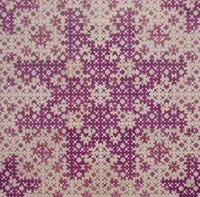
Ruler of the Universe - Courtesy of The Dominion Post 2006-11-03
Wellington artist Martin Thompson's mesmeric matrices
by Mark Amery
As much as I embrace a certain amount of chance and disorder in my life, the older I get the more I notice how life can be crippled by unreliability. Ruler of the Universe - Courtesy of The Dominion Post 2006-11-03
Wellington artist Martin Thompson's mesmeric matrices
by Mark Amery
As much as I embrace a certain amount of chance and disorder in my life, the older I get the more I notice how life can be crippled by unreliability.My body and computer equally seem increasingly susceptible to virusescramps and various functionality issues.
I almost shudder to write it, but I find myself looking for more certainty, order and routine to help me deal with what gets thrown at me.
For a very long time beauty was associated with numbers. And in numbers we find order. Pythagoras believed that the origin of all things lay in the number, and that in this way it could be ascertained that the universe is limited. All things existed because they could be ordered, shown to be in balance with each other as part of a mathematical equation or law.
Beauty in art therefore lay in paying attention to principles of balance and proportion. Mathematical principles were integral to the practise of artists from the ancients on. Through art order could be restored and the world put to right.
To immerse yourself in the mesmeric matrices which are the drawings of Wellington artist Martin Thompson at the Michael Hirschfeld Gallery is to see the wild intricate beauty of the world made comprehensible. Complex mathematical equations are realised as shimmering tiles of geometric beauty.
Thompson has an extraordinary ability. He can transpose equations in his head directly into images on graph paper, filling in tiny one-millimetre squares with a fine felt tip pen. Mistakes are corrected with a scalpel and Sellotape.
Thompson carries his work in progress with him, working at it everywhere at every given opportunity. His art is an integral part of his life. It is as if he is has found a grid within which as an individual he can not only make sense of the randomness in life that he encounters, but can express and encapsulate its awesome beauty.
At my school there were those ubiquitous perforated white ceiling tiles at school. I recall the endless times, bored in class I tried to make sense of their complex repeated pattern of dots. I also remember in times of trouble adding up the digits in our home phone number in as many different combinations as possible in my head. A way of avoiding thinking about what I was experiencing, it was as if I might by this process eventually find that a series of numbers don't always add up to the same total. That the situation I was in might somehow be avoided.
No doubt Thompson also gains comfort from the certainty of numbers. The universe is mapped and brought under control. Yet whilst those school ceiling tiles ultimately frustrated because they closed the possibilities of the world down to a fixed irregular pattern, Thompson's works open the world up.
What seem at first random active spidery patterns reveal themselves as repeated mirrored motif. But just as you manage to stretch your eye's computability to realise this, they fall back into place as part of one of many layers in the pattern. The work is constantly active. It leaves you always reaching for possibilities. It's already as if your mind is repeating one tile over and over, to map and express forms and forces beyond your field of comprehension.
In the text that accompanies this exhibition it's revealed that Thompson was inspired by the work of mathematician Benoit B.Mandelbrot. Mandelbrot invented the concept of the fractal - geometrical figures that can describe natural phenomena that seem chaotic in nature. Analysing forms such as waves, clouds or snowflakes he showed how they could be defined by mathematical equations.
This is interesting in context because here for the first time Thompson has also worked on a computer with a graphic designer to scan and then manipulate his handmade creations. This makes new colours available to him, emphasising his strength as a colourist (always previously shown in the gradation in tone of his work).
It also allows him to repeat his drawings (always completed in pairs, with a positive and a negative version) as units in a larger whole. This reveals new geometric constructions and rhythms that one tile only presents a piece of. This has been, I am told Thompson's dream all along. The exhibition even features a section of specially printed wallpaper - if only they could have papered a whole room.
There's an interesting tension between the interests of the artist and viewer here. While Thompson strives for perfection, and can realise it with the aid of the computer, one of the things that has always made his work bristle has been the fact that the unsteady marks of the individual hand are evident when you look closely at his crystallisations of the world.
As with a Mondrian, when seen for real and not in reproduction you notice the mistakes, the occasional grubby marks (that give away their street origin) and that some works are stronger than others due to the variance in the steadiness of the mark-making.
This tension between the individual and universal is part of the work's strength. It's emphasised in this exhibition by presenting some of these drawings unframed on glass window-panes. This allows you to not only see the intricate network of taped amendments to the back (which add a subtle fission in the imperfection they provide to the pattern on the front), but also an irregular geometric pattern to the side where Thompson has cut out squares to mend mistakes.
On the one hand the digital prints develop Thompson's practise beautifully, allowing us to swim in complexities and subtleties not previously apparent. On the other they lack the tension that a bruising with the world gives the original drawings.
Image: Martin Thompson
Martin Thompson, Michael Hirschfeld Gallery, until 12 , November - Image courtesy of Anna Bibby Galllery