Maori illustrated history wins science book prize
Written by
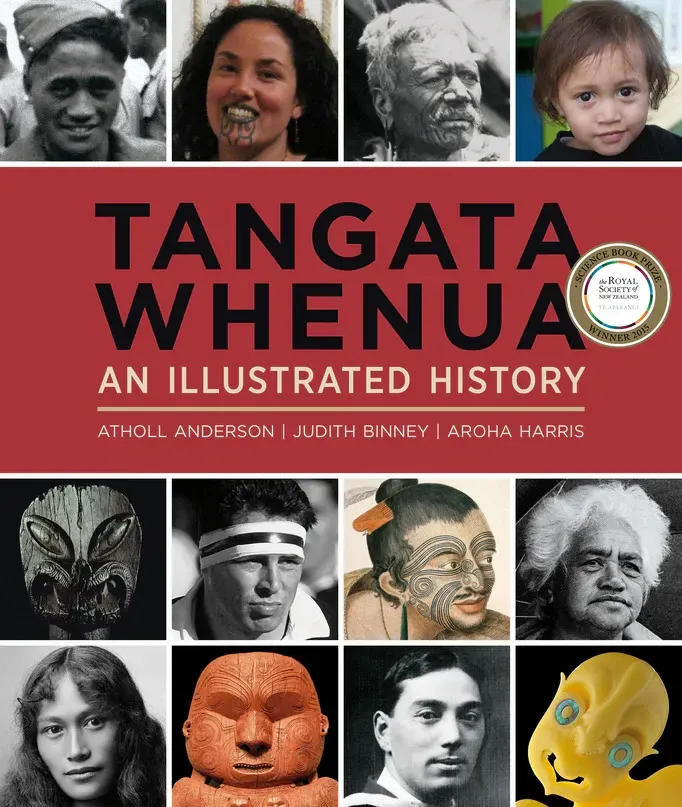
Tangata Whenua: An Illustrated History has won the Royal Society of New Zealand 2015 Science Book Prize.
Authors Atholl Anderson, the late Judith Binney and Aroha Harris, with publisher Bridget Williams, worked for several years with a team of writers, researchers, designers and editors, to produce this new history of the Maori people.
Museums and archives around New Zealand provided thousands of images from which over 800 were selected. The publication was funded through the BWB Publishing Trust, with support from trusts, institutions and individuals that made this remarkable book possible.
Described by the judges as ‘a dazzling work of scholarship’, this magnificent narrative draws on a broad sweep of knowledge. Emeritus Professor Atholl Anderson (Ngai Tahu) writes a compelling story of Maori origins, drawing on disciplines that range through archaeology, genetics, linguistics, and climate science. The text relies too on information offered by the traditions handed down as oral history through generations. These early chapters offer many routes to understanding a complex and fascinating history.
The two centuries from 1820 to 2014 present a dynamic narrative, based on archival research, oral history and the many published stories of these two hundred years. In the history of the twentieth century by Aroha Harris (Te Rarawa, Ngapuhi), the analyses provided social sciences also bring new perspectives to bear.
As Sir Tipene O’Regan has written: ‘This is a rich and authoritative account of our journey from the deep past to the present day… one that will make a significant contribution to a fuller understanding between the peoples of New Zealand of their shared history – and the possibilities of a brighter future’.
Speaking for the Royal Society of New Zealand, Dr Andrew Cleland noted that Tangata Whenua incorporates research from a wide range of disciplines from the sciences, including social science, and the humanities, which mirrors the breadth of scholarship supported by the Society.
Tangata Whenua: An Illustrated History is written by Atholl Anderson, the late Dame Judith Binney and Aroha Harris and published by Bridget Williams Books.
Source: Creative New Zealand
Book award is an acknowledgement of Maori history
University of Auckland
A book co-authored by the University of Auckland’s Dr Aroha Harris has won the Royal Society of New Zealand 2015 Science Book Prize.
Tangata Whenua: an Illustrated History is written by Dr Harris, Dr Atholl Anderson and the late Dame Judith Binney, and is published by Bridget Williams Books.
The book charts the sweep of Maori history from ancient origins through to the twenty-first century.
Dr Harris (Ngapuhi, Te Rarawa) is a senior lecturer in History in the School of Humanities in the Faculty of Arts and a member of the Waitangi Tribunal.
Atholl Anderson, who is of Ngai Tahu descent, is Professor Emeritus at the Australian National University, and Dame Judith Binney was Professor Emeritus in History at the University of Auckland. She died in 2011.
Dr Harris says she was “stunned” to hear Tangata Whenua announced as the winning book from the five shortlisted by UK science writer Philip Ball at an event at the Auckland Writers Festival. She says the book’s success is great for the humanities.
“We do regard it as an acknowledgement of Maori history and its capacity to incorporate a range of sciences and methods - archaeology and genetics, whakapapa and sociology, environmental science and demography.
“It affirms the collaborations that are possible between the sciences and the arts. I think the prize is great for the humanities; I hope others see it that way too.”
The three co-authors decided to write Tangata Whenua about seven years ago, however Dame Judith Binney passed away in February 2011. Dr Harris says her contributions are an important influence in the book.
“Judith's passing was an enormous blow, but also a spur to do a good job, one of which she would be proud,” Dr Harris says.
She now hopes that people will take many strong messages from the book, particularly the need to respect the past.
“The past matters. The past informs who we are, and helps us understand how we came to be who we are. If we don't pay attention to our past we deprive ourselves of the lessons it has to teach us.”
The judges, Professor Jean Fleming, Professor Ken Strongman and Dr Rebecca Priestley, said the book "brings together physical sciences, social sciences and the humanities in a dazzling work of scholarship".
"It draws on these disciplines to tell the stories of the Maori people, their origins, their journeys to find this country and their stories in Aotearoa New Zealand.
"This beautifully published book has a broad public appeal and will be read widely by New Zealanders keen to discover who we are and where we come from."
In addition to being a history, it is based on research on genetics and climate science as well as archaeology, anthropology, ethnography (the study of culture) and paleoecology (study of past ecosystems or environments, reconstructed from fossils).
Professor Strongman says the short-listed books in this year’s science prize were all extremely readable and very well done, but Tangata Whenua stood out.
“It is a book that is likely in the future to be found in any sentient household in NZ. It tells the story of the Maori people so fully that it is bound to be the work most referred to in this context.
“The book represents a seminal melding of the humanities and social sciences and in so doing forms a model for future works.”
Dr Harris is currently working on the Waitangi Tribunal inquiry into Te Rohe Potae (King Country)
She is the author of Hikoi: Forty Years of Maori Protest, a book on political protest in the late twentieth century.