Making space for Lepage
Written by
During the NZ Festival, The Big Idea’s intrepid critics will be keeping you abreast of the shows with reviews and commentary. Here's Mark Amery on his first day with Robert Lepage’s Needles and Opium.
“Normal service has been interrupted. Do not return to your seats. When the city becomes a theatre - you need to make room."
* * *
As the amphitheatre that is Wellington’s central city fills, you have to make room. A little like how, as others join you on the crowded bleachers, you shuffle along making more space out of less.
As the fog clears on opening Festival day I cycle over to Asteron House near the Wellington Railway Station. The public are squeezing together to make room on the pavement outside the flash office tower to hear a speech on the revolutionary troubles of this generation’s youth, from inside the corporate glass frontage. Its part of Circadian, a welcome and well-curated performance art series inserted into this location, as part of the Fringe. Then it’s back to Civic Square where scaffolding design has created space where there was none for a community legion of drummers, band Kora and ensemble Strike. In the evening there will be a struggle to fit half the public audience in for this opening celebration, The Big Bang.
You have to make room in your life, I’m reminding myself. Festivals wreak havoc on work and home life routines. Suitably loud and bombastic rehearsals for The Big Bang play havoc with having the headspace to write in the neighbouring library, and the wi-fi falls in and out on a deadline. The newly opened survey of recent work by Turner Prize winning British artist Simon Starling is a treat, but its highly-tuned conceptual complexities, dry but witty, deserve time and repeat viewings, echoing the way this artist opens out and turns things. Visiting friends mean last minute arrangements for meeting are made. Hot tickets to Robert Lepage and his company Ex Machina’s Needles and Opium materialise halfway through a meeting, and babysitters must be found. Then there’s a friend’s gallery opening amongst others with the kids in tow (Gary Freemantle’s strong South Island mud mirror landscape paintings at Photospace, with photographers Mary McPherson and Hans Weston) in bustling, liquored Courtenay Place. Normal service has been interrupted. Do not return to your seats. When the city becomes a theatre - you need to make room.
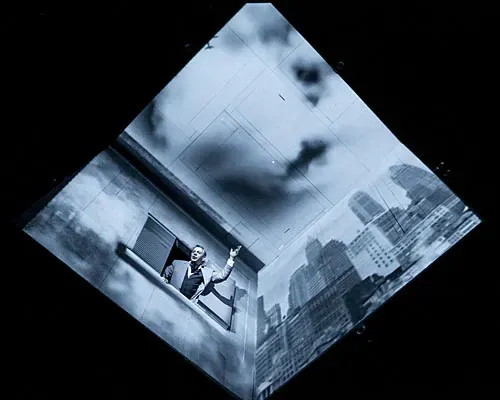
Theatres are boxes that provide the space for you. For Needles and Opium Ex Machina create a box within a box to allow for transformation, and thoughts to be layered, float and dance. Their extraordinary suspended set comprises three sides of a cube, resting on what is presumably some ingenious hydraulics system. It allows the action and scenes to be slowly tumbled like a die, walls becoming floors, and corners slippery emotional channels or expansions into galactic space. In an astonishing piece of acrobatic choreography between bodies, cinema and set (all hail the accompanying stagehands as puppet master-like performers!), scenes materialise and dematerilise with the use of trapdoors and moving image. We’re in the hands of a master-magician in the seamless bringing together of all artistic media into one 3D cuboid framework.
Like a box of mirrors, in its thematic flips and folds, interest in how narratives are constructed and nostalgic immersion in modernism and its technological and cultural history it’s a perfect festival pairing with the Simon Starling show, In Spectrum – catch them both.
Revisiting a work he first made 20 years ago with new technological capability Le Page revisits as subject the transatlantic cultural crosscurrents between in 1940s and 50s Paris and New York, through Jean Cocteau and Miles Davis.
As it stands the Cocteau strand is a frail framing device, difficult to follow and needing to be strengthened). The narrative focuses principally on paralleling Miles Davis’s journey through finding musical freedom and love with Juliette Greco in Paris and drug addiction in New York, with that of Robert, a French Canadian actor in the late 1980s trying to emotionally extricate himself from a failed relationship in New York. Robert is our narrator. He’s having difficulty sleeping, trapped in the boxes of cheap hotel and recording studio in Paris, doing voiceover for a film on Greco, at the behest of an American producer. Frames are created within frames, resonances within resonances, all slowly emotionally squeezing our protagonist.
The production’s title is a little misguided, but it does fit the fact that Needles and Opium is a celebration of the transformative power of music and film, accompanying a central question “how does one keep creating with such pain”.
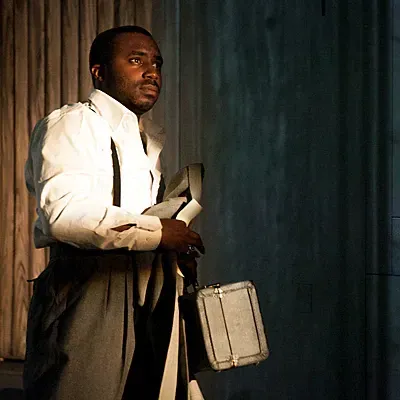
As Miles Davis, Wellesley Robertson III trumpet twirls in body and spirit elegantly. The production however is held gently yet forcefully by Labreche as Cocteau and Robert. Held is the right word. He holds all emotionally together, and there’s also the sense of him holding a reservoir of beauty and pain that is slowly being released. Take away all the technical wizardry, and I sense I’d still by Labreche be spellbound.
Needles and Opium’s story is small, and in a way easy in its longing and wistfulness for the past. Yet, like a flower, it beautifully opens itself out to the world, an exquisite object that creates for us the audience emotional space.
Needles and Opium, Ex Machina (Canada), by Robert Lepage
Opera House, Wellington, until February 24
NZ Festival 2014