Magic Kingdoms: The Beautiful and the Damned
Written by
Courtesy of The Dominion Post
Mark Amery explores how Joanna Langford creates landscapes for the mind.
I suspect we all have places in the landscape that hold magic. Sites that lodge themselves in our imagination as stage sets for dreams, where we slip easily from reality into fantasy. Landscapes where scale shifts and layers of memory create shifting perspectives over their terrain. Courtesy of The Dominion Post
Mark Amery explores how Joanna Langford creates landscapes for the mind.
I suspect we all have places in the landscape that hold magic. Sites that lodge themselves in our imagination as stage sets for dreams, where we slip easily from reality into fantasy. Landscapes where scale shifts and layers of memory create shifting perspectives over their terrain.There are many minds doubtless to be found at any given time careening across the North Island's Central Plateau, twisting around those power pylons as if the electricity charges up the ground and air up there for theatre.
That stage set is on the way to a more private site for me. At the top of the Bay of Plenty's Okere Falls - a terrific bush-encased set of rapids leading from Lakes Rotoiti into the Kaituna River - is a small scenic lookout. It looks down on tumultuous whitewater, once the site of the first hydro-electric power station to supply a New Zealand town with electricity (Rotorua). At night, looking down from some height on the roar of water, behind you the darkness is studded with the pinprick light of glow-worms, generating their own small townscape of light against the ferny bank.
If you've visited Joanna Langford's installation The Beautiful and the Damned at Michael Hirschfeld Gallery, or any other of her works, you will have already got my drift. Langford's miniature worlds draw you back to that childhood play where an environment of skew-whiffed scale was built from blocks.
With their fragile spider-web like architecture spun in the air (here at the Hirschfeld with bamboo skewers, tiny LED lights and a glue gun) they grow up from the floor to meet you. Tottering like hybrids of giant pylons, street lamps and watchtowers, and creating pools of lights for your own imagined Liliputian dramas, they transform your perspective.
There's something of the joy and wonder of a Len Lye sculpture in the way Langford recklessly pushes her own ecologies to a point of fantastical frailty beyond reason. I'm even reminded of the tall frail figures of the sculptor Giacometti. The air becomes full of constructions made out of light recycled materials, with ladders and pathways suggesting a framework for a townscape of the mind. Trailing tiny cords through the Hirschfeld, you follow the lines as if it were lighting your way to a private grotto. There's a figurative and kinetic potential to these constructions (reminiscent of the work of Richard Reddaway) as if they are shuffling forward, transforming in a state of stop-motion animation.
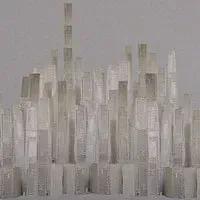
In the Hirschfeld show bamboo skewers hold up towers comprised of recycled computer keyboards placed end on end, with the keys removed and paper boxes behind them holding LED lights. With the backlights turning on and off, from a distance it resembles a twinkling model city skyline made from cardboard in a shoebox. Each keyhole has become a window for a possible fairy tale world to appear. Get close and you get engrossed with their constructions and how at their feet tiny streetlamps provide lit spaces for imagined scenes amongst the towerblocks.
Langford has a strong grasp on the surreal potential of landscapes. A 2004 Masters graduate from Canterbury now Wellington-based another great recent work was an installation earlier this year at Enjoy Gallery, Brave Days, where a desert landscape you looked down on was created out of crinkled brown paper bags, but with flimsy super-sized pylons and wires towering above you.
Plastic bags have been another favourite Langford item, materials like these providing a skeleton or packaging for us to fill with, or skewer, food of the imagination. There's the clear influence of the '60s arte povera artists (Italian for "poor art") and Langford shares her interest in recycled materials with many fellow contemporaries. Yet what marks out Langford is both the complexity of her play with actual space, and the openness of her matrices to be played within by viewers.
Meanwhile, in a neat twist the grubby keys from those keyboards in the Hirschfeld show have been used to create another magic kingdom in the window space at Govett Brewster Gallery in New Plymouth, also this month. Entitled Twilight Falls its cascades of white and shadows promise again to take me back to Okere Falls.
Image: Joanna Langford, The Beautiful and the Damned installation (detail), 2008.
The Beautiful and the Damned, Joanna Langford, Michael Hirschfeld Gallery, until 31 August
15/08/08