Love will tear us apart
Written by
By Mark Amery
Love is complicated; art is complex. This could be the subtitle for this fascinating exhibition. Complex, because with an array of art and artefacts contemporary and historical, from New Zealand and abroad, Tender is the Night teases out art’s ability to get under the skin of the platitudes we hear in popular culture about love.
It explores love’s many meanings and inherent conflicts and contradictions.
Love is everything, yet it is also nothing. Love is in the air, yet it lies deep inside us. It is truly mysterious. How can an artist capture this visually? How to depict it?
This question feels key to Tender is the Night. Erica Van Zon’s work ‘Don’t make your heart a lion’s den’ meanwhile feels at the show’s centre. “Once I had a love, and it was a gas,” sang Debbie Harry. This work is made of gas, pink neon spelling out the title. The statement is active, but pushes and pulls in different ways. Its oddness also comes from being translated from Dutch. The tugs of love are hard to put into words, but its mood is expressed by the glow of a set of words.
Love is also often depicted through looks and gestures of longing. There are plenty of those here. The exhibition is refreshing for it’s mingling of the contemporary and historical. Large gold-framed English Victorian paintings, featuring overwrought classical scenes of yearning have renewed vitality in this context. An exquisite small rugged Rodin sculpture is amusing as well as marvellous. A naked man prostrates himself before a woman who seems more interested in massaging her foot.
The exhibition’s title is that of an F. Scott Fitzgerald novel and before it Keats’ poem ‘Ode to a Nightingale’. The exhibition relishes the way, like this, art renews and respects, and the powerful unifying glow an enigmatic phrase like ‘Tender is the Night’ can cast over a diversity of situations. Be it Van Zon’s or ‘Love Will Tear Us Apart’, the exhibition explores the way we encapsulate the enigmatic in a phrase, a look or a mood to anchor deep wells of emotion.
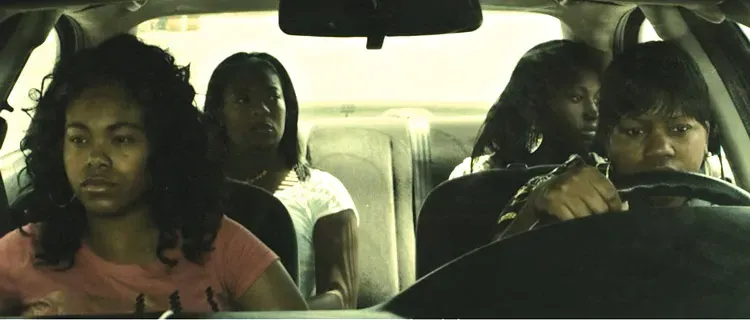
If there is the traditional look of love, there is also the nonchalant contemporary glance. I like particularly how video works here zoom in on love, but with the lens of film, television and advertising to work with and against. They try different modes. Australia’s David Rosetsky achieves a mannered, lanquid glow that plays off the aesthetics of a Jeans commercial as much as it does art history. In his take on the confessional interior monologue nothing can be trusted and the vacuity yet enormity of being in love as a teenager is brought beautifully to life.
Iain Forsyth and Jane Pollard’s alternative documentary making meanwhile shows the inherent sweetness and nobility in young people, their eyes shining as they relate the relationship between experiences of music and love.
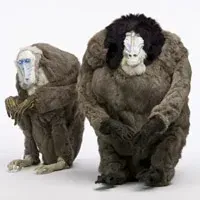
Love here is also that complicated beast post courtship and consummation. I love the suites of images in the West Gallery that focus on family and matters of life, death and marriage. A line up of portraits of couples, from Francis Upritchard’s stuffed baboons to Stanley Spencer’s prancing couple, are comical yet tender and lead you to Harry Lamb’s Death of a Peasant and Phil Dadson’s Breath. These are two of many treasures here from the national collection.
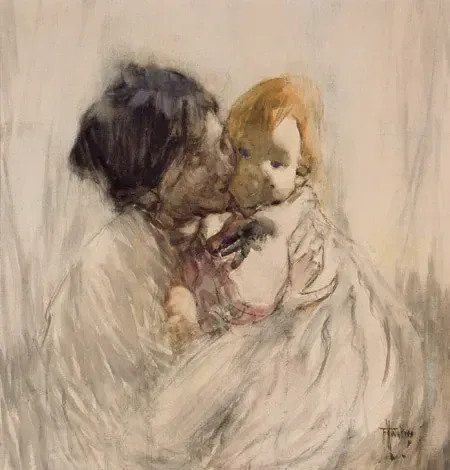
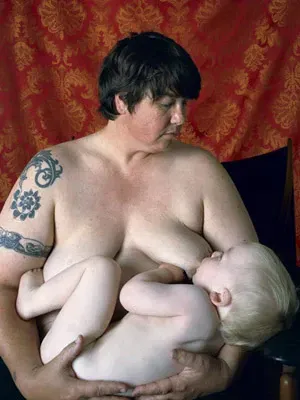
Around the corner H Linley Richardson’s portrait of his own family, in sickly tones, ‘In Fancy Dress’ is fascinatingly strained and puffed up. There is also a wonderful set of portraits of mothers and babies, breastfeeding, including Rita Angus, Frances Hodgkins and a tender little hand painted plaster Madonna and Child by Eric Gill. They lead to American photographer Catherine Opie’s portrayal of the ordinariness of lesbian families, where the boundary between the documentary and the gaze of the portrait is awry.
That an exhibition should deal with such a universally appealing theme with such a diverse range of art you’d think would be remarkably common. Yet Tender is the Night feels remarkably fresh. It stresses how much contemporary art here now seems nervous of being expressive of human emotion and the ordinary. It’s as if someone had opened up the windows.
Borrowing extensively from Te Papa, Christchurch Art Gallery, artists and private collections, here and abroad the show must have also been a labour of love for curator Heather Galbraith. The irony is having recently left Te Papa and before that City Gallery to take up a post heading Massey’s School of Art, Galbraith has left behind the sort of exhibition both institutions could do with more of.
As much as anything it’s the exhibition’s individual personality that makes it rewarding. It doesn’t pretend to be comprehensive or equitable across the visual arts, or New Zealand. There’s no need to ask ‘why isn’t such an such represented?’
Instead it gives space to powerful sets of work by a handful of New Zealand artists. Michael Harrison’s work is full of soft moonlit shadows, expressing thoughts of touch and longing. Jeffrey Harris’s brilliant fractured and frayed drawings of his family under stress are of love lost and broken. In the next gallery Harris’s exquisite ‘Two Lovers’ shows a couple entwined in intercourse, like the roots of a tree. It talks beautifully to a set of Shunga, Japanese erotic prints, and to a few wonderful new works by Kushana Bush, with their decorative grace and bawdy slapstick humour.
In this, the East Gallery, artists’ make complex the sexual subject. Liz Maw’s long voluptuous portrait of a naked synthetic Nicky Watson casts her as fairy queen Titania, next to Robert Plant as Oberon. Watson is distinguished by a royal red backdrop and the subtle placement of blue geometric shadow shapes within her form. With ethereality and abstraction it cleverly absorbs and counteracts the cut and weight of human longing that her Venus figure carries.
- Tender is the Night, City Gallery Wellington, until 17 July