Kleinkunst or Neo-Burlesque?
Written by
By James Hadley in London
London's burlesque performers are staging a 'pastie protest' in response to the London borough of Camden allegedly attempting to ban burlesque performance in their region, or at least force venues hosting burlesque shows to get the same adult entertainment licence required for strip clubs.
For those wondering, that's not 'pastie' as in Cornish pastie, but pastie as in adhesive strip used to cover a burlesque performer's nipples, with or without tassles or similar attached. So the protest will be a bit of a test case: will those burlesque performers marching in protest with only pasties on their upper half be arrested for indecent exposure?
That this issue has arisen is indicative of the continuing popularity surge that burlesque is experiencing in London - cabaret and burlesque even has its own section in 'Time Out's what's on listings, bible of all things worth being aware of in London entertainment. It's a treasure trove if you're looking for an alternative performance experience - but you wouldn't expect to find a strip club listed in this section; there's a clear distinction. I wonder if historic central London venue The Hippodrome will be prevailed upon to get a strip club licence considering it's hosting the city's highest profile burlesque act 'La Clique'?
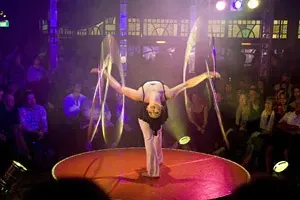
If anyone were looking for proof that burlesque is being taken seriously as an artform within London's performing arts sector, they need look no further than 'La Clique', which has had rave reviews and won the 2009 Olivier Award for Best Entertainment. I was lucky enough to catch 'La Clique' when they performed at the Auckland Festival of the Arts, within the Spiegeltent for which the show was created. The show's described as 'a melange of cabaret, new burlesque, circus sideshow and contemporary variety.'
This rather complicated genre description was a key concern at an evening of performances and talks organised by Central School of Speech and Drama that I attended recently under the banner of 'Kleinkunst'. The emcee of this evening, Dusty Limits gave an entertaining speech where he proposed that we replace all the various labels listed in the above definition of 'La Clique' with the German term 'kleinkunst' (which literally means 'little art').
Kleinkunst was apparently used in Germany to describe the various short form performance pieces you might experience there from the early twentieth century onwards. The term refers not only to the fact that these are short pieces, often performed by a solo performer in a small space at an intimate distance from its audience, but also that the whole approach is in opposition to that of 'high art' with its serious aims. The suggestion is that 'kleinkunst' is instead usually subversive, using a tongue-in-cheek lack of seriousness to question the status quo and the power of authority figures within society.
A drag/burlesque performance during the evening by Killpussy - aka Lise Munroe, who happens to be a New Zealander now based in London - was a perfect example of the subversive nature of much kleinkunst.
A collaborator portraying Princess Diana in latex mask and prom dress, waving to the crowd, was joined by Killpussy in a latex mask of the Queen, in similar formal dress. Once Diana had crashed her car, Killpussy as the Queen lipsynchs to Queen's song 'Another One Bites the Dust', kicking the dying Diana around the ground in time to the music. The challenge to authority of portraying the Queen this disrespectfully is as subversive as it is hilarious. When she proceeds to pleasure herself with a cardboard cut-out corgi dog, it's barely any more shocking. At the end of the song, the two performers threw off their masks and dresses to the anarchic strains of The Sex Pistols' 'God Save the Queen', revealing punk hair and makeup and Union Jack bikinis. During the course of hurling themselves about onstage and through the audience in time to the song, Killpussy discarded her bikini, in keeping with burlesque's tradition of titillation. But given the context, this was far from an act of revealing her body for a mostly male gaze - it was clearly a gesture of defiance and anarchy, and made by a feisty performer who was the most powerful figure in the room at the time.
This performance also highlights some of the distinctions of 'new/neo-burlesque' as opposed to traditional burlesque, and why the suggestion that strip club licences should be required comes as such an affront. While burlesque was originally shaped by patriarchal societies' appetite for risque entertainment which flirted with the boundaries of how much of the female body could legally be revealed, neo-burlesque is the product of a feminist/post-feminist world, where gender's performative nature is knowingly played around with. As an openly lesbian performer who often performs for queer audiences, Killpussy is knowingly subverting the old dynamics of the male gaze shaping the way a female body is revealed in old school burlesque when she takes her bikini off.
Many of the talks and performances within the 'Kleinkunst' evening were particularly expressive around issues of gender and queer theory. Emcee Dusty Limits followed up his speech with a cabaret performance of an early twentieth-century cabaret song, obviously usually sung by a female. With an impressively wide ranging voice, and in an outfit blending both female corset and male shirt, he assumed the traditional trappings of female cabaret performance such as straddling the back of a chair and flirting with audience members over the singing of sexual innuendoes traditionally associated with female sexual roles. Then academic Claire Nally spoke of the way much Kleinkunst performance inadvertently reinforces heterosexual gender archetypes at the same time as subverting them.
There was clear illustration of this in another of the evening's performances, by Lazlo Pearlman. Dressed as an ultra-macho mechanic, he skulled a pint of beer and used car magazines as erotic aids before unzipping his fly to pull out a car gear stick with a dangling pair of fluffy dice, with which he proceeded to drive himself wild. A traditional burlesque striptease followed, his overalls unzipping to reveal a broad and hairy chest and, ultimately, female genitalia. Being the final moment in what has to be one of the most excessively masculine performances I've ever seen, this was as full frontal a challenge to traditional concepts of gender as a binary as anything I've seen. Lazlo's work is often inspired by his FTM transgendered experience, and increasingly the kleinkunst format is proving a well-suited format for such expressions, expanding on the popularity of short-form drag performances within GLBT communities. Interestingly, the evening featured several performances which could be considered drag, but they were all by female rather than male performers, using drag to interrogate society's unrealistic projections of ideal feminine appearance.
Akin to this, and highlight of the evening from my perspective, was a talk by Bird la Bird about the Bird Club which she co-founded in 2006, and is now a monthly club night at (ironically) Bethnal Green Working Men's Club. Celebrating queer femme subcultures, the Club was set up in response to the dominance of concepts of butch dyke personae within London's lesbian communities. Bird talked about her desire to reclaim the term 'bird' as a label for females and to celebrate the full breadth of the spectrum of femininity through satire and performance. Rather than cabaret or burlesque, which are both features at the Bird Club, Bird specialises in satirical stand up comedy, infused with a winningly no-nonsense personality. She had me in stitches with her gags about the need for single people to counter the social prejudices against them with tools such as new 2 for 1 deals where a couple share one seat on the bus while a single person gets two seats for themself and their bag. Such thinking outside the square is both subversive and enlightening through the fresh perspectives it gives on the dynamics of sex and gender within our society, and this is probably the area about which much Kleinkunst has most to contribute to the wider performing arts and society in general.