John Kinder - Early New Zealand imagery at AAG
Written by
Courtesy of National Radio
Presenter (Wayne Mowat): The Reverend Dr John Kinder was one of this country's most influential ministers and teachers. He was also a committed amateur artist. He travelled the land making drawings, water colours and photographs as he went.
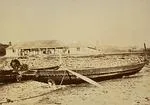
Image:Waka at Te Taongaroa, Mechanics Bay, circa 1865, albumen on paper.Courtesy of National Radio
Presenter (Wayne Mowat): The Reverend Dr John Kinder was one of this country's most influential ministers and teachers. He was also a committed amateur artist. He travelled the land making drawings, water colours and photographs as he went.
Image:Waka at Te Taongaroa, Mechanics Bay, circa 1865, albumen on paper.It's estimated he may have created as many as 1000 paintings and photographs and for the first time an exhibition to honour his substantial achievement will tour the country in the coming months. Ron Brownson is the Senior Curator at the Auckland Art Gallery. He's with me today to discuss the work of this significant New Zealand artist. Afternoon to you Ron.
Ron Brownson (Curator, Auckland Art Gallery): Hello Wayne.
Presenter: Thanks for coming by.
Brownson: Pleasure.
Presenter: Now these colonial works, both the paintings and the photographs of John Kinder, why have they not been exhibited at length before?
Brownson: Well they have been exhibited before actually. They were first exhibited in 1958 by Hamish Keith.
Presenter: Together?
Brownson: No, actually this is the first time that so many paintings and so many photographs have been brought together but I did a show 20 years ago just of the photographs. I mean Kinder's photographs are one of the great secrets of New Zealand's art history.
Presenter: Fantastic aren't they. I mean it's all right for me, I've seen some, but for those who are not familiar talk about this guy as an early artist. What was his background?
Brownson: Well we as New Zealanders really need to know about our history, you know, recent events in our nation should tell us that. We need to know what this country was like 150 years ago and when you're looking at Kinder you can actually get a sense of what history is. It's not just going to historic houses to understand history. It's seeing things in the way that he saw them. That's why he's so interesting I think. And when you look at his photographs and you look at his paintings in combination you realise he had this sort of parallel life. He worked as a painter but he also worked as a photographer. Now when I say work I mean this was his hobby. You know, to produce 1000 works as a hobby that's not just commitment, that's a wonderful obsession.
Presenter: Yeah how did he work that in as an Anglican Minister and a scholarly teacher and being an artist?
Brownson: Well he was also an itinerant Vicar to a number of churches giving sort of, if you can say this, freelance sermons and he was also an acting chaplain to the military. This man was busy all the time. How did he work it in? Well I think that many of the paintings were produced after studies that he made on the spot travelling all round New Zealand but they were produced in his study at home. It was something he would do in the evening. And then the photographs, I mean you may have read my text about the photographs, but the photographs are like 10,000 times more difficult to make than a digital image. You need another person to help you make them. These are contact prints that you see in this book that the Auckland Art Gallery has published. So the negatives, the negatives that he actually had to take into the landscape were large 10 by 12 inch glass plates that he then had to cope with this viscous medium wet collodion. It's a very early technique. It's a bit like vaseline. Then you had to do this in a tent, you know, at the bottom of a dark gully you're in a dark tent and it's hot, because you can only photograph in summer mostly, then you've got to expose it for some minutes, then you've got to develop it, then you've got to fix it, then you've got to let it dry, then you've got to let it varnish. So if Kinder made one photograph a day he was doing well.
Presenter: Wow and there's hundreds. What process - you know, you've talked about the process but can you explain a bit more about - I mean what was his approach to photography? Did he see his photos as works of art in their own right?
Brownson: Absolutely. He only - Kinder only exhibited twice during his life in the late 1860s and the early 1870s, so he's doing all this work but he doesn't care a josh about showing it. Now the thing is they're slow to make and he has to plan them. And his teacher, Erin Penley, that he had before he came to New Zealand, taught him this technique that you must look, look, look at landscape and see it for what's unique about it. And that's really one of the things that's significant about Kinder is that he sees things that we look, you know, when we see as works of art and we look back 150 years, we think yeah that's New Zealand. That's authentic, that's original to here, it's the only place in the world with this sort of cliff with pohutukawa all over it and these slimy rocks. I mean I'm really encouraged by contemporary artists' response to Kinder, Wayne. They like him. They like him not just only for his achievement but for what they see in his work.
Presenter: So when he came here he'd forgotten everything he'd learnt really, or put behind him the English countryside and just looked at what was sitting in front of him and didn't worry about anything else.
Brownson: Yeah well you must remember that when he came to New Zealand the first big impression that he got was how much light we have here. Do you know that we have the highest uv levels of any country in the world?
Presenter: I do know that.
Brownson: You know, Raoul Island, if you put a painting on Raoul Island, we're not going to do it, but if you put a painting on Raoul Island it'll fade four times faster than if you stick at Uluru, Ayers Rock. You know, we're blasted with light here and it was that beautiful Pacific light that Kinder really was charmed by. You know, he could see the dark shadows under pohutukawa trees, he could see ponga, he could see different ferns, and so he went out looking for what was specially local.
Presenter: The other thing that comes through in I think it's your text, Ron, is he was doing it for his own thing, you know, it was his amusement wasn't it originally, yet he didn't teach or preach about his art.
Brownson: No. Actually you could say he was the most private obsessive. He - there's no - you know, in his autobiography he mentioned - that he wrote for his son Harry, he only mentions once the fact that he was, you know, he was a little much liking to do sketching, that's what he said, but it was his private love.
Presenter: He took a lot of military photographs didn't he?
Brownson: Yeah and they're important. They are really important.
Presenter: Why?
Brownson: Because, you know, after Crimea the British Army realised that photography could be a means of reconnaissance and because Kinder was an acting chaplain with the military just living there in South Auckland, in Albert Park in Otahuhu, on the way to Waikato really, on the way to invade Waikato, and Kinder was with them, he was photographing as they were making this road to the Waikato, you know, this is the road of invasion. He's photographing all the stages of that construction of the military road. But how he made people know about this is he sent his photographs and a text that he'd written, a very substantial text, plus a map that he'd drawn, to the illustrated London News and they engraved his photographs, they engraved his map, they published his text. So in another sense the reconnaissance that the military was doing was parallel with the reconnaissance that Kinder was doing as he was accompanying them. The captains and the majors of the garrisons, especially the 65th Regiment, actually had their own cameras and used them.
Presenter: Was he one of the first into the pink and white terraces?
Brownson: No he was the second. Bruno Hamil went there in 1857 but, you know, it's a long time between looks, you know, 1857 to 64, 65. And he went there a number of times and I love those photographs of the thermal edges of Rotorua and Okaraka and Rotomahana because it's absolutely photography at the most difficult. Because when you've got your wet viscous gummy gluey messy negative and it's a big thing and it's fragile and you're walking over all this thermal landscape the chances are that you'll slip or something will happen. It's tough work to make. Then what happens is all the atmosphere is filled with, you know, it's hydrosulphate at Rotorua isn't it -
Presenter: Yeah, yeah.
Brownson: Yeah. Well you see the chemicals in the emulsion, the silver nitrate actually starts to develop because of the sulphite in the air so it becomes silver nitrate. So the actual negatives themselves had this incredible gritty look to them as if they are little incrustations.
Presenter: Yeah but you can almost feel that hot water can't you?
Brownson: Yes and up on the right hand side of that photograph you're looking at it, it looks all sort of misty and that's actually him painting on the negative to show the steam.
Presenter: So do you - I mean was he acutely aware that he was recording a young country that was changing?
Brownson: Completely. Absolutely. He knew that he was - I mean he was a leading member of a church that had missions to Maori, that had -
Presenter: He was keen on recording those wasn't he, the missions?
Brownson: Very early stuff, super rare. No one else was doing it in the ‘60s like he was because it's on the spot stuff, you know. There was people photographing Maori people in studios but on the spot, no there's not lots. Yeah he really felt pleased to be in New Zealand when he arrived in 1855. He'd left a bit of difficulty behind him in England.
Presenter: What sort of difficulty?
Brownson: Well he - his personality partly contributed to his difficulty. He was a very staunch and focused person but didn't always get on well with the people he worked with. In fact at the one of the schools he was at in England they took up a petition to have him removed and that fact actually followed at St John's College. People wanted him removed from there when he became the master there.
Presenter: Why, because he was just so tough or staunch?
Brownson: Well yeah. Well, he wouldn't suffer fools gladly and he had his own interests and his interests were the things that probably made him a bit lonely. Like if you're fluent in Greek, and his wife was fluent in Maori, there's not many people that you're going to have conversations with in Auckland in the 1860s. You know, it's like the lonely yawps of a scholar.
Presenter: So okay, background to his life, well educated obviously?
Brownson: Super well educated.
Presenter: What else about him - wealthy?
Brownson: Wealthy enough to afford a home in Remuera. You've always had to be wealthy to buy in Remuera.
Presenter: Even in 1860 something?
Brownson: That's right.
Presenter: Well he's done a lovely painting of a church standing out there in Remuera. I thought that was one of the standouts.
Brownson: Yeah and notice how symbolic it is, you know, with the volcanic mountain in the background. There's a lot of symbolism in Kinder. I mean, you know, he's glad that the church has arrived in this nation and he's often using images to be advertorial about it if you like. It's commitment. It's commitment to trying to see a place for, you know, a religion.
Presenter: He looked pretty fearsome, didn't he, with that big beard?
Brownson: You know there's a bit of a gossip about that beard?
Presenter: Well no I don't.
Brownson: He was reputed to have had the first beard of any Anglican Minister in the 19th Century. I don't quite believe it but he certainly never took it off. You know, in that Lindauer portrait that they've got, I've reproduced in the book -
Presenter: When he was at the College of St John?
Brownson: That's right, his pupils gave it to him as a gift but he never took it with him to his house.
Presenter: Quite a character in other words?
Brownson: Yes I think so. I think he's an artist that we can feel proud of and this is a project that's going to travel to Te Papa, to Dunedin Public Art Gallery and to Christchurch so New Zealanders are going to get a chance to see it. Just need to say one thing about this whole thing, Wayne -
Presenter: Yeah I've yet to ask you about the exhibition.
Brownson: It brings together the three great collections of Kinder and it's the first time they've certainly been brought together – the marvellous Ferrier-Watson collection that the Fletcher Trust now own and have placed on deposit at Auckland Art Gallery, and then the terrific collection of photographs that Kinder sent to his sister. She was living in Dunedin and Kinder's sister, Olga, gave it to the Hocken Library in 1922. They've had it since then and they're in perfect condition and like I'm so grateful to the Hocken Library for lending these because these are some of the rarest of their treasures. And then Auckland's own collection, given by Harry Kinder in 1937. So these have all been brought together for the first time and I think in these 100 works it's an opportunity to really sense what New Zealand was like 150 years ago. We've done some technical things that make the experience of the exhibition much more pleasurable.
Presenter: Such as?
Brownson: We've imported this glass that is completely non reflective. It's less than one percent of the incident light is reflected back to you. Not like the old 60s, you know, non reflecting glass. This doesn't mean a lack of focus; these things are still in astonishing focus, and we've got a special light environment with a white light because these very rare works of art can only be shown at 50 lux which is way less than what we have in daylight here in New Zealand. And you don't want to go into a show and feel that you're walking into a dim piece of Dickensian refuge, you know, you don't want that. You want to feel good. So we have this special 50 lux white light that you can still see all the wonderful colours in Kinder's water colours and the tonal values of the photographs.
Presenter: Terrific. You've got some precious cargo on your hands.
Brownson: You've got to see this show when it goes to Wellington.
Presenter: Well it is coming. I'm going to talk about that too. How's it been received in Auckland so far? Okay, I know it only has been running since the end of last month, which is just a few days ago, and it goes through until mid may or 9th of May?
Brownson: Ninth of May. It's growing. People are enjoying it. This is an exhibition - you know, like look at Michael King, that wonderful Michael King, and all the people that have bought his wonderful new book. There's an absolute desire to see and know things about our history and I think this exhibition is part, just a little thing that contributes to this thing of knowing about ourselves and knowing what's really local about here.
Presenter: Good of you to talk about it Ron and thank you for that. We look forward to it when it hits Wellington. For others it's running June through to August there I think and then on to Dunedin and Christchurch in 2005.
Brownson: Absolutely.
Presenter: Have a great couple of years.
Brownson: Thanks. Bye, bye.
Presenter: John Kinder's New Zealand by Ron Brownson who has curated the exhibition and put together this marvellous book. It's really quite stunning, the first exhibition to honour the artist's substantial achievement as both a painter and a photographer recording our colonial days, colonial New Zealand.
Ends