Impossible Choreographies
Written by

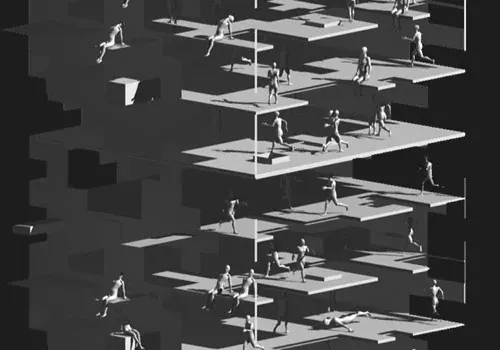
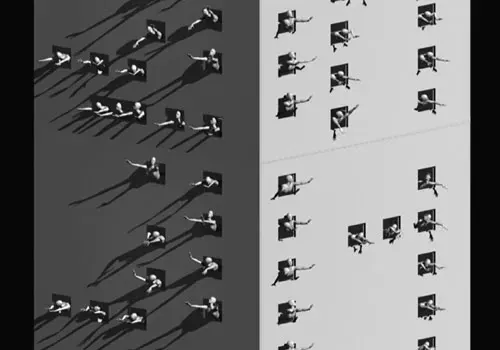
Projections of Gregory Bennett's animated performing figures onto the Smith & Caughey building in Auckland will be one of many Living Room 2011 works encouraging the public to ‘re-imagine’ our urban surroundings in the next ten days.
Projections of Gregory Bennett's animated performing figures onto the Smith & Caughey building in Auckland will be one of many Living Room 2011 works encouraging the public to ‘re-imagine’ our urban surroundings in the next ten days.
“Hopefully it will prove to be an engaging addition and complement (or intervention) to the already quite crowded visual and aural landscape of the inner city.”
In this TBI QnA, Bennett talks about his collaboration with Michael Hodgson sound artist and specialist in large-scale projection events. And how their work explores the choreographic interplay between the moving figure and architecture, which structures the way we negotiate a city.
The council-funded Living Room 2011: Metropolis Dreaming is on from April 8-17 in public places in Auckland’s CBD and will include a mix of installations, performances, sound art, video projections and a poster project.
During what hours of the day do you feel most inspired?
Sunrise and sunset, or after midnight.
What aspect of your creative practice gives you the biggest thrill?
The initial conception of a work – the excitement of a new idea, and then its successful completion – what comes in between is always the most challenging.
Do you like to look at the big picture or focus on the details?
Details!
What's your number one business tip for surviving (and thriving) in the creative industries?
I have very limited business acumen! But always take opportunities offered you and always deliver on all your deadlines.
Which of your projects to date has given you the most satisfaction?
The latest project is always the most satisfying.
Tell us a bit about your background – including your work as a lecturer at AUT University.
I have a background in both fine arts and film making. My fine arts practice has always had a strong moving image and animation focus. I’ve also worked in film post-production in areas such as editing, and sound design, and at tertiary institutions teaching on largely practice-based moving image courses. I currently work in the School of Art and Design at AUT in the Digital Design department teaching 3D Animation and Visual Effects.
Tell us a bit about your Living Room project ‘Impossible Choreographies’ – from conception to inception.
I was invited to participate in this project by curator Andrew Clifford, who also suggested the collaboration between myself and Michael Hodgson, with the idea of finding an appropriate site in inner city Auckland for a large-scale projection work combining my moving images with Michael’s wonderful audio work. In addition there was the opportunity to draw on Michael’s expertise in the area of projection mapping where it is possible accurately plot your projected images to the specific architectural details of a building facade.
Michael and I spent an evening driving around the inner city looking for possible sites, when we identified the west face of the Smith and Caughey’s building. Michael then provided me with a graphic template of the facade from which point I started work on creating animation to be projected onto the building.
What does the work explore?
I have been exploring ideas of the interplay between architecture and the moving figure as a kind of choreographic exchange - how architectural structures can suggest and/or incite structures of movement, which I think resonates well with my work with moving figures in patterns of complex movement - but using the architectural facade as a direct impetus for a range of 'choreographies'.
I have also looking at playing with issues of the '2D' facade and the projection of illusionistic 3D depth as part of this interaction, and issues of ornamental embellishment - the 'animation' of architectural surface. The facades of the Smith and Caughey building also feature a kind of insistent verticality in the architect Roy Alstan Lippincott’s design motifs– the elongated repeated arch suggesting both upward and downward vectors of action – recalling the vertiginous art deco structures of the great science fiction film Metropolis (released in 1927, the same year Lippincott designed this building) or the Empire State Building of the 1933 King Kong.
In exploring the relationship of the moving figure to this kind of monumental structure I have also drawn on my interest in 1930’s Hollywood choreographer Busby Berkely’s articulation of mass automaton-like figures in monumentally scaled art deco environments.
Why do you think public events like the Living Room are important - for artists and ‘the public’.
Yes it’s a wonderful and indeed challenging opportunity to bring art from out of an art gallery context and expose it in a highly visible and public environment. Hopefully it will prove to be an engaging addition and complement (or intervention) to the already quite crowded visual and aural landscape of the inner city.
What other works are you looking forward to at this year’s Living Room.
All of them!
Further information:
Gregory Bennett and Michael Hodgson will use digital animation at an architectural scale to re-invent the Eastern façade of Queen Street’s iconic Smith & Caughey building, built in 1927 and designed by American architect Roy Lippincott. Situated in close proximity to the entertainment facilities of The Edge, this monolithic Metropolis-style tower provides an ideal canvas on which to project Bennett’s performing figures. Find out more about the presentation and artists.