Immersive Theatre (2)
Written by
By James Hadley in London
In my last blog I talked about a site-specific, promenade theatre production which was staged outside in a cemetery. This week I want to tell you about two further immersive theatre experiences, both just as unique despite being staged indoors.
The current popularity of this form of theatre, which keeps the audience literally on its feet, actively engaged with the presentation, is perhaps in part due to the hunger of new audiences to engage with something less passive, less meditative than traditional theatre-going experiences.
I've written before of the work of Cardboard Citizens - a theatre company who work with London's homeless and displaced people. My previous experience of their work was when I attended one of the forum theatre pieces they tour around hostels for the homeless, provoking discussion around relevant issues and giving audience members the opportunity to replace a character in a scenario and show how they would have solved a situation differently.
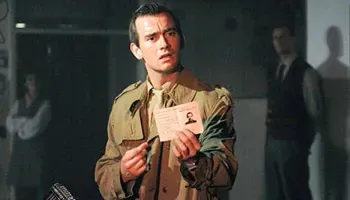
Their current show 'Mincemeat' is at the more commercial end of their activities - a full professional production of a play which has relevance to the past experiences of company members, and is performed by a cast including actors who have experience of homelessness.
'Mincemeat' is actually a revival of a play first performed by the company in 2001, and written by the company's Artistic Director Adrian Jackson and Farhana Sheikh. The script is like an Agatha Christie whodunnit, except it's the dead man who is the protagonist, and the question he's trying to answer is : who was/am I?
As this is a promenade production, it's a journey we go on with him, through the warehouse spaces of Cordy House in London's East End. The concrete rooms are like a blank canvas for a variety of different locations to be recreated as we follow different clues towards unravelling this man's previous identity. It's one thing to see a new set appear onstage, quite another to walk through a door and go from a bombsite to a morgue, or from an office to a room on a ship.
Just as the protagonist changes accents and body language as different theories of his real identity emerge, we move through quite different experiences of space, some of them false starts, so that it's like jumping from one person's life experience to another.
One of the subtexts to the story is the sense of to what degree it's a lottery whether your life is one of waking up on the streets or in a comfortable bed. Ironically, the most comfortable room for the audience is the WWII wartime homeless person's shelter of the play's final scene. In here we sit on bunk beds and mattresses on the floor, the shelter's inhabitants amongst us, to discover our protagonist's true identity: a homeless man who lived nearby to where we're watching the play. The memory of this scene is one not of watching a scene in a play, but of effectively having experienced a wartime homeless person's shelter, so convincing was the cajoling and comforting and harrassing of the inhabitants in this dingey but communal space.
The intriguing story of the play was based on the true facts that a homeless man's body was used by the government in a Second World War operation called 'Mincemeat'. His identity was effaced and replaced with a military uniform and hoax courier's papers suggesting the Allied Forces' were about to invade from a position other than the one they really intended; his body then dumped in the sea for the Nazis to discover - and the ruse actually worked. It was only a few years ago that papers were released revealing the true identity of the accosted body. The production is intended as one of a trilogy by Cardboard Citizens, each work to explore instances of a homeless person having influence over the course of history.
Completely different, but equally appealing for the immersive experience it offered, was the latest production at London's main venue for children's theatre, the Unicorn Theatre. It was a work called 'For the Best', developed with children attending the hospital school on the Dialysis Unit of Evelina Childrens Hospital. The director, Mark Storor, has a background in live art/experimental theatre, and this was very much the theatrical vocabulary with which we were engaging.
The first half of the piece leads the audience through the theatre's backstage rooms which had been transformed into a series of installations, some including performers, but purely as elements within a 3D composition.
If this sounds rather 'high art' for a children's show, what was ingenuous about the production was the care with which the authentic voices and imaginations of the children had been adhered to.
So the rooms were very much a child's version of an art installation - one room was filled with fresh baking and kitchen implements, with x-rays and other medical reporting elements mixed in, conjuring a sense of the uneasy mix of the domestic and medical that children on dialysis had had to negotiate. Smell was a strong element in many of the rooms, further adding to the evocative powers of each space, and sometimes the rooms were so detailed that you could easily miss a telling detail - such as the kidney beans which a man dressed as a tiger was slowly counting. It was as if the director had acted as a dramaturg, giving the children's stories a great amount of respect in the process of shaping the elements of their imaginations responses to difficult situations.
Eventually we found ourselves in a 'more conventional' scene - watching a nurse hook a child patient up to a dialysis machine for treatment. While the patient endured the boredom of the time-consuming process, his tethered down position was accentuated by the nurse, played by a circus aerialist, climbing draperies and then walking around the ceiling. The surrealism of this was clearly influenced by a child's imagination, with storybook playfulness mixed with adult magic realism.
Ultimately the piece developed into a surprisingly moving and dark exploration of the pressures and vulnerabilities of a family dealing with one of their children's illness. The illness was represented throughout by a man dressed in a tiger suit, lounging indolently around the edges of things, but ready to pounce when people weren't expecting it. Another example of the beautiful imagery resulting from the collaboration between the director and the children was the mother retreating to a bath when things got too much for her, burying herself completely underneath piles of novels. To appease her, the children then tied tulips to her feet.
I don't know if this was more affecting for happening at close proximity to the audience. Certainly it's harder to feel at arms length from the issues affecting the characters when you're right there in their space. When the family celebrated winning a tug-of-war with the tiger/medical condition by creating a fountain of soft toys being thrown into the air, the audience joined in with throwing the toys back into the middle so the fountain could be sustained. There's more than a passive suspension of disbelief going on in this sort of situation, and it's much harder to shake the images and issues when you have experienced them with all your senses as if within your own life.