History is Untidy - Richard Reddaway at City Gallery
Written by
Courtesy of Dominion Post - 2004-11-05
By Mark Amery
When Roman emperor Marcus Aurelius proclaimed that "No form of nature is inferior to art, for the arts merely imitate natural forms" I'm not sure he had in mind a nature with the mutant irregularities and impure hybridity, or an art of such cultural bastardry, as that found in the work of artist Richard Reddaway
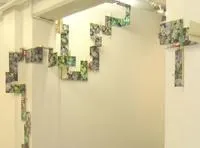
Image: Richard Reddaway's geometric vines climb up the walls of the Michael Hirschfeld Gallery.Courtesy of Dominion Post - 2004-11-05
By Mark Amery
When Roman emperor Marcus Aurelius proclaimed that "No form of nature is inferior to art, for the arts merely imitate natural forms" I'm not sure he had in mind a nature with the mutant irregularities and impure hybridity, or an art of such cultural bastardry, as that found in the work of artist Richard Reddaway
Image: Richard Reddaway's geometric vines climb up the walls of the Michael Hirschfeld Gallery. The Aurelius quote is to be found on the wall of Te Papa's Wild Design exhibition, where you are treated to blown up microscopic details of nature in all their divine cellular order and glorious symmetry. For real wild design however you're better visiting Reddaway's installation at City Gallery's Michael Hirschfeld Gallery across the road, a work that echoes the way both nature and culture send outs shoots - trails of dangling, mutated genetic strands. Growth is shown to be an untidy business.
In Reddaway's The Wieskirche, the gallery is left empty, all except for a viral invasion over the walls and into an adjacent, annex exhibition space. An organism comprised of half-constructed box-like growths appears, like a parasite to have got a grip on the space by wrapping its twisting angular tentacles around this outer abscess; a first step on its way to devouring its host. These strands are constructed crudely - as if like in some DIY nightmare - from cheap wood, resin, screws, clamps, and, finally, a coating of crackling fibreglass that gives the impression the whole apparatus has been ripped out of a larger system, or skin.
The strands crawl along and flip out at right angles into the air. On their outer glossy surface, like the upwards side of a leaf, are fragmented images of variegated ivy, a hybrid plant with leaves of irregular patches of colour known for its creeping colonisation of all before it. The works structure is also, as Hirschfeld gallery curator Sarah Farrar observes, like the aerial roots of an ivy plant, "grasping onto the surface of the gallery walls, continually extending their reach".
With this exhibition the gallery ticks another Wellington artist long deserving of a project space in a public gallery off the list. Lower Hutt born, Reddaway is a mid-career sculptor who has regularly appeared in public exhibitions since graduating from Canterbury School of Fine Arts in the 1980s. He is one of a few exceptional contemporary art practitioners in New Zealand well into their career who work quietly and steadily, plying fresh, distinctive ground but rarely receiving a great deal of public focus, despite the engaging complexion of their work.
The work here is immediately identifiable as Reddaway: the interest in everyday materials and cheap glamour, reproduction and mutation, the relationship between two and three dimensions, photography and sculpture, architecture and biology. Once you let the work get a grip on you it continually flips and twists with analogies to the world at large, whilst also engaging on a sculptural level in terms of its dynamic exploration of form, space and materials.
It creeps over the wall out the back, just as the last group show of younger Wellington artists, Milky Way Bar, left by the front. Like that last show it has something to say about being on the edge of worlds, existing in that awkward space between things. It has to be said however that Reddaway's work has both an initial aesthetic allure and enduring complexity that suggests these younger artists have a long way to go to establishing practices as rich as this.
Reddaway revels in awkwardness (our own ridiculous, dangling angularity as humans for example), and here he finds the perfect space for his work, in the awkward, contested zone between the walls of the main gallery and Nikau cafe. Likewise the ivy pictured has been photographed in the city's green belt; that contested space between nature and culture, the indigenous and exotic.
Reddaway's interest in the abject, which my Oxford defines as the miserable, the wretched, the degraded, is everywhere. This is a world of imperfections and of rejects. But it's also about finding beauty in the most unfashionable places to consider. You sense the artist's interest in beauty and its relationship to the world; the complexities over history of changing taste.
The installation takes its title from a church in Germany noted for its highly ornamental late baroque/rococo interior, which is in contrast to the church's plain exterior. There's an obvious echo in the space in the gallery here, and Reddaway's work has previously played with the fragmentation of architectural orders, but the interest goes much deeper.
In the baroque, decoration was also variegated. Beauty could be expressed through ugliness, through the animation of opposites and irregularities in every surface, with relationships constantly in an intense process of being made and remade. Much like in the 18th century poetry was to be found in ruins - in culture's fragments being devoured by vegetation - in this work it's as if we are witnessing a process. The more you look, how difficult it is to get a pattern on this work becomes clear, the code for their strong crystal structure appearing to be constantly being rewritten.
As photography folds into sculpture and sculpture into installation, we're reminded here of how over history one idea folds into another and creates echoes over time. There is with these boxes the constant sense of the packing and unpacking of references, a reminder in the work's ever-turning mutation and fragmentation of the constantly changing mix-and-match nature of our own tastes.