Getting to the rub
Written by
By Mark Amery
Fine art printmaking gets to the rub of things. In a time of copious digital reproductivity, dulling the senses and fingertips, I’m finding the sensual, elemental magic of paper pressed to stone and metal all the more magnetic.
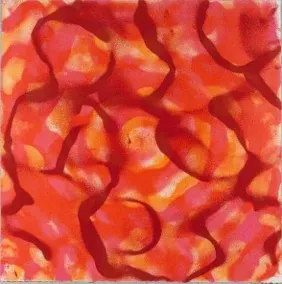
Some of the strongest lithographic prints currently on show at Solander - a gallery devoted to works on paper - provide scouring, scratchy and prickly line, blush-like blotches of colour, and hazy, burnished tones of heat. As the title of the exhibition, Struck, suggests there is a visual music to this fine touch. Our world in these works is in a state of emergence and dissolution. It is as it is in our heads, in a continuous state of change. In healthy tension are the pointed mark of the artist, trying to still things, and the fluid spirit of nature: water on rock, fire on metal.
Struck is a survey of the very diverse range of work completed by artists with printmaker John Pusateri over the five-year history of the Auckland Print Studio. They range from established New Zealand artists like Gretchen Albrecht, Andrew McLeod and Mark Braunias to street artist Askew One and international visitors from the Studio’s residency programme.
An American, Pusateri came to New Zealand to complete a Masters at Elam and noticed the lack of printmaking facilities and master fine art printmakers working with artists to realise prints. There has since become even more of a dearth: the celebrated Muka in Auckland ceasing printing in 2011, and Papergraphica in Christchurch reducing their work with artists.
The majority of work here is stone based. Put simplistically, lithography works on the repulsion between oil and water. An artist draws or paints directly onto stone with any material that has grease in it. Rolled ink applies itself to the grease, whilst water cleans the rest. Afterwards the stone is ground down.
An interesting exception is Pusateri’s collaboration with Tiffany Singh (a true collaboration). Productively extending the analogy to music, these abstract patterned works are in part sound generated. Sand is placed on photo-sensitive lithoprint surfaces and subjected to different sound frequencies. Each frequency is given a different colour and each work comprises of three different frequencies and colours, making up a visual chord. While the process is more interesting than the result, there is a delicacy and tang to the interweaving lattices of colour.
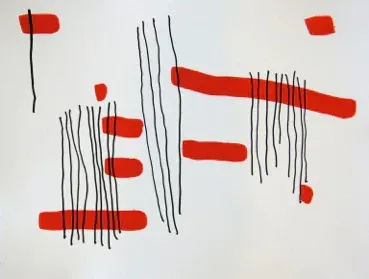
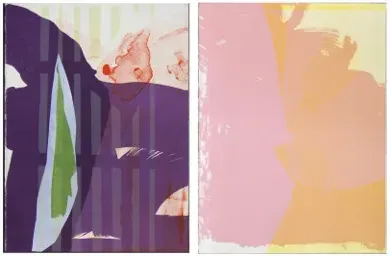
Stronger in its quiet music is the work of Nuala Gregory. With an exquisite use of colour, shape and stroke, overlaid collaged fragments form complex yet tuneful abstract compositions exploring the layered potential of paint on paper. The lines of cuts outs work over scrubbings, and stains under brushes. It’s as if the activity and decor of a home, peeled back over its history like layers of wallpaper has come into overlaid animated life, light and shadow passing over from the windows.
Always to my taste a more interesting printmaker than painter, Andrew McLeod’s Silk Road is a watery, hallucinatory warping together of fragments of imagery from ancient Western and Eastern art. Like glistening silver snail trails on jet black, cultural history is shimmied together, as if skew-whiff rubbings from varied ancient stones. History is self-erasing and corrupting, the visual artist its dreamy DJ sampler, mixer and manipulator.
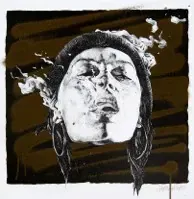
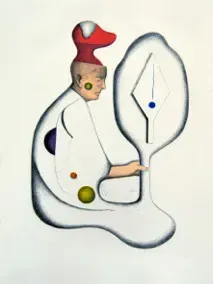
The lithographic process works well for artists interested in exploring the dreamlike slippage between the abstract and representational, creating dark, psychological spaces. Duncan Pepe-Long’s charged Eclipse provides an out-of-one’s head portrait with a heady heat-rubbed patina of colour. Askew One’s rich, graphic disembodied heads are heightened by delicate curls of expunged smoke and hazy drifts of paint.
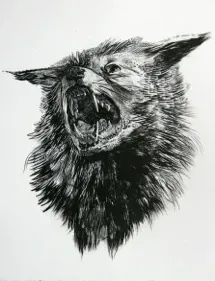
Other highlights include Jason Grieg’s arsenal of barbed, wiry and spiky line in wry meditations on death, aging and desire, alongside Pusateri’s own beautifully shaded articulation of the macabre. Albrecht’s Cloudy Mirror is proof this master artist has lost none of her ability to contain nature with measured poetry.
This exhibition is crowded and variable in quality. It would have benefited from more selective curation, allowing the stronger works to have their own space. Small they may be, but those prints provide fine, soft and subtle marks of touch that can allow an entire room to breathe.
- Struck, Solander Gallery, until 1 March
Must See
Shot around the dams in Auckland’s Waitakere Ranges, this short film captures the mesmeric meeting of water and concrete, and eerie magic of the bush. The use of an actor here is stagey and unnecessary, but both visual and aural attention to texture and pacing are exquisite.
- The Dam (O), Gavin Hipkins, New Zealand Film Archive, until 8 February