Frank Breuer and Fiona Amundsen at McNamara Gallery
Written by
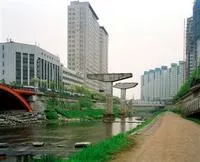
The photography of Frank Breuer and Fiona Amundsen is currently on display at McNamara Gallery in Wanganui.
Frank Breuer's work Poles, is shot mainly in Massachusetts, USA, and features images of large utility and telecommunication poles that spring up in the landscape and, through a mystery of tangled wires and transformers, connect different parts of the country.
Fiona Amundsen's Miracle on the Han River references the period of massive cultural, social, economic and technological development that South Korea has undergone since the Korean Civil War of the mid-twentieth century. The photography of Frank Breuer and Fiona Amundsen is currently on display at McNamara Gallery in Wanganui.
Frank Breuer's work Poles, is shot mainly in Massachusetts, USA, and features images of large utility and telecommunication poles that spring up in the landscape and, through a mystery of tangled wires and transformers, connect different parts of the country.
Fiona Amundsen's Miracle on the Han River references the period of massive cultural, social, economic and technological development that South Korea has undergone since the Korean Civil War of the mid-twentieth century.FRANK BREUER
Frank Breuer has been recording standardized industrial spaces in Germany, Holland and Belgium with his large-format camera. Architecture in the predominantly urban cultivated landscape becomes the central element in Breuer's photographs. In their austere monumentality, today's industrial buildings seem endlessly expandable and neglect a human proportion or familiar relationship. He draws attention not only to the scale of a building's imagined and relative size, but also to the sense that such structures function in their topographic environment as alien and displaced objects. Breuer's interest in modular structures resides in the reduced formal relationships and monochrome sequencing within the photographs themselves.
Parallel to his investigation of generic buildings, Breuer is also interested in commercial trademarks, logos and signs. As identification props for consumer products, one's ideals and desires are closely linked to trademark names whose logos confront us in virtually all areas of daily life from packaging and magazine advertisements to giant billboards. Breuer sees such signs as having no clearly defined size, and just as in photography, scale can be lost. As catalogued in his documentation of large outdoor signs, he is especially interested when a trademark's flat, two-dimensional and iconographic image is juxtaposed within a less familiar landscape context.
His new work 'Poles', is shot mainly in Massachusetts, USA, and features images of large utility and telecommunication poles that spring up in the landscape and, through a mystery of tangled wires and transformers, connect different parts of the country.
Frank Breuer lives in Cologne, Germany. From 1992 to 1996, he studied with Bernd and Hilla Becher at the Dusseldorf Art Academy.
His works are in several museum collections including the Museum for New Art, Karlsruhe; Museum Folkwang, Essen; and the Metropolitan Museum of Art, New York.
FIONA AMUNDSEN
Miracle on the Han River
- to look and to listen requires the work of attention, selection, reappropriation, a way of making one's own film, one's own text, one's own installation out of what the artist has presented (Ranciere 2007: 264)1.
The title of this project references the period of massive cultural, social, economic and technological development that South Korea has undergone since the Korean Civil War of the mid-twentieth century.
More specifically, Miracle on the Han River is used to describe the growth of Seoul - which hosts the Han river, that runs through both North and South Korea - from a city destroyed by war to a major industrialised economic centre. The phrase itself is a recontextualisation of 'Miracle on the Rhine' which described the economic rebirth of the newly divided Germany after World War Two. So, like the Rhine the Han River also acts as an important metaphor as well as site for the industrial modernisation of Korea: the expression also seems to adequately pay homage to this river's long political history.
One aspect of Seoul's renaissance involved the redevelopment and planning of its city centre; this directly affected the Cheonggyecheon, a tributary which flows through the downtown area eventually meeting the Jungnangcheon which in turn empties into the Han River. In brief, this stream was covered over by roads, other buildings, and eventually a motorway that in turn led to its demise. However, this area has recently undergone a major regeneration process involving pumping water back into the stream, relocating the overhead road, and developing recreational areas in the form of long parks running either side of the water flow: the newly beautified Cheonggyecheon was finished in late 2005. This area of Seoul is significant in that it is geographically representative of both traditional and contemporary aspects of Korean culture: old
Joseon Dynasty palaces sit alongside generic skyscrapers housing government officials and the like. In essence, Cheonggyecheon has become a unique site clearly mingling the old with the new, politics with history, the social with economics, as well as nature with culture - infrastructure that is not clearly visible but contributes to a sense of understanding, experience and knowledge of place.
Miracle on the Han River explores the disparity between the uniquely subjective experiences of being in public sites such as Cheonggyecheon, and their representation through photography. This project also plays on the socio-cultural understanding of both site and photography - the former is linked to how photographs actually do reveal something about what they depict, while the latter is grounded in the notion that space itself is always 'cultural'. Subsequently, what photographs disclose has more to do with the things we cannot necessarily see but are so connected to how we gather a sense and comprehension of specific sites: Miracle on the Han River establishes specific formal compositional relationships within each photograph's content to highlight this understanding.
Such formal awareness starts to upset the usual social conventions and narrative associations of photography. Therefore, it is the little shafts of light, or the direction of the lines on the pavement, or the curves of the architecture which become stilled through photographic representation, offering us something else. These aesthetic traits quite literally point to a different way of looking which in turn becomes tightly connected to our experience of such a site - Cheonggyecheon, and the
Seoul city centre. So, what Miracle on the Han River reveals is the possibility and potentiality of experience.
Image: 1 Ranciere, Jacques (2007) 'Art of the Possible: An Interview with Jacques Ranciere' (with Fulvia Carnevale and John Kelsey) in Artforum, March 2007, XLV, No. 7, Pgs 256-269.
11/11/08