Fractal or Fake? Novel art-authentication method challenged
Written by
Jackson Pollock couldn't possibly have been thinking of fractals when he started flinging and dripping paint from a stick onto canvas. After all, mathematicians didn't develop the idea of a fractal until a couple of decades later. But if one physicist is right, Pollock ended up painting fractals anyway. And that mathematical quality may explain why Pollock's seemingly chaotic streams of paint come together into an ordered, beautiful whole, and why the technique brought Pollock acclaim as a master of American abstract painting.
To read the full story in Science News, click here
Image: Katherine Jones-Smith made this doodle, "Pebbles," which she says shows the same fractal patterns that Taylor has found in Pollock paintings. Therefore, she argues, the paintings aren't fractal.Jackson Pollock couldn't possibly have been thinking of fractals when he started flinging and dripping paint from a stick onto canvas. After all, mathematicians didn't develop the idea of a fractal until a couple of decades later. But if one physicist is right, Pollock ended up painting fractals anyway. And that mathematical quality may explain why Pollock's seemingly chaotic streams of paint come together into an ordered, beautiful whole, and why the technique brought Pollock acclaim as a master of American abstract painting.
To read the full story in Science News, click here
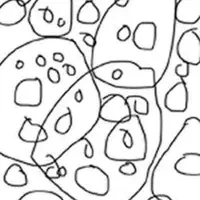
Image: Katherine Jones-Smith made this doodle, "Pebbles," which she says shows the same fractal patterns that Taylor has found in Pollock paintings. Therefore, she argues, the paintings aren't fractal.