Forced Entertainment
Written by
By James Hadley in London
Forced Entertainment have a reputation for being one of the UK's leading experimental theatre companies. This year marks their 25th anniversary. Appropriate then that I finally get round to experiencing their work.
I'd heard that many of their shows explore the fundamentals of the contract between audience and performers; playing with provocations about contemporary life hurled at the fourth wall until those on the other side hopefully feel or think something.
While studying postgraduate theatre at Victoria University in Wellington, lecturer John Downie showed us clips from one of Forced Entertainment's shows. The details have faded, but I remember the impact: theatre artists making work that was unconstrained by expectations of what theatre is. I hadn't seen much high quality experimental theatre in NZ at that point, and there's still quite a limited scene for this sort of work, so being exposed to some Forced Entertainment was horizon expanding.
London's SPILL Festival of Experimental Performance included the premiere of Forced Entertainment's new show, 'Void Story', and also a work by the company's Artistic Director, Tim Etchells, called 'That Night Follows Day'. This was the work I saw first, and although it wasn't under the Forced Entertainment banner, apparently it had many of the company's typically confrontational and provocative energy.
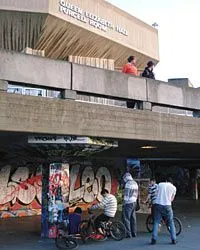
The concept of the show, staged at the South Bank's Queen Elizabeth Hall, is simple: 16 children aged between 8 and 14 stand in a line across the stage and speak a huge list of the things that adults tell children. The list was quite poetic at times, at others provocative. It wandered from statements that adults tell children to help them understand the world, to statements told to limit their understanding of the world. It wandered from truths told to explain life's complexities, to lies told to protect innocence, optimism or idealism.
There was a wonderfully energised section where the children vented their aggression in reciting a seemingly endless list of things adults tell children not to do. Perhaps more than any other section, this prompted enhanced consideration of the child's perspective. All these statements made to young people with limited knowledge of the world become a clear dynamic of manipulation. The power of the experienced adult to choose what facts and what lies to tell a child 'for their own good'. That every statement has been learnt by heart, like a multiplication table, by these children, brilliantly underscores the work's central message (at least in my reading of it): that, regardless of intent, the things we tell children are a process of indoctrinating children to a particular world view. The more you think about it, the more disturbing the dynamic of these stoic children reciting this huge text becomes. Yet it was also something you could listen to like performance poetry if you wanted - a wide ranging list of statements by which to understand the world and your place within it. The text made no judgements - it was very much left to the audience to interpret.
Because the work was made in Belgium, all the children spoke in Dutch. This was a bit distracting as your eyes darted between them and subtitles, but it also helped to distance the viewer to a more contemplative reading of the work - as you would a piece of conceptual art viewed in an art gallery. Ultimately, it was a humbling experience. A work which forced you to consider how communication from an adult to a child functions, reawakening memories of having a limited understanding of the world and having to trust what you're being told by your elders - but now revisiting that experience from a better informed position?
Forced Entertainment's 'Void Story' was equally challenging. I began to realise that, true to name, Forced Entertainment's shows are sometimes closer to enlightening hostage situations than watching a play for enjoyment.
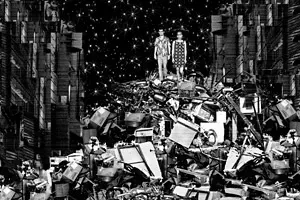
'Void Story' was effectively a script performed like a radio play while static images of the story were projected onto the screen above the stage. The performers concentrated all their energy into their voices, never making eye contact with the audience, so your attention was drawn to the successive images, as if watching a film in a darkened cinema. The images were like collages of black and white photographs. These formed a storyboard to the spoken dialogue, leading you on a violent journey through a world that you'd like to consider post-apocalyptic, except it was all disturbingly close to contemporary urban existence.
The story began with a couple looking out their apartment window. There's a knock at the door, they open it and a hitman shoots the woman. Another knock, and they're being evicted from their home. There's a restlessness to the story as the couple go on the run, without a sense of where they're heading, moving from one dangerous situation to another. It builds up a picture of a world where you don't feel it's safe to trust anyone, and that those around you could die at any time. Just when you think it's essentially an action movie experience and to just sit back and enjoy the ride, events remind you of things you've felt walking down your local high street. An oppressive atmosphere of fear, distrust and anxiety gradually accumulates - pungent enough that an audience member sitting in my row fainted half way through the show.
Many of us are so used to images of violence and urban isolation, particularly in action films, that the story could be followed as if it were entertainment. And there was indeed a sprinkling of cautious laughter as the black humour of things reliably going wrong for the protagonists. There was a disturbing hollowness to the experience, and I think this was the point. The work seemed, to me, to be a meditation on the breakdown of contemporary society, reflected by the fact that there was no longer even any direct connection in this piece of theatre at all. Where, usually, there is a sense of energy flowing between actors and audience, even if they're pretending we're invisible on the other side of the fourth wall, here there was instead something closer to a vacuum. A void.