Five words, two lives, two plays
As we hurtle once more towards year's end, Renee Liang finally has time to reflect on 2014 and five words that have helped her in the arts. She also explains what's been keeping her so busy.
* * *
It’s nearly Christmas. As my toddler would say, “whaaaaaat?” How did the end of the year creep up on us, again?
As it turns out, the answer is the usual. I’ve been too busy to notice. This year as contributor for The Big Idea, I’ve done 55 interviews, six festival blog entries, and listed two events of my own. I could have listed many more events I’ve been involved in, and posted more responses to the amazing shows I’ve seen. But I have to sleep some of the time (admittedly not very much.)
One thing that’s missing from the list is a blog entry of my own. I started TalkWrite to talk about my experiences starting out as a newbie in the world of the arts. Six years down the track, the learning curve is still pretty steep, but I’m more comfortable in my skin as an artist. So I’d like to use this blog, my end-of-year wrap up, to talk about the things I haven’t had time to, all year.
First observation: the arts isn’t everything. It's easy to think, when you’re starting out, that what you are doing is super important. Why else would you be working two day jobs, rehearsing at night and eating three meals of instant noodles a day (well OK, supplemented by cookies from Moustache)?
Well, life has a way of showing how trivial you were. Two lives, in my case: the baby who interrupted my self absorption in March, and his sister who came 20 months earlier and was the direct result of writing a play (but I’ll tell that story another day). My writing *cough* facebook time is now scrunched into the blissed-out hour or so between when hubby and I get them to sleep and when we pass out ourselves.
Yes, kids are the main reason I don’t get much sleep. But life has never seemed so distilled, so packed full of feelings and thoughts. Not so much light bulb moments as tickle moments, interspersed by supernovae. I only hope I’m storing them up well enough that they’ll flow into my future work. For now my strategy with ideas is the same one my ambulance colleagues sometimes deploy: scoop and run.
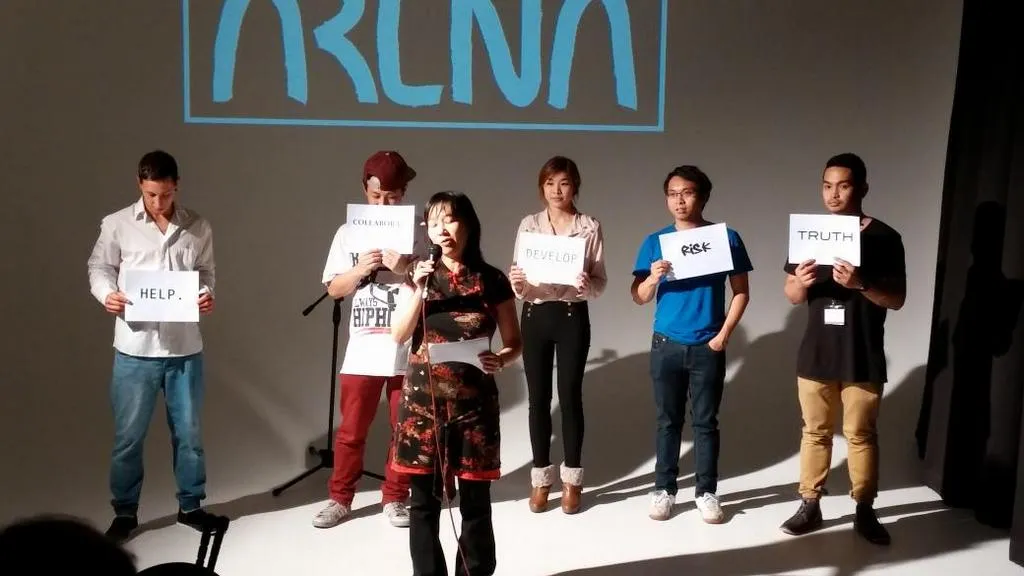
Second observation: it doesn’t take long to become an expert. (A kind of inexpert expert, anyway.) One of the events I was involved in and didn’t have time to write about was Arena, a pan-artform, performance and cross-linking event. Like many good ideas, it started off small – organiser Joselyn Khor thought, “I know so many creative people, why not get them all together in one room?” As is usual with impulses, the event grew and grew until it involved over a hundred people. I was asked to speak on my experience as an emerging artist. I had five minutes, so I came up with the idea of five words that I’ve found useful so far.
Truth. You heard the one about write what you know? Also write what is true. This isn’t the same as historical truth, at least, not all the time. (History generally isn’t true.) You will know what is true by the stories you’re driven back to, again and again. The untold ones, the ones you were born to write. Audiences are hungry for the truth. In response, writers are happy to gut their lives and hang their secrets out on display. But be warned, audiences can tell when you’re lying. They’re not dumb. They want emotion. Realness. Characters based on people you know. Your truth.
Risk. Picking up that story that might piss off some people if it were told. Choosing to make an opera when you’ve never done opera before. Asking that amazing director that you know will turn you down, but will make your year if they say yes. Signing that venue contract. Going for funding you don’t think you’ll get. There’s all kinds of risk, but if you don’t take it, you’ll never do anything. Sure, you’ll faceplant one or ten times, but all awesome rides involve a few bruises. Plus, each time you’ll learn something.
Develop. I used to be really bad at this. One of the things I loved about theatre from the outset was that ‘page to stage’ could be as short as a few months. (That’s how long my first play, Lantern, took). And let's face it, I'm an instant gratification junkie. But as I’ve been longer in the industry I’ve learnt the value of taking my time. Workshops can be useful, as can preparing the funding applications for all the stages of a work. I’ve taken longer and longer to develop new work – though it doesn’t prevent me from having to pull the occasional all nighter to reach a writing deadline.
Collaborate. This is something I had to learn how to do. Writing is, by nature, solitary and introspective. You need the mind space to ooze into before you can write. But once the writing is done, you’re going to need help to get it out. And that means that you’re going to have to let other people have fun making, too. I had to learn how to write spaces into my work for other people to fill – actors, directors, the audience. Behind the scenes there were publicists, venue managers, festival directors – all with their own vision of the work. So there’s a bit of jiggling involved, but the end result, to use a cliche, is so much bigger than the whole.
Finally, Help. This is the big one for me – it’s what I attribute my ‘success’ so far in the Arts to. By this I mean helping others. There’s this idea I like of creative karma: if you help someone out, someone else (not necessarily the same person) will help you. It's not altruistic – it’s growing the community that supports you. It’s also getting a name for yourself as a ‘yes’ person, a doer, and that’s a reputation worth getting. Ditto for accepting help from others. When I started out as a writer I used to nervously go along to live readings. ‘Known names’ –people I’d studied at school – would come up afterwards to say encouraging things, and I would rack up the courage to ask them to have coffee with me. One coffee meeting turned into another and many ended up as mentors and later friends. It’s happened in each new genre I’ve tackled, so it’s just the way our community works. It wasn’t long before people were asking me for coffee and advice, too. I always say yes, despite the niggling worry that they should really be asking someone with more experience.
Third observation: like love, time expands to embrace everything you're passionate about. Or at least that's what I hope is true, even if physicists haven't found this theory out yet. I get asked - a lot - how I fit it all in. The family, the day job, the research on the side, and then the arts. I actually don't know. I keep thinking it'll all fall down around me, that I'll be exposed, but I keep on learning, keep on doing. Saying yes because I think it'll be cool, and picking up stuff as I go. I think that might be the real value of the Arts. It teaches us to just go with our hearts, open our minds, and trust that the world will shift a little to accommodate. As my toddler is fond of proclaiming, at full throttle, on the couch early in the morning: Let It Go.
So as the year closes I’m looking at an even busier year ahead. Mr. Eight Months learnt to crawl forwards last weekend so now we have two wanton, but increasingly accurate tornadoes. Meanwhile (self promotion alert), I am doing two new plays in the first part of 2015, for Chinese New Year and Fringe: a comedy based on the lives of my two cheeky grandmothers, and an adaptation of one of my favourite folk tales (tip: put ‘farting’ in the title of a play and everyone wants to come). In January I’m also coordinating and teaching a writing workshop for migrant women and editing and launching a writing anthology.
Christmas? Is there time for Christmas?