Everything Washes Away Eventually: Street Art and DAF106
Written by
By Mark Amery Courtesy of The Dominion Post
Wandering round on warm evenings this time of year a relaxed celebratory vibe seems to takes over in central Wellington from the more typical, tense social posturing. People are interacting with the public spaces around them. A host of festivals and events, and a trail of public art, encourage them to engage with the environment around them, and find ways to participate.
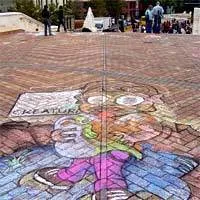
A highlight on Saturday was walking the city to sea bridge and encountering this year's Fringe Festival Chalk the Walk (pictured), whereby allcomers annually are supplied with chalk to make their mark. By Mark Amery Courtesy of The Dominion Post
Wandering round on warm evenings this time of year a relaxed celebratory vibe seems to takes over in central Wellington from the more typical, tense social posturing. People are interacting with the public spaces around them. A host of festivals and events, and a trail of public art, encourage them to engage with the environment around them, and find ways to participate.
A highlight on Saturday was walking the city to sea bridge and encountering this year's Fringe Festival Chalk the Walk (pictured), whereby allcomers annually are supplied with chalk to make their mark.In a great stroke of benevolence this year it appeared the public had been given the opportunity to add their own ideas to the stone staircase and pyramid like structure that leads to the Para Matchitt bridge. It was supposed to finish at three, but the kids were still going at eight. It had been raining, leading to a rainbow like effect upon which people continued to enthusiastically pile on additions to the conversations. "Everything washes away eventually," somebody had written up large.
The whole event was given an extra charge by Helen Clark's announcement in a skateboard park last week of a crackdown on grafitti.
No doubt much tagging amounts to vandalism. Yet, not only is it easy to be dubious about the effectiveness of some of the proposed measures, but the campaign also ignores the fact that grafitti can be a welcome addition to our visual lives, and an assertion of identity and creativity by people in urban environments reacting to having identities imposed upon them by an increasing amount of corporate advertising.
Street art has long been recognised as an important part of the buzz of a city like Wellington. You only have to walk up Cuba Street to see how individual statements on walls create lively and often intelligent conversations with the world around them, and contribute to the patina of time which cultural ephemera provide. The influence of British artist Banksy is strong in these smart combinations of stenciling and writing by artists who, like Banksy, stay anonymous.
As part of this year's Fringe, photographer Dra McKay is exhibiting examples of this local work in her exhibition What We Walk By at DAF106, up the much decorated Aro Street. McKay has been documenting the work of street artists in Wellington since 2005. Like many others she has admired the growing talent of a bunch of renegade public artists and writers in the inner city and the lively interactions between them.
Beauty is in the eye of the beholder, and McKay makes a key point in light of Helen Clark's announcement in including in the exhibition a dictionary definition of vandalism: "(the) willful or ignorant destruction or damaging of beautiful things." There's nothing ignorant about the actions of many of these artists, and they themselves can beautify by making our visual lives more interesting.
McKay's camera focuses in on the juicy dribbles and blocks of paint that see the imagery bleed away into abstraction and interaction with their setting. She zooms in on the liveliest and most complex interactions. These walls ask questions rather than make political statements: "Yeah - na," as one stenciler goes.
Pertinently in one "Beauty is a weapon" is written within a stencil of a hand mirror, whilst below it someone else has stenciled "Could this be a mirror", and someone has scrawled below that, "It's a wall stupid".
McKay has a keen eye and there's a half dozen strong photographic works here, printed on vinyl, where not only are the conversations strong between the different elements but the camera gives the torn, pocked and fading status and permanence. In one, tyre-marks run over a series of spray-painted angel wings, in another the word 'remember' is stenciled three times, each time the paint blodging and fading in a different way.
Each of the arrangements upsets expectations, and what I found most interesting is that through what McKay has selected the exhibition is packed full of humanity and emotion; signs asking us to take care of one another. Faces are everywhere, particularly those of children, with the imprint of paint marking these young people as both bold and vulnerable.
What We Walk By, Dra McKay, DAF106, 106 Aro Street, until February 28
Image: www.texture.co.nz