Enough Already: Fiona Hall and the Australians at City Gallery
Written by
By Mark Amery Courtesy of The Dominion Post
Question. What do the following established and acclaimed contemporary New Zealand women artists have in common? Fiona Pardington, Jacqueline Fraser, Jacqueline Fahey, Judy Millar, and Margaret Dawson. Answer: none have had survey exhibitions at City Gallery Wellington. By Mark Amery Courtesy of The Dominion Post
Question. What do the following established and acclaimed contemporary New Zealand women artists have in common? Fiona Pardington, Jacqueline Fraser, Jacqueline Fahey, Judy Millar, and Margaret Dawson. Answer: none have had survey exhibitions at City Gallery Wellington.The relevance? In the last five years City Gallery has curated or co-curated survey shows of the work of four Australian women artists and two Brits. Certainly, in that time City Gallery has curated surveys of the work of New Zealanders Joanna Margaret Paul and Elizabeth Thomson, and I for one have been grateful for some excellent shows which have positioned the gallery as an international go-getter. Yet as I look over the current survey of the work of Australian Fiona Hall filling the entire gallery I'm crying "enough already". Asking, on behalf of New Zealand's established artists for a little more love.
Beyond McCahon and Australian resident Rosalie Gascoigne I can't recall a single New Zealand contemporary artist who has had a survey tour to a major Australia public gallery. Nor can I recall hearing of any major New Zealand artist projects in public galleries across the Tasman. Four Australian artists have been given project space at City Gallery in recent years.
Fiona Hall: Force Field is so beautifully presented and curated (by City Gallery's Gregory O'Brien and Paula Savage, and Vivienne Webb from Sydney's Museum of Contemporary Art), and accompanied by a strong catalogue as to majorly rub the point in.
Hall creates enticing displays of meticulously crafted objects that examine the complex contemporary relationship between culture and nature, and the similarities between plant and human behaviour. Weaving and sculpting replica of natural and manufactured containers out of culturally-loaded materials - from birds nests out of shredded American dollar bills to seed pods and domestic utensils out of soap - Hall states the dangers of capitalism's trade of natural materials. How we store and fertilise seeds, and bring on growth both expected and alarming.
Hall has an enduring interest in the botanical and zoological, and is fascinated by both the behaviour of and aesthetics of the natural world. Working in series, often over many years, she emphasises our own natural nestbuilding instincts through her own attention to the collection of materials, to handicraft, and her use of domestic objects - be it delicate gouache drawings of leaves on an array of bank notes or a flower which is part woven petals and part toilet brush.
Hall reminds us that we too are nature through representation of our own sexual scent, the human body and its sex organs present alongside seed pods. Meanwhile, overlaid or woven through her work is commentary on our use and abuse of nature in the pursuit of commerce and war. Text often provides an additional layer, with humour another lure. In Cash Crop a range of seeds carved in soap are set in a museum vitrine with each given a witty description - sugarcane titled "deal sweetener" and the opium poppy "hush money".
One of Hall's most successful series is Paradisus Terestris, glinting sardine tins containing metal reliefs of human body parts, with intricately cut metal plants bristling out from their tops. The success of this work lies in the tension between the contained and wild, and the mystery and poetry to be explored in the space between them.
This highlights something that troubles me about much of Hall's other work. In the process of refining, containing, classifying and cabineting, I find nature gets over stuffed and deadened in her work. Too often the life and mystery is crafted and layered out of the work. It can only be read literally, the work at pains to state its potential meanings rather than allow you to explore its undercurrents.
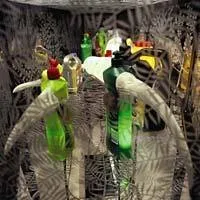
Hall's work is about our need to realise our own connection to nature, yet ironically I feel I'm being talked at rather than being allowed to feel anything. This is at its worse in the most recent work Mourning Chorus, which features the beaks of endangered New Zealand birds attached to lit chemical bottles set in a glass coffin. No room is allowed for anything other than that which is so thumpingly obviously stated.
There's no doubting the appeal and strength of much of Fiona Hall's work, but filling City Gallery with a survey of her work, reaching back to photography work from the 1970s and 1980s, only emphasises for me how rare such luxurious treatment for Hall's New Zealand contemporaries is.
Force Field: Fiona Hall, City Gallery Wellington, until 19 October
See previous articles by Mark Amery
Related story
Australian artist mourns our flora and fauna
12/09/08