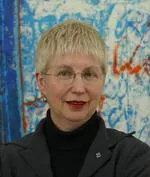
Elizabeth Kerr CE of Creative New Zealand talks to the editor of tbi
We sent some questions to Elizabeth Kerr, Chief Executive of Creative New Zealand asking her to comment on a range of issues including, the mysterious arts economy, the new terminology 'creative industries', the state of arts education, new media, biculturalism at CNZ, and new international opportunities etc. She sent us the following generous and very interesting reply.
Image: Elizabeth Kerr CE of CNZWe sent some questions to Elizabeth Kerr, Chief Executive of Creative New Zealand asking her to comment on a range of issues including, the mysterious arts economy, the new terminology 'creative industries', the state of arts education, new media, biculturalism at CNZ, and new international opportunities etc. She sent us the following generous and very interesting reply.
Image: Elizabeth Kerr CE of CNZJacquie Clarke for tbi: I wonder if you could please comment on the nature of the arts economy. I regularly read Take, the NZ Screen Directors Guild magazine and I notice from reading it that people in the film sector have a strong sense of a film economy that they are participating in - anywhere in the continuum between mega-budget blockbuster and quirky edgy short-film production. There is a confidence in that sector in its revenue-building abilities. The arts economy in comparison seems deeply mysterious. A month or so ago The Listener ran an article about investment in New Zealand art and profiled some investment stats re a few high-yielding artists. More recently there was media covering a disappointing auction of New Zealand art. However despite that type of activity the creative economy still seems mysterious to those who are newly emerging into it?
Elizabeth Kerr: The interesting thing about the creative economy is that it thrives on talented individuals and creative teams who are able to utilise their imagination, creative ideas and skills to create products, projects and services that generate and/or exploit intellectual property (IP). Typically, the ability to do this successfully relies on developing good networks and relationships, and a willingness to work collaboratively, often across disciplines. In addition, people in the creative economy are adept at utilising multi-media and digital resources to either get the job done and/or to promote and distribute the creative project effectively. Unlike older economic models based on known, often place-anchored modes of organisation, the creative economy operates in a milieu that is dynamic, multi-dimensional and international in its outlook. It is an economy that actively seeks novelty and it operates in an environment that has a high tolerance for diversity. Understanding how to successfully generate work and income from within such a complex scene is difficult. Many of the processes and opportunities that will deliver revenue in the short or long term are invisible even to those who are actively engaged. Or they are so reliant on market and other factors, that financial certainty in advance of actual income and / or sales is very difficult to predict.
tbi: My impression is that the many fields of creative sector enterprise and innovation act very independently of each other, eg. film, design, music etc. What do you perceive the connection is between the arts and the creative industries?
Elizabeth Kerr: I believe that the arts and creative industries are interconnected, even enmeshed. Both sectors drive creativity and innovation to generate new meanings, approaches and/or solutions to various opportunities, challenges and/or problems. Both sectors are vital contributors to New Zealand's economic growth and development. The creative industries sector however is more firmly connected to the market economy than the arts sector which has not traditionally relied on market-driven economic forces to deliver production and consumption. For instance, there has been a willingness within Government policy in New Zealand and other western countries to underwrite arts activity where there are perceived cultural and social benefits (ahead of or alongside economic returns). What connects the two sectors are highly creative practitioners who are not afraid of risk, their quest to bring to life great ideas that are often fuelled by the imagination and a willingness to work in flexible, highly creative ways to deliver the best ideas into the public domain and / or market place.
tbi: How do you see the role of 'new media' within the creative sector as previously clearly defined practices keep morphing into hybrid forms such as digital sound performance, 3D publishing, online interactive exhibition sites, techno opera, as well as incredible developments in digital design capability?
Elizabeth Kerr: In New Zealand, as in the rest of the world, this is an exciting and developing area of practice and Creative New Zealand is currently undertaking sector consultation in this quarter. This consultation will help better inform Creative New Zealand about this area in a general way, as well as from a funding perspective. We have already taken steps to make this clearer in our new funding guide, with the introduction of a new section that specifically provides information and advice around this subject (pp 79 - 82).
In the main, despite the changes taking place and the morphing and hybridising you refer to, it is still possible to separate out the key artform that is driving a particular project or activity (you have done that in the examples you provide) and what we are finding is that the various artforms are themselves adapting and absorbing the changes that are taking place and which might be impacting on their particular domain.
tbi: I've heard much speculation over the last few years about the large numbers of creative graduates emerging into the creative sector community every year. Do you see that the education sector is in a sort of short term boom cycle with its emphasis on design and creative programming. Is it sustainable?
Elizabeth Kerr: I do see that the education sector is in a growth cycle with regard to art and design and creative offerings. One of the recent developments in this is the rebranding of arts and design programmes under Creative Industries banners. In some institutions, this has been part of a rethinking and restructuring of academic programmes and has led to a more cross-disciplinary approach while in others it could be seen as largely a repackaging of relatively unchanged programme content.
You ask whether this is sustainable. It's difficult to tell. In many ways academic institutions are offering programmes in response to market demand. Many in the arts sector ask a different sustainability question related to the career prospects for graduates of arts and design courses. It's very difficult to make any predictions in this area with any great confidence as well. However, looking back over changes to both compulsory and tertiary education programme offerings over the last 30 years, it is possible to see links between more comprehensive education offerings in the arts and a growth in student interest in the arts and subsequent growth in real work and income opportunities for graduates of these programmes. This is particularly evident when looking at the visual arts and design sectors.
tbi: Creative New Zealand recently advised of two new Asian residencies - one in China and one in India. Do you perceive more Asian networking possibilities in the future for New Zealand artists?
Elizabeth Kerr: Creative New Zealand has recently launched two new artists residencies based in Asia; one in Beijing and the other in New Delhi. The agreements with these two hosts resulted from an extensive investigation of suitable residency hosts in a number of countries in Asia. While the Arts Board has set aside funding for these two inaugural Asian residencies for a two year pilot programme, it is also keen to receive applications from artists for residencies with other Asian hosts. Creative New Zealand has identified a number of residency hosts in other countries that may be suitable for New Zealand artists across all artforms and is in the process of making this information available on its website. Artists are encouraged to contact these hosts directly and if they reach agreement with the hosts about their suitability for the programme they may then apply to Creative New Zealand during the biannual funding rounds for support to undertake a residency. The Arts Board hopes that its inaugural initiatives and the support it may provide through project funding will lead to increased and ongoing professional development and cultural exchange opportunities for New Zealand artists with our Asian neighbours.
tbi: Creative New Zealand is known and respected for its profile as a bicultural organization. How will CNZ keep negotiating this cultural mandate in an increasingly divergent cultural environment?
Elizabeth Kerr: Acknowledging Maori as tangata whenua is embedded in our organisation. It begins with our legislation and is manifested by our structure, our policy and the way we work on a daily basis.
The Arts Council of New Zealand Toi Aotearoa Act 1994 establishes two arts boards. Te Waka Toi, the Maori Arts Board works on the principle of “for Maori by Maori†and is serviced by Maori Arts Services. The Arts Board is a general board, catering for all the diverse cultures within New Zealand. The Pacific Arts Committee is a sub-committee of the Arts Board and is supported by a Pacific Arts Advisor.
This structure supports three of the principles in the Act which direct that we shall recognise:
• the cultural diversity of the people of New Zealand,
• in the arts the role of Maori as tangata whenua
• the arts of the Pacific Islands' peoples of New Zealand
So our strategic decision making, targeting of resources, arts development initiatives, funding and assessment committee criteria, as well as our publications, all reflect the principles above. Our “bi-cultural†mandate will be maintained alongside our work with other ethnic cultures.
Creative New Zealand is currently developing a new strategic plan for 2004-07. One of the strategic priorities identified in the draft was the need to develop a formal cultural diversity strategy (bearing in mind that Creative New Zealand already supports many projects and initiatives that are culturally diverse). In the development of the cultural diversity strategy we have made an explicit commitment to recognising the role of tangata whenua.
“Cultural diversity†will be interpreted by Creative New Zealand to encompass the diversity of New Zealand's ethnic (including refugee and migrant) communities, communities of interest (eg. youth, people with disabilities), as well as communities of place (eg. rural, regional and urban).
In feedback received about the draft strategic plan, 70% of the respondents strongly supported this priority.
The development of Creative New Zealand's cultural diversity strategy will be dynamic. We will work with community leaders and artists of the many diverse cultures within New Zealand - and we're very excited about the possibilities in this work!
Thank you to Elizabeth for her considered and generous response. Ka kite.