Dunedin dance filmmakers win Spanish film award
Written by
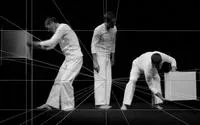
Dunedin choreographer and film maker Daniel Belton has just won a prestigious international film prize at a Spanish Film Festival for his film Figure[s] of Speech
Image: Figure[s] of Speech still from the film influenced by the Bauhaus movement.
Read on for an interview with Daniel from the Spanish media outlet CANARIASMEDIAFEST 2004
-With Figure(s) of Speech do you want to tell that body language is more pure than a language?
If you pull back to any impulse, to a feeling or thought, to the intuitive; then you can see that this place is very fragile, and often difficult to 'fix' into words either spoken or written. Dunedin choreographer and film maker Daniel Belton has just won a prestigious international film prize at a Spanish Film Festival for his film Figure[s] of Speech
Image: Figure[s] of Speech still from the film influenced by the Bauhaus movement.
Read on for an interview with Daniel from the Spanish media outlet CANARIASMEDIAFEST 2004
-With Figure(s) of Speech do you want to tell that body language is more pure than a language?
If you pull back to any impulse, to a feeling or thought, to the intuitive; then you can see that this place is very fragile, and often difficult to 'fix' into words either spoken or written.Right now is a good example. I'm sitting at the computer trying to put my thoughts in writing and it feels clumsy, for me the process necessitates a loss, distillation, a compression. Any form of compression from its original source faces similar issues, that is, a sense of loss or even inadequacy as we try to express ideas and feelings to others.
The need for signal and data compression is ubiquitous in dance, image, video, and speech processing, finance, and computational science. Where data stores become very large the need is not met by simple file compression schemes, and we must turn to sophisticated coding techniques. The saying 'a dance is worth a thousand words', hints at similar sophistication in coding of movement. Learning like this, and stories conveyed through the act of actually imprinting our physicality and our whole energy in space, affects in a way that music, literature, painting, and even sculpture cannot. The ephemeral nature of dance carries a fragile and powerful essence. There is no other voice like it, but it too relies on coding and reading of communication codes.
Every stroke of the pen, every letter and word can hold importance, and is valid, but I am interested in the mark of the body in space, our whole energy working space, engaged in space. This can come down to the closest focus, the smallest movement of a finger, the breath, the heart pulsing, it is subtle, and it can also be explosive. The body library, our own individual biological library is buzzing with life, and is therefore constantly in flux. In one sense a 'books library' is full of dead words. When things fall into words they usually descend. Words have an earthy gravity. We have become so cerebral, so reliant on and bound by words.
In the film, the dancer is anchored in space by the cube- the flume chamber, and the line. Increasingly our technology works in the digital medium and everything we engage by these digital tools speaks in squares of datum; pixels and mosaics of the square. Notation is referenced as Neumes. Print block typography and charting or marking space defines a linear mode of thought. Without these elements the human figure would be completely freeform in the screen space. These objects with which the dancer interacts enable an illustration of space that can at times defy gravity. I wanted to show how the line, the boxed flume chamber and the cube present forms of restriction and at the same time they allow reference points in space, from where the dancer can work. The word 'reflective' is also appropriate for the obvious reason that in order to have a reflection you must have a surface or dimension to reflect from. At the very end of the film following the credits, we see an attempt at writing by Pepa, my daughter, then aged 3. The 'letters' are abstract and almost hieroglyphic.
Even though there are 6 billion humans with shared contexts and understandings, we all use and interpret language as individuals. However, is there one single language that has its source in movement and can be best understood through geometry? If we perceive ourselves and our world in geometric terms, then dance may be regarded as 'moving geometry'. Movement, consequently, can be seen as the basic 'datum' that holds meaning and provides the communication.
Instead of forming conclusions, the film has I believe opened up yet more questions about how we communicate.
-What did you wish to express with your work?
What can be found and created by looking at the intersections between language,
code and frequency in relation to human movement?
For the project I have developed a choreographic template which is activated within several specific environments. These environments enable the mouthpiece - or a 'voice' of expression unique to the film. This 'way of moving' is a kind of excavation; focused with the intent to search, to seek out, to delve beneath surface.
Consistent with how we speak, I employed a type of physical punctuation which could 'still' the choreography so that segments of what is made or built can complete in a series of tableaux. I hoped to convey a kind of unwrapping in this process. This can also be related to the post modern concept of unpacking: going back into the object or story and seeing it as the product of situations in culture.
We create ideologies and systems, project into, mark out, and imprint our journeys on each other and the world around us. Our responding to words and language means placing these interpretations inside a kind of 'living library' within each of us. Everything is archived in our cells. Our life journeys are recorded and coded into us as we create them.
Dance is regarded as the oldest of the arts, requiring only the body as its instrument. Just as the child learns to gesture and to walk before speaking, so is it believed that communication began in the earliest times through movement.
-Your idols? Who are your inspirations?
In the film there are references to, or influences from the Bauhaus movement: their Form Dances, and design ethics; from Rudolf Steiner's eurhythmy; to our early modern dance pioneers. There are references to ancient Greece, the golden age, ancient structures, sacred geometry, and to Socrates, Pythagoras, Plato, and Aristotle. Sumerian writing systems, cuneiform, hieroglyphics, signing, semaphore, Braille, Morse code, music notation, neumes, alphabets, typography, and print are all informing the film choices made. References to the anatomy of speech, spectrographic analysis, internal radiologic images, and endeovideoscopy of the larynx are merged with children's voice, spoken language altered, and, with communication technology sound.
There are also deliberate and meaningful links to my previous works for both live performance and film: Tongue , Hampshire Dance Festival, England 1994; Time-Flexor, Unitec, Auckland 2003; Foil, New Zealand School of Dance, Wellington, 2002; Whai, Black Grace Dance Company, Auckland, 2002; and, the two films from my own company Henge, 2001, and Lumin, 2002, made in Dunedin, NZ, and screened internationally. If you were to view the works in succession you would see clear and careful shared vocabulary. They can be seen as part of an ongoing series of work which is pulling me in a new direction. Figure(s) of Speech represents a significant step towards where I want to take my work.
DUNEDIN DANCE FILM-MAKERS WIN TOP INTERNATIONAL AWARD
Dunedin choreographer and film maker Daniel Belton has just won a prestigious international film prize at a Spanish Film Festival - beating off competition from over 400 entries from around the world.
Belton and film maker Jac Grenfell took the top prize in the Best Art Video category at the International Video and Multimedia Festival of the Canary Islands in Spain for their dance film 'Figures of Speech'.
"Winning this prize is a fantastic boost. I've been moving from dance into dance film over the last few years, and it is wonderful to get this affirmation from Europe that here on the edge of the world we are cutting edge - and that audiences there love it."
Daniel Belton was was last year awarded the Creative NZ Choreographic Residency in association with the University of Otago Dance Studies Programme. "Being recognised at this level is a real leg up into the international art video market. We've just finished a new film which we're sending out to some festivals - so watch this space!"
Belton and Grenfell are preparing a special video to be played at the Awards ceremony in Spain on Saturday because there is not time for them to travel there in person. Belton says they'll buy a great bottle of Spanish wine with the $7000 prize money - but the rest will go on state of the art film equipment.
Good Company Arts was founded in 1999, and specialises in performance film and digital art.
IMAGE (c) copyright 2004 www.jacdaniel.net