Diamond in the Rough
Written by

By Mark Amery
The relationship between public display and private commerce is pretty explicit when public and dealer gallery both exhibit the same artist at the same time. You like the work? You can buy it over there.
Yet, crazily, given the interest there should be in a dealer showing new work by a celebrated artist the connection is usually discreet. It’s rare for a public institution to even mention there’s a dealer show on at the same time. As if things might be sullied by the mention that art is actually for sale.
A survey exhibition of leading German jeweller, now Island Bay resident, Karl Fritsch at City Gallery is currently complemented by a showing of new work at his dealer Hamish McKay, and even come with a joint brief catalogue (essentially, it must be said, a brochure). McKay continues to keep City Gallery close, having already staged in 2010 exhibitions by Seraphine Pick and Milan Mrkusich simultaneous with their City Gallery surveys.
Anything wrong with that? Not really. As much as we don’t like the smell of private money around public spaces it’s blatant these days in so many other respects. Perhaps we’re not far off returning to work being for sale in public galleries.
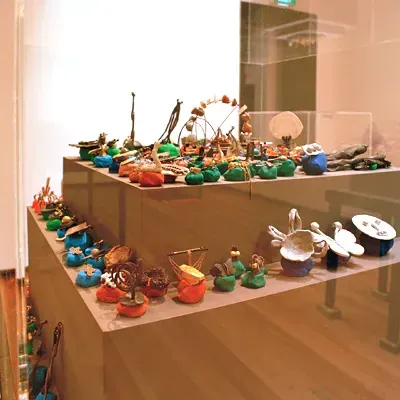
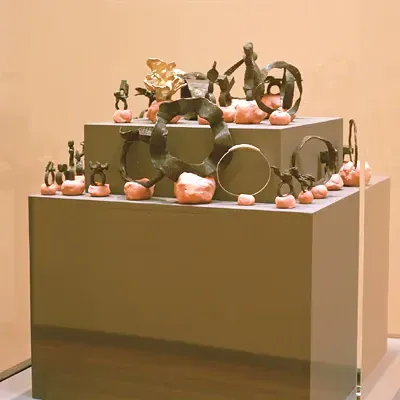
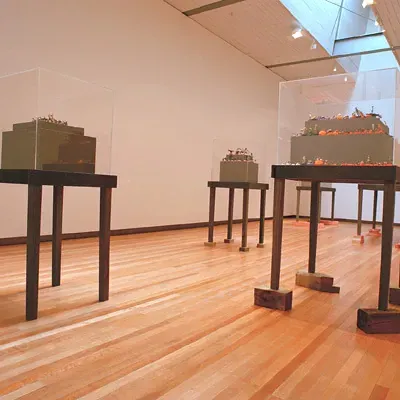
As he does with his jewellery, with his display at City Gallery Fritsch twists tradition into lively contemporary animation. He mimics but then plays with the conventions of the grand museum vitrine display of rare artefacts. Like temples to the tiny, the work is presented in tiered displays, yet these are then jimmied up on rough blocks of wood, disturbing the illusion of permanence and status.
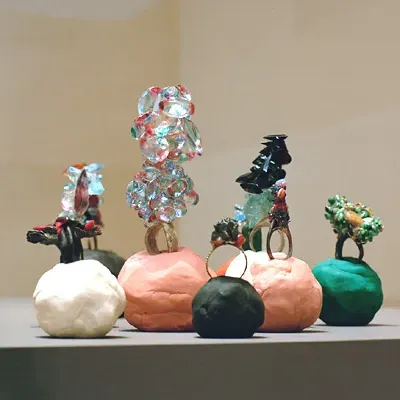
As the exhibition title Scenes from the Munich Diamond Disaster suggests, the pristine presentation of gems has been upturned, as if some artist jester has been at work after hours. There is a precarious profusion of divergent materials in explosive clusters, sprouting like fungi from brightly coloured lumps of plasticine. That might sound ugly, yet it is both beautiful and original in the way it builds new ideas out of both championing and questioning the old.
I often find the small dealer gallery shows of recent work more engaging than the bulky survey exhibitions that have become such a staple of public galleries. And so it is here. The sheer number of items in close proximity at City Gallery makes it hard to appreciate them individually.
As much as I like the presentation at City Gallery the objects remain in a kind of detached theatre behind perspex. Rings are made to be worn, and at Hamish McKay Gallery they are not behind glass. They lean out towards you from plasticine on charmingly wonky makeshift shelves. They ask you to pick them up and try them on,.
Here again Fritsch subverts gallery presentation with the humorous and provisional. The dealer’s coffee table has been suspended on top of two plinths (the usual mode of object display). On top are silver salt shakers, from which have grown rough and eloquent abstract shapes.
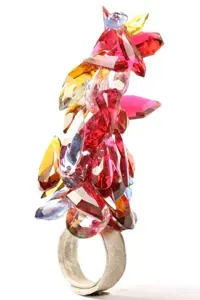
A jewel is usually treated in the opposite way to plasticine. The ring in a jeweller’s window is all clarity and perfection, industrially polished of human marks. It looks like another you’ve already seen, just bigger, more intricate or brighter.
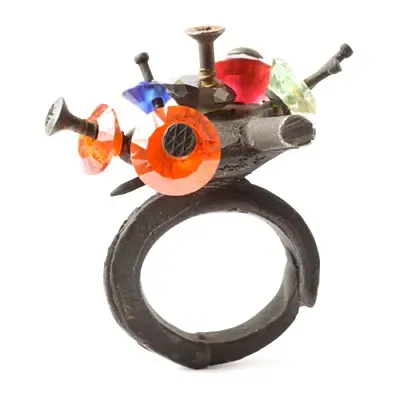
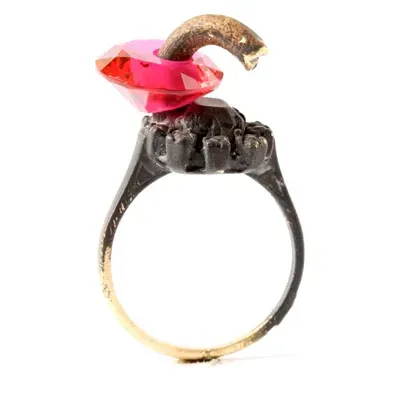
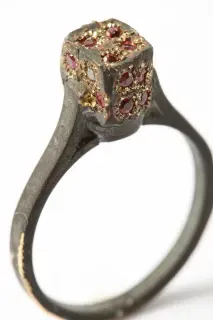
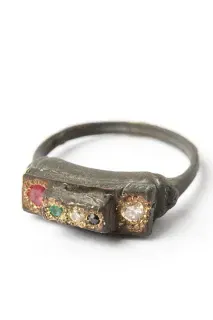
Fritsch’s rings are everything these standard rings are not. The harsh marks of their creation are made a virtue of. They speak of the earth from which materials come and, in their use of rusty screws, pipes and nails, the industrial process that build a culture. On top of blackened and sooty gold and silver in traditional settings gems are literally pierced through by piping. Value is complicated.
Fritsch’s use of plasticine underlines that his work is all about process, play and the human mark. Ideas are visibly being wrestled with, toppling over one another to find new shape. The work teases, at once violent and provocative and playful and fun. In meaning it asks to be played with - much as you can have fun with the McKay exhibition title ‘Some Rings are Fuckwits’.
Most jewellery I see avoids tradition in favour of the ironic elevation of everyday material. Fritsch however tackles the past head on, as respectful as he is disrespectful of his work’s roots. The work feels powerfully of both past and present.
I adore the complex animation of each ring. Pushing and cajoling every which way, they explode with fractal energy before coming together with one great thrust. Like punk, a refined order is found in subversion. These rings can feel like weapons (and some could be used as such), yet just as one provocative assertion is made it starts to curl in on itself, or break off as another takes root.
The work reminds me of the visibility of history in a European city like Berlin, the pockmarks of the recent past visible in the sides of old buildings, with the present asserting itself alongside. The rings often look as if they have been buried or subsumed by fire, the past glittering through grimy layers.
There is the sense that each ring has a rich patina of stories to be slowly rubbed into life by their wearing.
Scenes from the Munich Diamond Disaster, until 16 January 2011, City Gallery Wellington
Some Rings Are Fuckwits, until 9 December, Hamish McKay Gallery