Destiny Deacon - Walk and Don't Look Blak
Written by
Destiny's Child
- Courtesy of Dominion Post - 2005-04-14
By Mark Amery
One of the clearest differences apparent to me when visiting Australia between us and our neighbours concerns race relations. While the Australian government continues to refuse to say sorry for two hundred years of prejudice and oppression, the white liberals I have met tend to quietly apologize and then stare at the ground. Destiny's Child
- Courtesy of Dominion Post - 2005-04-14
By Mark Amery
One of the clearest differences apparent to me when visiting Australia between us and our neighbours concerns race relations. While the Australian government continues to refuse to say sorry for two hundred years of prejudice and oppression, the white liberals I have met tend to quietly apologize and then stare at the ground.Guilt and denial abound. While in New Zealand we struggle through the necessary lengthy negotiation over rights and what biculturalism really means, in Australia Indigenous grievances have yet to be recognised.
This distinction is often apparent in the visual and performing arts. While highly sophisticated and progressive, contemporary Aboriginal work can often in its concerns feel more reminiscent of contemporary Maori work of the 1980s and earlier.
Case in point is Destiny Deacon, one of Australia's most significant artists of the last 15 years. She is the subject of a major survey exhibition, Walk and Don't Look Blak currently at the Adam Art Gallery, following its closing at Sydney's Museum of Contemporary Art in January.
Deacon is a self-taught political artist dealing with issues of identity, gender and appropriation and the politics of language and representation. Issues with which we in New Zealand are now long familiar. Her work bangs on brashly with raw, ragged energy and strong colour about the racism of white Australian stereotypical representations of contemporary Aborigine, reappropriating their use to comment on the continuing oppression of a race's stories and lives.
One is tempted when faced with her reappropriation and manipulation of Kitsch White Aboriginal memorabilia, or 'Aborginalia', to cry 'been there, done that' and ask when after 15 years of these ploys is Deacon going to move on. Yet you also have to remind yourself of the economical and political differences of the Aboriginal situation, next to Maoridom's re-empowerment.
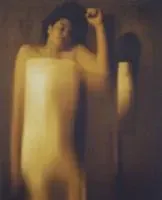
Deacon's most common prop is the black plastic doll, reanimated, dislocated, redressed and manipulated with great expressive skill. The dolls' essential inanimate qualities remind us, disturbingly, in these videos and prints of a continued helplessness. Deacon is an adept animator, the dolls are lifeless in limb yet strangely expressive emotionally in face. There's a lingering powerful trace of the spirit world in both their eyes and Deacon's photographic action. It is as if through mask and performance something integral to the world beyond is being evoked, to be felt in the blurred, colour-saturated spaces that are left to hang in the picture frames.
Deacon is essentially a performative artist, reimaging and restaging her and her family's own life in tragi-comedy soap operas. These vignettes wring out the complexities and contradictions in contemporary Aboriginal urban life utilising photography, film and installation. Any sense of empowerment however is always tempered by the helplessness of dispossession - in a New Zealand context I found this ultimately frustrating
Formerly a broadcaster, actor and activist, Deacon skewers cultural cliches with sharp wit, keen emotion and a strong grasp of the power of melodrama. Her tribe is a subculture of Australia's cities. Living in rundown rented accommodation, within the stereotype children are always lost and orphaned, car tyres flattened, mothers' and father's violent and alcoholic. Here those stereotypes are played up to and against, with as much warmth and joy in the communities enacted as there is pain in dislocation. A sense of community is maintained as much as it is lost. Like Tracey Moffatt (her more glamorous and commercially-sexy contemporary Aboriginal counterpart) Deacon's impetus to becoming an artist was not liking the way 'whiteys' depicted her own people in photography.
Children are to the fore in Deacon's work, hiding behind masks (reappropriating figures like Elvis and the Black and White Minstrel) while adults engage in games with them which play with stereotypes. In the powerful videowork 'Forced into Images' two children sit before the camera, wearing the oppressors demon-eyed masks and alternately suck thumbs and poke out tongues. The effect of the role-playing in the stronger work like this is complex, both sinister and playful, as the subjucated play at being the oppressors, and take control of the way they are framed while at the same time remaining trapped within it.
This survey exhibition is crammed full, not always to the work's benefit. You feel like you're being hit over the head repeatedly with a golliwog. The blatancy of Deacon's approach is arguably more effective in more tightly-curated doses, with the more complex work given more space. Once you've seen brown baby dolls laid out in a baking tray like Chocolate Crackles, or two white boys waving Union Jacks whilst a brown doll and rubber cane doll lie carelessly under their feet, the message is understood. The complexities start to become diluted, and the ironies come stated in capital letters with little shift into a deeper experience.
There is much to savour taken in smaller doses. I was taken with Deacon's increasing adeptness with photography. There is an appealing artful artlessness, with her love of the 'el-cheapo' (as she describes it) self-taught approach in a nice conflict with her increasing sophistication. The transference of Polaroids to large lush digital prints make precious packages out of gritty, direct subject matter. In her artlessness she is again role-playing. At the same time she makes strong art historical and abstract associations which emphasise emotionally her themes. You sense she is connecting into something 'other' through the learned action of making work, with all its meditative and accidental actions, as Indigenous artists have done before her. In 'Princess' for example a doll in blood red pants on a bloodied pedestal is on a tilting stage, the image shot through with yellow, referencing both the great symbolic abstractionist Joan Miro and Deacon's own concerns
There are also series here that see Deacon deviate in her approach to her concerns. While the recent 'Camouflage' series felt rather old hat, 'Postcards From Mummy' from 1998 is a refreshingly different poetic approach to the repossession of landscape and memory. In this powerful series Deacon photographs places from her mother's Queensland childhood, reimagining her history through her mother's eyes. We the viewers string together a narrative across landscapes that reference both unspoilt innocence and possession and protest.
Deacon's shares the gallery space with Recent Works from contemporary Maori artist Lisa Reihana. They have shared many similar concerns over a similar period of practise, and also an interest in working as performative artists across media. While in the Sydney exhibition Deacon recreated her own Brunswick, Melbourne living room, here with Reihana they create a shared living room, a composite repository for the display of their collections of 1950s and '60s Koori and Maori kitsch.
Walk and Don't Look Blak, Destiny Deacon until May 1, Adam Art Gallery
Mark Amery
Script Development Manager, Playmarket
www.playmarket.org.nz
New Zealand's playscript advisory service and playwrights' agency
Tel: +64 4 382 8462
Fax: +64 4 382 8461
developer@playmarket.org.nz