Death of a Stream - Call for artists and exhibitors
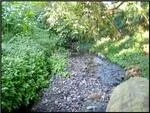
A call to all artists to document the dying moments of one of Auckland's most remarkable and forgotten heritage sites - the Waipapa Stream in Parnell.A call to all artists to document the dying moments of one of Auckland's most remarkable and forgotten heritage sites - the Waipapa Stream in Parnell.A call to an Art Gallery to run an exhibition ' Death of a Stream' showing the work of Auckland artists on this subject of the Waipapa. Following the exhibition, selected art work will be secured in a time capsule for opening in 2040 when Auckland celebrates the bicentenary of its oldest suburb, Parnell.
The Issues
All sites along the last natural vestiges of this stream are now under threat by developers. Myopic planning and ill conceived gentrification policies of Auckland City will most probably lead to a final demise in 2003.
In 1860, the Waipapa was the only survivor of the 5 major streams that defined the central Auckland.. It is a miracle spring fed remnants of the Waipapa have survived until the 21st Century, it is a travesty these will be now lost to the barbaric practices of intensive rail-side town housing.
The Waipapa
The Waipapa stream was selected by Gov Hobson and Ngati Whatua to define the Parnell boundary of NZ's oldest park, the Domain, in 1840. From 1840 to 1870, the pure spring waters of the Waipapa were used by Auckland's first brewery (near site of Lion Nathan), distillery, and baptisms by the first churches in Parnell. The power of the Waipapa's flow was harnessed by the first flour mill (Low & Motions), and Mr Robertson's Rope Walk. This Rope Walk was opened in May 1843 (160 Years ago and manufactured rope spun by the Waipapa, and was the birth place of Auckland' s maritime Industry.
The Waipapa is also rich in Maori history, having a roles in both nurture and warfare. It's steep banks served as a natural moat protecting two flanks of the mighty Pukekawa Pa (now site of Auckland Museum). The Waipapa has a long history as a killing field through centuries of warfare, and struggle to control this strategic resource and access way between Harbour and the inner isthmus. There are important associations with Ngati Whatua, Ngati Paora, and Tainui. Also with Te Wherowhero (later the first Maori King), and 1846 internment of Te Rauparaha by Gov. Grey in Te Wherowhero's house on the banks of the Waipapa.
Parnell was established nearly 200 years ago around the Waipapa Stream. Auckland first land sales took place along the banks of the Waipapa. Only Claybrook House (1842) remains today.
What we would like
Protection and enhancement of the Waipapa with a natural publicly accessible reserve, and reinstatement of the Waipapa into its original stream bed from the Old Parnell tunnel to Carlaw Park. Such an eco-heritage project could attract international praise for New Zealand.
How to find the Waipapa
The last natural vestiges of the Waipapa survive from the old Parnell Tunnel (built between 1865-1872) at the back of 21 Birdwood Cres., Parnell to the Ngahere Terrace steps (off Gibraltar Cres., Parnell). The easiest way to reach the stream is via the Ngahere Terrace steps. From here you will see a small cascade of clear spring water spitting into a storm water pipe - this is the end of the Waipapa. Explore up stream, past the wrecks of old rusted trains, and you will find yourself in a charming wilderness of one of this country's most historic of sites.
To learn more about the Waipapa
read the 22nd February edition of the Listener. There is an excellent two page feature entitled ' Springs Eternal' by Alistair Bone, photos by Jane Ussher.
Radio NZ - Aired National Station Sunday 23 February 03. Copies of this programme can be acquired through Replay Radio.