Dan Salmon interviews Michael Apted
Written by
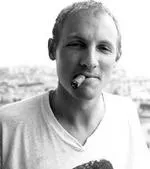
Dan Salmon, new President of the NZ Screen Directors Guild, recently attended the third international meeting of English-speaking Directors' organizations in Dublin. He interviews Michael Apted - president of the DGA (Directors Guild of America) - about Guilds, the directing business and the business of directing.
Image: Dan Salmon with smoking fire stickDan Salmon, new President of the NZ Screen Directors Guild, recently attended the third international meeting of English-speaking Directors' organizations in Dublin. He interviews Michael Apted - president of the DGA (Directors Guild of America) - about Guilds, the directing business and the business of directing.
Image: Dan Salmon with smoking fire stick(Michael Apted is an interesting appointment as the DGA's president not least because he is British, but also because he manages to
balance documentary making, including the 7Up documentary series, with a highly successful career as a Hollywood director. His American
feature film credits include Coal Miner's Daughter, Gorillas in the Mist, Nell and more recently Tell No One, Enough and Enigma, with
Scheherazade in pre-production. Less well known is that Apted's eclectic resume as a director, writer and producer also includes a small acting role in John Landis' Spies Like Us as an 'Ace Tomato Agent').
DS I thought we'd better start by talking about the role of a directors guild as that's why we are here.
MA I've always been very aware of the need for the Guild and committed to the importance of that, both to provide a normal trade union
function - the protection of economic and bargaining rights - but also to protect and constantly reassess creative rights. This is a period (at least for America) where we are on the back foot. The industry's tough: money's tough, multi-national corporations run the place, and wherever I look everybody is scrambling to get stuff done and to create their territory, whether that's television or the writers
trying to establish territory at our expense. In movies it's the producers and studios with their hair-raising schedules.
But beyond all that, I've always found the most enjoyable and rewarding part is the Guild's collegial atmosphere because directing
is a very lonely job. It's weird, you never see how other directors work but at least with the Guild you get to talk to them. I find that both educational and informative as well as being just sort of emotionally helpful to chew the fat with other directors, finding out what they go through and how they deal with things. I like talking
with and meeting other directors, so the Guild works for me on all sorts of levels: political, economic and human. And, too, it's good to be collaborative with people who do the same jobs as us. Frankly, it makes us better directors to be part of these kinds of organizations.
DS Is there a tension between your being English and President of the DGA?
MA Yeah, it's kind of weird isn't it? I think I'm the first foreign president of the Guild although I have lived in America for 20 years and have dual citizenship. I don't think there is a tension, and I am more jumpy about it than anybody else. It's never mentioned and I always feel odd about it but, in a time when we are trying to internationalise the Guild, it is a strong calling card. So I think it worries me more than it worries other people and I'm not sure why it
worries me, except at the end of the day I've been accepted as an American director when, in fact, I'm not really, I've never seen myself as a mainstream American director at all so it is a slight oddity.
I'd been ambitious for the job for a while, and wondered whether it would be possible though I was never asked for my passport or even if
I was an American citizen. So at the moment I only see an upside and, too, the great thing about having an English accent is that people
think you are smart. Americans are intimidated by English accents so I've always kept my accent and traded on that. I'm living off its patina of intelligence.
DS Tell me about the DGA's internationalisation?
MA I haven't been president for long but once it was put to me, it did kind of fit. Jay Roth (DGA National Executive Director) and Warren
Adler (DGA Associate National Executive Director) saw it as opening up possibilities, which hadn't really occurred to me until I was in the
job. We are involved with other international organizations but this hasn't been a very aggressive feature of the Guild, however this is a
bit different as we are now really trying to get more active and aggressive. Not just meeting and being chummy but putting these relationships to some kind of use. Actually getting out there and
offering help to smaller countries, smaller guilds. It's a two-way street. It's in our interest to internationalise the job, it's financed internationally so we have got to be international.
And, without losing any of our (each country's) indigenous needs, impulses and dynamics, I think it's good to have an area of our institutional mind that looks beyond, that is international. I went
for it like a duck to water. Americans aren't that good at being international so in a small way one can help grease the path a bit, it's time America presented a different face.
DS There is a fear, voiced in the smaller guilds, which goes: 'what is America doing, is this some kind of DGA take-over?'
MA Yeah really, and I think we were more paranoid about it than you. I mean if we had an agenda (here in Dublin) it was the reverse agenda of not appearing bullying, imperialist or anything. We were absolutely paranoid about being conceived in that sort of way. It did make us nervous. And there is the genuinely huge issue of American culture flooding the market at the expense of local indigenous work. We want
no part of that, but are associated with it simply by being part of the American entertainment industry so we are very aware and jumpy
about presenting the proper face to our international colleagues.
DS We don't have collective bargaining rights, but we can lobby for economic conditions although without the clout of a union. And we also
lobby hard for creative rights. How do you think these two aspects of a guild's role fit together?
MA They are separate but it's more powerful if they are integrated. When we started this (the Dublin Declaration) we found, in a sense, that we had two separate documents (creative and economic), but that there was so much overlap it would be better to make one document,
even though we gave it two chapters.
I don't know where you start. If you come from a trade union background then it starts economically, but if it's more a guild (like
the DGA began) then it comes from creative rights. The impetus for the DGA's beginning came from great directors like Capra, King Vidor and,
subsequently, Ford, Hitchcock and David Lean, etc, saying: "We've got to organise ourselves".
The big thing I want to say to younger guilds like the Irish or Australian or your guild, is that it's important that the best, the brightest, the rich and famous, rally round and support it. In the US
the heavyweights had that sense of community, they wanted to create those rights for everyone in the job, to feel that we could work better and be stronger if unified.
What's been impressive here (in Dublin) is to see Jim Sheridan and Neil Jordan turn up, show their faces at this laborious meeting and say: "We're with you". And that's very powerful. I would hope your world-class directors - of which you have many - will rally around because the only way you can get going is to have that kind of muscle.
It's your important television and feature directors - the guys who have achieved fame and wealth - who have that muscle. Otherwise it is
hard to get it started...if you are not empowered it is very hard to create power. But if you are incredibly valuable as a commodity, as an
artist, then you can make people listen to you.
DS What concerns should we have for the future of directing?
MA Well, I think serious concerns. I can see we are being marginalised in America. I can see it in television where directors are treated, and some behave, like traffic cops. They just come in and shoot, so the power of the job is diminished, anyone can do it; and in news and sport, associate directors now edit. So I think we are threatened on all sorts of fronts. Other people - like actors, producers' friends and so on - come in and direct, and that stuff is hard to deal with. I
feel we are threatened everywhere, including technology, although we have to grow up about this and learn to make it work for us.
In my relatively short time in America, I've seen accountants and lawyers take over the business, all people are concerned about is the opening weekend. The director is making product and no one is interested in the director as artist, or in the director's vision. The director is just someone who can deliver the picture on time, on budget and keep everybody happy. I think there may be some 'facts of life' in there, but I don't think we want to see ourselves as traffic cops, I really don't. If we are not careful and don't gather our
strength we will be seen as, and treated like, traffic cops. These are the fears we have to hang on to and this is the purpose of the Dublin
Declaration: to identify who we think we are, the dignity and importance of our job. There are so many junky movies made these days and we all think the more the director is disregarded, the worse the 'product' becomes. If the product gets terminally bad, then people will walk away from it.
DS I get nervous when we talk about the director as artist because I think, well where's the art... (then we all go to Jim Sheridan's 'In
America' and cry like babies)
MA It's there because it's manifest in the history of the form, and if movies cease to deliver people will get bored and move on. Films have to appeal to all sorts of people. If they just appeal to teenage boys, or teenage girls, and we lose contact with any mature or adult sensibilities, then we are just going to be dispensable and
disposable, like fast food.
DS What sort of relationship do you see between the DGA and the SDGNZ?
MA The DGA has expertise and resources to give you advice and help. I mean you should stand up on your own, but if we are in an alliance then we can be very helpful and work with you and for you. I was talking to the Irish Guild about sending people to Ireland, or bringing people to America to talk and watch films being made, just
that social intercourse between directors. I think that's important.
But I think in the end the really important thing is to create a cultural marriage between us so as to try and have some influence on the way films are made, marketed and distributed.
If we are international we can get into this issue of how to get a balance between protecting local product, indigenous culture, and getting our films seen by as many people as possible. An alliance and friendship will allow us to help you with both issues. I think as artists, rather than makers of fast food, we have to respect and respond to local or indigenous voices. And if we can have an alliance that gives us a voice at the table: to use our power and resources, our knowledge and passion, then between us we can get a foot in the
door in these free trade agreements. And I think from your point of view (and the Irish and British) you've got to have a lively productive film industry, otherwise you are finished.
I think it's better for us to be in cahoots to protect that, than for the studios coming in and swamping you with our stuff. That's our aim;
we have no interest in putting you out of business, we are interested
in protecting our U.S colleagues as artists.
DS Getting back to your comment that the successful should be
supporting us, they do have to do their contracts through you guys,
and at present this has to be so for many practical reasons, but there
is a conflict there.
MA If it's a film made by a DGA signatory then I suppose they will
have to work DGA, but our aim is that there should be international
agreements - further down the road - where we have the same kind of
deal. All of us protected by the same thing, and which would allow far
greater flexibility. Again it's not us trying to flood the market, but
I think we all hanker after the same protection. There is a duality:
you guys struggling can't even collectively bargain while your
brightest and best are on our collective contract making millions and
millions of dollars. So we want to do a trickle down - so you can get
some contractual strength - and then who knows...until you can be
organised we can only go so far. But the aim is to strengthen
everyone's bargaining position. It's important to all of us to have
directors empowered worldwide.
DS Moving away from guild business, can you tell me about your ability
to straddle documentary and feature film directing?
MA I've always done it. It's always been in my blood. You know it's not easy, because you do have to make a decision to go off and make a
doco and put this other stuff behind you. But I do enjoy it. I think at heart I am a documentarian, that is my spirit and I think it informs my movie style. I love the change of pace. I love having a
huge crew and three assistants running after me. But then you get fed up with that cos it's like an elephant and you hanker for the van with
just five other people. Then you get pissed off with that and want to go back.
I enjoy all that. But it's important for me to get out of Hollywood and go back to my documentary roots, so I make a real effort to keep both strands going, to try to keep a foot in both camps. But it's not easy and it's murder to get finance for documentaries. Not only to get
them made, but to then get them seen. It would be easier to take the softer way of just making movies, but since I don't write my own stuff, it does, in a sense, give me pride of authorship, a more creative buzz. In terms of actually creating material, I feel more of a genuine author doing documentaries.
DS Are you still directing documentary, other than Seven-Up? (49-Up in production next year)
Yes I am. I started a longitudinal thing with marriage where I took nine couples -who married in America in 2001 - and I'll be following
them for a decade. And I did a disastrous documentary with the Rolling Stones last year, which Jagger and I fell out on; my version of it is
dead in the water. So I do try to keep them going, other than the 'Up' films, which is not really a huge commitment, just three or four every seven years.
DS In NZ, many of our feature directors come from TV commercials, do you think documentary is just as valid a route?
MA Absolutely, I think you have much more respect for character and much more respect for the long form story. Commercial directors do
very well but there can be a certain limitation to the purely visual shorthand of commercials when put into a long form genre. I think it is perfectly valid for people from documentary to have as good a chance at doing a good job on a feature film as people from commercials. Commercials are fun, but I can't see they're any more valuable a calling card than working in documentaries or working in television. In some ways I think it's more an advantage coming from documentaries and television as you are used to working with people and, in television, with actors. Both documentaries and television are more used to the long form story.
DS Did you start out doing both?
MA I've done very few commercials, but spent 20 years in television. I would say I came out of television documentaries and went into
theatrical movies and theatrical documentaries.
This interview was republished from Take 33 Spring Issue a publication of The Screen Directors Guild of New Zealand. With thanks.
SDGNZ website