Cultural Crosscurrents: Chris Charteris
Written by
By Mark Amery Courtesy of The Dominion Post
In the news this week has been the small island of Takuu, a Pacific atoll with a population of 500 people, thought to have little time left before it disappears into the sea. It's claimed that Takuu is the last place on earth where traditional Polynesian religious practice is still central to island life. Imminent for these people then is a cultural erosion and crosspollination long familiar elsewhere.By Mark Amery Courtesy of The Dominion Post
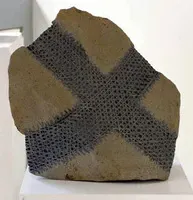
In the news this week has been the small island of Takuu, a Pacific atoll with a population of 500 people, thought to have little time left before it disappears into the sea. It's claimed that Takuu is the last place on earth where traditional Polynesian religious practice is still central to island life. Imminent for these people then is a cultural erosion and crosspollination long familiar elsewhere.I'm reminded of Chris Charteris' sculpture Pounamu Whaiora. A polished pounamu cross cradled in craggy rock, the cross is revealed by carving into the rock as if it has been worn out by the action of the sea. It has the power of an altar stone, but as lifted straight from the edge where land and sea meet. The luxuriant pounamu surface undulates and pulsates like the surface of the deepest ocean, encapsulating the power of the ocean curling around rocks on the shoreline but also a tremendous spiritual energy rubbed between sea and shore.
Artist Chris Charteris crystallises in simple, polished powerful forms and patterns the complexity of our relationship to the coast and the cultures it has brought. Physically New Zealand is all jagged edges, and culturally we deal with an edginess and fluidity related to ocean migration. How important our relationship to this edge was clear in reaction to the Foreshore and Seabed legislation. As a country of coastline we're forever walking around the rocks.
Charteris is one of a number of New Zealand artists whose work deals directly and intuitively with material and forms from our coastline to explore our cultural relationship to place. While Charteris is one of a number of Pacific Island jewelers and sculptors drawn naturally to cross-cultural concerns, Charteris' is just as connectable to the practise of more senior Pakeha sculptors like Chris Booth, Judy McIntosh Wilson and Virginia King.
If an individual is an island, Charteris' is an atoll heavily influenced by crosscurrents. The way his work reflects the wash up of different influences is reflected in the title of his current exhibition at Janne Land Gallery - Cross Culture.
As well as English and German ancestry, Charteris is of Kiribati descent - a group of Pacific atolls also currently under threat from rising sea levels. Yet it wasn't until 1995 that Charteris discovered his ancestry. He grew up adopted with a closer affinity with Maori. At the core of his work continue to be Maori values, but carved into such a core are cross-cultural references. With their multiple pathways, teeth and hatchings the abstract patterns explored within his smaller personal pieces of jewellery for example suggest not only different cultures but the journey for the individual.
Charteris is best known currently for his huge necklace-like wall sculptures, polished stones from the sea, thread on cables. There's ocean music in their melodic arch and the wave rhythm of alternating evenly-proportioned stones. Charteris gives the commonplace a contemporary spiritual power and beauty. Granite and quartz as found commonly on the Coromandel where he lives become pearls. In one work, Southern Waters, he alternates granite with carefully cut plates of paua shell which radiate light onto the stone, evoking the cool green depth of our ocean.
The size and gravity of these works suggest they're neither for personal or domestic adornment but rather, in keeping with Charteris's roots in Maori carving and tikanga, provide devotional icons for community spaces. He has previously talked of their relationship to the wharenui, as if they are to be hung decorating the meeting house as itself a body (something Chris Booth's recent giant stone blankets also allude to).
Their power lies in the primal universal way in which they provide meditation on the spiritual world as held within nature. The more directly figurative works in this exhibition, Birdcall and Flight, are less successful. Meanwhile the more abstracted figure carved from pounamu, Traveller is powerfully evocative. It harnesses Charteris's strength in conveying movement in the abstract, suggesting a manaia figure that (like the operation of his other works) moves between the physical and spiritual world.
Recalling Maori pou, or sacred land markers, Charteris's powerful new Pacific Cross works are like anchor stones. Their carved barbed belts are reminiscent of both Polynesian tattoos or tapa, and lashings that bind pathways across sea and air to the ground. It's as if in the movement provided by Charteris's polished cuttings into the stone he is releasing the energy, light and life from within them.
Just around the corner from Janne Land's at Walrus Gallery (corner of Jessie and Taranaki Streets) painter Sandy Rodgers is dealing with the cross currents to be found in contested territorial waters.
Rodgers' smart paintings provide collaged reproductions of early New Zealand and Pacific maps, charters and other historical documents. Through the simple juxtaposition of selected artifacts (the story of Wellington harbour's Taniwha and the proclamation of Wellington borough, for example) there's the suggestion of unwritten tensions crossing and blurring the ink lines remarked out on these canvases.
Employing watercolour, ink, paper and a coat of shellac, these paintings strive to be, as the exhibition title suggests 'Contemporary Artifacts'. Their intention isn't like Charteristo explore both personal and universal tensions, and they don't have that power. However, through the smoky glaze of shellac they provide a historian's layering of history that leaves us then contemplating our claim and connection to the rocks we stand upon.
Cross Culture, Chris Charteris, Janne Land Gallery, until December 16
Contemporary Artifacts, Sandy Rodgers, Walrus Gallery, until December 12
Image: Pacific Cross 2006 by Chris Charteris