Conversation Pieces at Adam Art Gallery
Written by
Courtesy of Dominion Post 1st October 2004
By Mark Amery
At the same time as late modernist abstraction was seen as painting itself into a corner, the market for Australian Aboriginal painting was burgeoning. A people whose culture had been denied for centuries, found their practise at the centre of Australian painting.
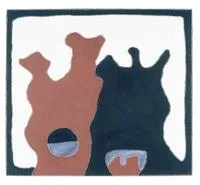
Image: Rusty Peters
Great Grandfather's Fathers Burial Place, 2000
Natural Ochre on Linen, 122 x 135cm
Two Laws - One Big Spirit at the Adam Art Gallery (until October 10)
Courtesy of Dominion Post 1st October 2004
By Mark Amery
At the same time as late modernist abstraction was seen as painting itself into a corner, the market for Australian Aboriginal painting was burgeoning. A people whose culture had been denied for centuries, found their practise at the centre of Australian painting.
Image: Rusty Peters
Great Grandfather's Fathers Burial Place, 2000
Natural Ochre on Linen, 122 x 135cm
Two Laws - One Big Spirit at the Adam Art Gallery (until October 10)
Both artists and galleries have benefited. Leading contemporary Aboriginal artists have been encouraged to focus and strengthen their individual vocabularies, providing - at least to Western eyes - sophisticated, fresh painting in which traditional spiritual values and contemporary aesthetic values meet. Given modernism's debt to the so-called 'primitive' in the first place, perhaps its not surprising that painting's next step should be to ask the traditional to adopt the modern.
Contradictions abound aplenty, and the exhibition Two Laws - One Big Spirit at the Adam Art Gallery (until October 10) steps right into the middle of them. Featuring seven canvases apiece from Pakeha New Zealand-born artist Peter Adsett and Rusty Peters, from the Kimberley region in Western Australia a conversation is set up between artists and cultural frameworks.
Adsett invited Peters to come and work for 14 days at his then home at Humpty Doo, South-West of Darwin. Peters painted a work on the first day, before Adsett responded to Peter's work with a painting on the second day. Each then followed the other on alternate days, on identical stretched canvases with predetermined palettes.
This was dialogue rather than collaboration, with each artist continuing to operate within the strict 'laws' they had built around themselves over time. In this way the project emphasises the way artists communicate with their own individually developed languages. Here we see two painters able to communicate cross-culturally in the abstract, without one practise assimilating the other.
Now resident back in New Zealand after 20 years in Australia, Adsett may initially appear to be a geometric abstractionist whose work has a cool urbane distance from life. On closer inspection, he has an interest in exploring how abstraction may be rendered useful in relation to the world, and art as a process might make connections to the world around it. In the Northern Territory he has worked in exchange with both Aboriginal and South East Asian artists. As a Pakeha in this cultural context you sense perhaps, that his cultural dislocation has forced him to find a way for his abstract practise to plug into the land around him, as Aboriginal artists have had to plug into the big city cultural landscapes.
With their shifting white rectangular slabs on black (simply titled 'Painting Number 2' and so on), Adsett's work might at a glance seem the most po-faced of flat, shuntings on of geometric abstraction from Malevich. On closer inspection however the surfaces come alive - as if to reference modernism and then, within their skin, subvert it. The surfaces have a rich density. An undercoat of bright red accentuates the flecked cloudy surfaces, and is brought up to the surface as a deep crimson vein of colour - like a strata in the soil, distant horizon line at sunset, or bloody incision. These veins form the boundary between the black and white spaces, as if light is being let in by the shifting away of a slab, or the opening of a door.
There are no lack of symbolic readings to be made here, encouraged by their interaction with Peters' work and its specific reference to the land and his people, but their complexion is the way they sit in the space between abstraction and symbolism. The white seems to shift over the black over the course of the series of paintings as if part of a partial cultural eclipse, but there is also a rigorous exploration into the shifting politics of positive and negative space, echoing the Gordon Walters in the nicely paired Prints and Design exhibition downstairs (also on until October 10).
Counterpointing Adsett's minimalist angular shape-shifting, Rusty Peters' canvases use an earthier palette and the lines are sinuous, creating pools and dancing ribbons of energy - reminiscent at times of pulsing amoeba in a petrie dish. While Adsett's work echo the architecture of the gallery, Peters' work maps human energy in the curves of mountains and rivers.
Both have a sense of dreaming about them, but while Adsett's have an ethereal spirit, Peters' speak to the ground and the trails of the ancestors. It's as if together they speak of death and birth, the life of the combined work in a state of reincarnation between two different worlds.
The way these works talk to each other reveals itself subtly over the course of following the exhibition around. It's as if we too are observing the artists finding a way to communicate; to echo movements made by the other in their own space and time.
The 14 panels are spread over three distinct spaces in the gallery, so while we see in strong pairings of the work how Adsett responds to Peters, conversely we don't get to see so clearly how the work evolves as an entire series. Nevertheless, you sense that something significant has passed between these two artists; a pushing forward in their respective work made that might not have been made otherwise.