Contested Landscape: Manapouri: Art, Power, Protest
Written by
By Mark Amery Courtesy of The Dominion Post
Driving from Wanaka to Christchurch this summer was to realise how impressively we have employed an immense landscape for our own means. Visions of Peter Jackson's Middle Earth are impressed on the mind through the Lindis Pass. At a rest area in the Waitaki the sublime postcard view of Aoraki Mount Cook is accompanied by an information panel that notes that every minute an Olympic swimming pool's worth of water from the Southern Alps passes through the dam beneath us.
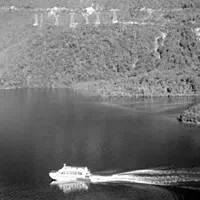
Image: Haruhiko Sameshima, West Arm, Lake Manapouri, 1995/2007, toned silver gelatin printBy Mark Amery Courtesy of The Dominion Post
Driving from Wanaka to Christchurch this summer was to realise how impressively we have employed an immense landscape for our own means. Visions of Peter Jackson's Middle Earth are impressed on the mind through the Lindis Pass. At a rest area in the Waitaki the sublime postcard view of Aoraki Mount Cook is accompanied by an information panel that notes that every minute an Olympic swimming pool's worth of water from the Southern Alps passes through the dam beneath us.
Image: Haruhiko Sameshima, West Arm, Lake Manapouri, 1995/2007, toned silver gelatin printAnother panel points out there are efforts nearby to save the Kaki, an endangered black stilt within a captive breeding area. This the world's rarest wading bird is viewable from a visitor hide. Reaching the Canterbury Plains we watch water being pumped out onto the fields on an immense scale.
The tourism experience then can be complex. A tangle of feelings about awe-inspiring nature and our use of technology to frame it, abuse it and create something useful out of it.
Take a photograph by Haru Sameshima in Manapouri: Art, Power, Protest at the National Library Gallery. It's a view of Lake Manapouri showing a boat speeding across this remote beautiful lake carrying tourists to tour the Manapouri Powerstation. The pylons the station supplies are directly in our line of sight, disrupting the bush. There's the doublewhammy thrill for the tourist of astonishing scenery accompanied by a fast boat ride to a cathedral of a powerstation, in one of the remotest areas of the world. Step back to earlier last century and there's Thelma Kent's photograph of her shiny motorcar next to the lake - the vehicle that made it possible for the less intrepid to enjoy the view.
It's these sorts of complexities which makes this exhibition, curated with clarity and intelligence by Aaron Lister, such a rewarding experience. Lake Manapouri provides a site with a particularly complex history with which to dip into the library archive as well as exhibit a suite of contemporary art photographs that confront this legacy.
Lister's focus is on Manapouri as a Pakeha construct and contested site. He draws our attention to the fact that the name itself is a construct from various mistranslations of Maori names. The label Manapouri neatly packaged something up for those artists looking for postcard perfection.
By the 1920s the lake's suitability for generating hydroelectricity had also been noted. An unidentified photographer circa 1927 provides a beautiful panoramic view of the West Arm but its accompanied by a caption that notes that its "taken from near the lake and the proposed tunnel". It was a commission by a company formed to assess and promote to the government the lake's power generating potential. Yet even as early as 1904 a government engineer had concluded that the beauty of the lake was worth preserving to "to the fullest extent".
This panorama talks nicely to Mark Adams' contemporary series which in dull silver gelatin prints mimicing the historic he forlornly documents sites of importance to Ngai Tahu that have been substantially altered by human intervention. There are no glistening peaks or waters in these prints, yet as Adams notes "every time you drive a car you're implicated."
The exhibition documents the massive feat in engineering that was the building of a giant underground powerstation under the mountain in the 1960s. Again the complexities come thick and fast. Workers were lodged aboard a ship, and the exhibition comes complete with cans with specially produced 'West Arm Beer' and 'Deep Cove Beer', the packaging complete with scenic shots. Cans were provided for fear that floating beer bottles would be a hazard to visiting sea planes.
With the slogan 'Save Manapouri' writ up large, the bold marketing for this exhibition draws attention to how the word Manapouri has also taken on a wider symbolic significance for the environmental movement and popular protest. Using a well known slogan from the past about preserving things for the future in the present is a smart way to emphasise the exhibition's contemporary charge.
Bumper stickers on cars featuring this slogan were everywhere in 1970 when a huge Wellington-led national campaign - the first of its kind - campaigned against the proposal to raise the lake level to maximize the power stations efficiency. A quarter of a million people (10% of our then population) signed a petition, an indication of why this successful campaign is considered such an important part of the birth of the environmental movement.
A once schoolboy petitioner Craig Potton is represented amongst the contemporary photographers, but his work here lacks the resonances provided by the other photographers.
Wayne Barrar specialises in the depiction of human-altered landscapes. His 2005 series underground of the power station provides a powerful contemplation on our mix of awe and dread within this manmade subterranean world. Just as in Samushima's gorgeous triptych here of the gleaming turbine hall, electric light generated by the powerstation provides a contemporary sublime. This could be imagined as Plato's cave, that allegory for the mind seeing but a shadow of reality, an echo of the camera's chamber. Our eyes follow electricity cables across rock deep under ground, the camera drawing us down tunnels, which are alternately roughly cut grottos and smooth hospital like corridors. A sign saying 'Caution: Equipment May Move Without Warning' as if alluding to the alarming shifts in reality these images can make.
Manapouri: Art Power Protest, Until 15 March
07/02/08