Collective Conscience: Human Rights Arts and Film Festival 2008
Written by
Collective Conscience considers the recent shift in contemporary artistic practice away from individual experience towards inter-personal activity and social exchange.
The artists in Collective Conscience represent, to varying degrees a re-humanising of artistic practices via an emphasis on participation, dialogue and collaboration. New Zealand artist Fiona Jack is one of the participating artists whose work will be displayed at the exhibition in Melbourne from November 12 to 30.Collective Conscience considers the recent shift in contemporary artistic practice away from individual experience towards inter-personal activity and social exchange.
The artists in Collective Conscience represent, to varying degrees a re-humanising of artistic practices via an emphasis on participation, dialogue and collaboration. New Zealand artist Fiona Jack is one of the participating artists whose work will be displayed at the exhibition in Melbourne from November 12 to 30.Through a variety of perspectives, approaches and forms, Collective Conscience explores issues of human rights, and the power of collective action.
Participating Artists
Alex Martinis Roe, (Australia)
Culture Kitchen, (Australia), Taring Padi, (Indonesia), Gembel (East Timor).
Fiona Jack, (New Zealand)
Freedom Burmese Artists, (Burma)
MHUL Conversation Program, Christian Thompson, Helen Johnson (Australia)
Panther, (Australia)
PVI Collective, (Australia)
Richard Bell, (Australia)
The Long March Project: Chen Qiulin, Yang Shaobin, Jiang Zhi (China).
Curators: Romy Sedman & Andrea Bell
_____________________________________________________________
ARTISTS:
Fiona Jack (New Zealand)
Fiona Jack works across many media to investigate the conceptual, geographical and political definitions of shared space - a space that includes linguistic, physical, social and historical contexts. In a recent collaborative project with the Tangata Whenua of Tamaki - Ngati Whatua o Orakei (the local Maori of Auckland) a reconstructed palisade fence along Auckland's waterfront recalls the fence that was built in 1943 to protect the Pa (Maori village) from encroaching urbanization and persecution. Jack has also installed several site specific painting installations internationally that locate their process and critique within Situationist thinking, and are based on local research, collaboration and intervention to generate their form.
Alex Martinis Roe
Feminism can no longer be used as a label to describe the political movement of a universal group called 'women'. Uniting women without particular regard to race, class and sexual preference performs similar exclusionary practices as the ideological power structures that feminism seeks to undermine. However, despite the necessary abandonment of a universal feminism, it continues as an invaluable body of research, strategy and action with a well-recognized trajectory of addressing the sexual politics at play in any given context, in an ongoing fight against discrimination.
Discrimination in the Australian arts industry can be as obvious as the disproportionate numbers of successful male artists to the numbers of practicing female artists, and as subtle as the way that a gallery visitor gazes at a work of art.
Over the last few years Alex Martinis Roe's performance based video installations have been driven by her political commitment. The self-reflexive production of her work has been informed by the rhetoric around 'representation' and the female body. Her commitment comes from a belief in the potential for artistic performance to impact upon the gender-based subjectivities of audiences and other performers.
Culture Kitchen, (Aus) Gembel (East Timor) Taring Padi, (Indonesia)
'Recovering Lives Across Borders' is a collaborative project between artists from Australia, Indonesia and East Timor. The notion of understanding was at the core of the process. Before the first pencil was sharpened, there were extensive discussions about what concerns each artist. Each artist came to the project with different concerns, cultural perspective and ideas, yet all had similar goals in mind. As artists, we wanted to work together, and through discussion come up with collective solutions and approaches to the artwork in the same way that we expect governments should be able to do the same. We see this project as an exercise in inter-culturality, which places a strong emphasis on interaction, exchange of ideas and the quest for understanding, and is a way out of the 'multicultural' impasse. It goes beyond seeing pluralist cultures and difference and begins to look at a future of sharing similarities and forging understanding. It is also distinct from arguments made around integration and community cohesion in arguing for a much more productive engagement between cultures. This implies mutual learning and growth and a process of inquiry.
"Recovering Lives Across Borders" confronts viewers with issues such as poverty, environmental degradation, the depletion of resources, affluence and ignorance - the ugly realities which underpin the economies of all three nations, although affect their citizens very differently.
Freedom Burmese Artists (Burma)
Freedom of expression can often lead to a life sentence in prison or a lengthy sentence with hard labour under the brutal, oppressive and violent Burmese regime. A word, a line or a scratch can lead to arrest, imprisonment, jail, torture and death of an artist.
The voice of Burmese have been silenced since 8-8-88. Since then, Burma has accelerated itself into 164th place out of 169 in the world in restriction of 'freedom of expression'.[i][1] One artist U Win Tin, born in 1929, now 79 years old, is the world's longest serving "prisoner of conscience" who has spent one fourth of his life time or 19 years or in prison since 1989, often in solitary confinement. Restriction of art supplies, severe poverty, aggressive censorship, brutal crack down, absence of support, training, funding or an accessible gallery system make a Burmese artist's life an impossible struggle. Nonetheless, through their art they reflect on human rights violations inside Burma and the situation of Burmese under the brutal regime. They reflect lives, dreams, sufferings, struggles, beliefs, hopes and empower the voice of the powerless. Their arts are a reflection of the floating lives of Burmese artists and their fight for freedom in Burma.
Helen Johnson & Christian Thompson
Mhul Conversation Program Acmi: Workshops (Australia)
The term MHUL is a Bidjara word from central Queensland meaning 'idea' or 'concept'.
In 2007 the MHUL conversations program, organized by Christian Thompson for
ACMI, hosted a workshop based around the possibilities of poster-making as a cheap and effective way to convey ideas. The posters included in Collective Conscience are the product of a one-day workshop facilitated by Melbourne artists Helen Johnson and Christian Thompson with a group of emerging indigenous artists from across Australia.
The politics of personal and cultural identity were strong themes for all the artists involved. The posters were produced on a small scale, from which multiple enlarged copies were made so that each artist could keep documentation of every poster produced. Participating artists include Moses Gibson (Fitzroy Crossing, WA), Nicole Smythe (Warburton, WA), Kresna Cameron (Warburton, WA), Chad Creighton (Perth, WA) and Nicole Foreshew (Sydney, NSW).
Panther (Australia)
Panther is a performance collaboration between Madeleine Hodge and Sarah Rodigari.
Over the past four years Panther have created works across documentary, performance, improvisation, video and site based intervention. Through their work
Panther seek to create an ongoing cultural dialogue and social critique.
The idea of happiness is a cultural phenomenon. In western societies it has become a huge commodity. In America, it's a democratic right. In the UK, they are considering a Gross Happiness Index to stand along side the GDP. In wealthy countries with excellent living standards, the question is being asked why are our people who supposedly 'have it all' more miserable and then those who don't? Exercises in Happiness calls into question our understanding of happiness and its meaning and importance in relation to basic rights, freedom and equality.
PVI Collective (Australia)
Founded in 1998, PVI Collective are an independent artist collective based in Perth,
Western Australia. With a background in visual art, film theory, new media, performance, psychology and live art, the group have a long standing pre-occupation with producing artwork that investigates issues of privacy, surveillance and its impact on social codes of behaviour in the public realm. Resist aimed to test the notion of conflict in Chile by inviting 7 citizens to step forward and go head-to-head with PVI in one of 7 public tug of war contests. Armed with a 20 metre length of rope and seven pertinent issues to solve, the work was performed directly outside Chile's notorious seat of power and site of dictator August Pinochet's violent coup in 1973, the presidential palace. Resist was produced during the South Project's Santiago gathering in 2006 and was part of a larger body of work called 'the future belongs to crowds' series which investigates the relevance of people power in contemporary society.
Richard Bell (Australia)
Whether paintings, performances, videos or T-shirts, Richard Bell's works of protest, confront and unsettle common ideas about Aboriginal and non-Aboriginal Australians' relationship to each other, to this country's history and to art itself. His paintings play with the practice of appropriation, often mining the pop art styles of Roy Lichtenstein and Jasper Johns, or the paint drips of Jackson Pollock, while including texts that complicate the way we think about racism and race politics in Australia. 'Aboriginal Art - it's a white thing' is one of the artist's famous 'Theorems' in which he accuses the contemporary art world of manipulating and exploiting Aboriginal art. 'Scratch an Aussie' is a new video installation in which stereotypical Australians are psychoanalyzed by the artist, who charades as a black Sigmund Freud.
Long March Project (China)
Initiated in 1999, and begun in 2002, the Long March Project is a complex, multiplatform, international independent arts organization and ongoing art project, that can be simultaneously considered a curatorial lab; a publishing house; an artistic collection; a meeting place; a gallery space; a consultancy; a commissioning and production atelier; artistic facilitator; and author. From a critical distance, all of these avenues of production aim to provocatively construct, and in turn renew, presumed action and thinking concerning 'contemporary art'.The Long March Project is a constantly changing, mobile entity that seeks to challenge and move beyond fixed definitions of artistic practice between local and international, individual and collective, in the creation of new forms of production and consumption that are encouraged and allowed to interact.
Chen Qiulin
Chen Qiulin is a young female Chinese artist currently based in Chengdu, Sichuan
Province, China. Much of her work addresses social situations of upheaval, both physical and psychological, particularly concerning ideas of displacement and trauma of memory. Chen Qiulin spent her childhood in Wanzhou City, which was partially submerged by the construction of the Three Gorges Dam on the Yangtze River in
2006, which displaced more than one million people. Through installation, performance, photography, and video montages of surreal landscapes and ghostly, ephemeral figures, she reflects on China's urban development and its rapidly altering social landscape.
Yang Shaobin
The fundamental anchor to Yang Shaobin's practice (born Tangshan, Hebei Province) has been his awareness of a social consciousness. Rising to international prominence in the late 1990s, early explorations engage with the corporeal individual in society and collective memory. Later work enters the political realm, where familiar faces of Western, Soviet and Middle Eastern leaders haunt the surface of amid scenes from media reports which are interspersed with Yang's violent abstractions. Born to a coalmining family, Yang Shaobin has recently turned his attention to the coal-mining industry in China. Collaborating with the Long March Project, he has delved into the underground world of human exploitation, labor conditions and the physical repercussions suffered by China's industrial reforms.
Jiang Zhi
Jiang Zhi was born in Yuanjiang, Hunan, China. Graduating from China Academy of Art in Hangzhou, in 1995. Jiang Zhi's works are inspired by the social reality of China today. His works articulate an introspective, at times historical insight into the consequences and tribulations of urban life in a constant state of transformation.
Particularly influenced by the effect and meaning of light and shadow, absence and presence, Jiang Zhi's works often provide a humorous perspective on ideas of flux in the contemporary human condition. He currently lives and works in Beijing.
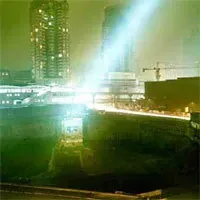
Image: Things would turn nails once they happened 2008
Photograph, Lightbox
150cm x 200cm
Courtesy of the artist and Long March Space, Beijing
Human Rights Arts And Film Festival 2008
Exhibition Venue: The Carlton Studios
193 Bourke St
Melbourne, 3000
Dates: November 12th - 30th November 2008
Exhibition hours: Wed - Sunday 12 - 9pm
Opening Night: Wed 12th November 6 - 9 pm
Public Program: Artist Talk
Venue: The Carlton Studios
(upstairs)
193 Bourke St
Melbourne, 3000
Date: Sunday 23rd November
Time: 2 - 3.30pm
Participating Artists:
Helen Johnson
Alex Martinis Roe
Panther
Freedom Burmese Artists
Industry Speaker: Bryony Nainby, Senior Curator, La Trobe Regional Art Gallery
Curators Romy Sedman & Andrea Bell
MEDIA ENQUIRIES
Curators - Romy Sedman (0419 157 002) / Andrea Bell (0402 784 013)
hraffarts@gmail.com
ADVERTISEMENT
04/11/08