Brad McGann - In My Father's Den
Written by
Courtesy of NZ Screen Director's Guild Take Issue 37
Interview Brad McGann - Writer/Director of In My Father's Den
Shonagh Lindsay: Maurice Gee's book, In My Father's Den, was published in 1972 but you've brought it into today with the protagonists' past being a more recent one. You've also made other changes can you tell me about those and why you chose to make a film of this particular book?
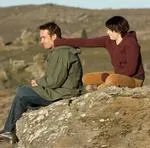
Image: Paul (Matthew MacFadyen) and Celia (Emily Barclay) not so on the rocksCourtesy of NZ Screen Director's Guild Take Issue 37
Interview Brad McGann - Writer/Director of In My Father's Den
Shonagh Lindsay: Maurice Gee's book, In My Father's Den, was published in 1972 but you've brought it into today with the protagonists' past being a more recent one. You've also made other changes can you tell me about those and why you chose to make a film of this particular book?
Image: Paul (Matthew MacFadyen) and Celia (Emily Barclay) not so on the rocksBrad McGann: The book, which was set between the 30's and 60s, was really about Protestant ethics, the nature versus nurture debate along with the effects of repressed sexuality in a polite society. There was also the 'man alone' theme that was prevalent at the time. In the book, Andrew is the killer and he kills Celia for psychosexual reasons, with the righteous mother - who is dead - feeding into his psychosis. Andrew was more featured in the book - a more important character in many ways than Celia. So the relationship between the two brothers was more of a focal point. And there was no blood link between Paul and Celia - she was merely a student of his who happened to be the daughter of a girlfriend he'd had when he was a teenager.
Celia is a bright student that Paul encourages to become interested in literature, but, in the book, there's also a 'Lolita-esque' echo in their relationship. It was told from Paul's point of view and he was fighting these sexual urges towards her. So the main changes from the book to the screenplay were - besides some integral changes to character and location - the dynamics of the mystery, the period setting, and the nature of Paul and Celia's relationship. The film also steers away from the religiosity that was present in the book, which is more causal in Celia's fate. Structural changes also occurred such as shifting Celia's murder to the end.
I chose the book for two reasons. I was looking to do a mystery and what attracted me to Maurice Gee's book was that on one level it was a mystery, yet was a crime story where the mystery became a conduit to explore deeper themes such as the harbouring of family secrets, how the past impacts on the present, living with complicated and fractious familial relationships and the effects of being cut off emotionally from family members. It also dealt with the anti-intellectualism of a developing society. The other reason was that, given it was thirty years old, it wouldn't be in the public consciousness, allowing me a freedom to make changes. I wanted to work with material that had a strong thematic core, but with the licence to change that material in order to make it work as a modern-day film. New Zealand is a culture that changes very rapidly so it would have felt dated if I'd remained true to the novel.
Shonagh Lindsay: By making Paul's father Celia's blood father you touched on a modern reality - unknown and absent fathers, confusion over parentage.
Brad McGann: In hindsight, the book was almost the starting point. As I went deeper I found the relationship I was most interested in exploring was Paul's and Celia's and I wanted to expand on that material. I also wanted to shift away from the 'May-September' dynamic of their relationship, so I began looking for other reasons why Paul could have a vested interest in Celia; and what I came to realise was that the type of interest I wanted to pursue was protective as opposed to sexual, where Paul recognises a part of himself - who he used to be - in this sixteen year-old girl. So I searched for methods for employing this - an emotional thread as well as a dramatic payoff - and it made sense that in someway he was connected to Celia by blood. By losing the sexual dynamic it allowed space for other things to come forward.
Shonagh Lindsay: I thought that it made for a far more interesting relationship as a result, one with many other dynamics but still brought in the theme of teenage sexuality, a force still to be reckoned with ...
Brad McGann: Yes, I guess what I was also looking for was how a person can find intimacy in unlikely sources. Paul is a character who has gone out into the world, but ceased to engage with it emotionally. He comes back to this town he fled from and finds intimacy with a teenage girl who may or may not be his daughter, and at the same time she becomes kind of conduit for him to unravel parts of himself that he would possibly not share with anyone else. So I made the den a kind of meeting point between past and present, a place of reconciliation between Paul - and his past - and Celia, a product of that past.
Shonagh Lindsay: Paul seems to have been an unfortunate catalyst not just once but twice in his life, did you feel concerned you might have loaded too much onto his character?
Brad McGann: I was very aware of that when I was writing. In the book Celia's death does not break Paul, in fact his final line is: 'I miss Celia, but more than anything I miss my books.' So the character of Paul remains fairly hard, even in the end, but I was conscious that I really wanted to break Paul, I wanted to bring him to a point of crisis. The other thing I was really fighting was: would that necessitate Celia's death? It was almost an ethical question - do I need to kill a sixteen-year old girl in my film?
I even did an edit where we took this out. She just disappeared, vanished like the ocean in her story, and you didn't know what had happened to her. But it remained very unsatisfying because what Celia's death does is bring everything to the fore. Something of sufficient enough magnitude had to occur, to be sufficiently cathartic to bring all that shit out into the open. Her death was also in the narrative DNA of the novel, she's killed on the first page and as you are unravelling the story you realise that she is, in a sense, a sacrificial lamb. But I didn't want her to be perceived in this way so I took out any reference to her dying from the beginning, which allowed you to get to know the character. I was concerned I'd over burden Paul, but I also realised the book was a tragedy and the film I was making was a tragedy.
Shonagh Lindsay: Did Maurice Gee have anything to do with the writing of the script?
Brad McGann: He read a couple of early drafts, and without going into any detail said he was pleased we were making discoveries in order to update the material. He gave me licence to do anything. A book published in 1972 is a very different entity to a film made in 2004.
Shongah Lindsay: Did you have a script consultant to help you?
Brad McGann: I did and it came about this way. I was working on a project with Fox Australia based on a short story, and I'd thought Den would be my second feature, but the development wing at Fox Australia folded. Caroline Grose, now head of development at the FC but then my creative executive at Fox Studios was just so good at script development; she has this wonderful knowledge of story with similar tastes to me in the films she likes. So I asked her to be my script editor on Den. She was absolutely key in helping me to develop that story.
Shonagh Lindsay: This was the largest budget first feature made to date in NZ, did that give you more to pay cast?
Brad McGann: We paid what was appropriate for both the UK and NZ actors. But although the budget was about NZ$7million we had a lot of extra costs due to it being a co-production: 30% had to be spent in the UK, the exchange rate made that very expensive and we had enormous legal fees, so it was more like a $5 - $6 million film.
Initially the UK production company were going to be a lot more international in their casting: Jackie was going to be played by Rachel Griffiths at one point, and for Celia they wanted an American. In the eyes of distributors actors are international property, and they go for what they consider to be the most marketable, a way of reducing the risk on a first-time director. So my biggest battle was to keep the actors localised. Dianna Rowan was really instrumental in helping us achieve that. Without her I would have been in dire straits - they had sufficient respect for her for that to make a real difference.
Di will steer you in casting, but she won't make your choices for you - she's adamant you make those for yourself And she knew how to play the game in terms of a co-production, and was really protective of my vision. She is really gifted in that way and she reminds you to always go with your strongest instinct. Luck swung our way when they saw Jodie Rimmer's audition tape - the eight who saw it loved it and agreed to let that role go to a New Zealander. Di, Trevor and I then formed a strong front over the actors we wanted and, in the end, they were all very happy with the performances.
Shonagh Lindsay: What made you choose Emily Barclay?
Brad McGann: She just was really authentic. When she read my script I stopped hearing it and could only hear the character. She suspended my disbelief as a director, and could totally dissolve my script. If that isn't a sign of a natural performer...
Shonagh Lindsay: Had she done cinema or drama training before?
Brad McGann: No, nothing.
Shonagh Lindsay: What other ramifications were there of the film being a co-production?
Brad McGann:There seemed to be a myriad of issues I had to get around. I knew I wasn't making a NZ feature where I could have complete licence to do as I wished. People had put a substantial amount of money into the film so they felt they had a say; there were many small battles and I had to choose which were the most important ones to fight.
Shonagh Lindsay: Starting with the script?
Brad McGann: I had to do a draft, which took note of the interests of the investors, principally the UK Film Council.
Shonagh Lindsay: Did you have to take those on board?
Brad McGann: Yes and no. To a point. Many of their suggestions were good, and others may have been good but perhaps didn't belong in the film. We have to remember this was a low concept NZ film about local people - it's about the relationships between characters as opposed to a handy high-concept that you could conveniently hang the film, or a plot you could sell in a 'smart two-minute pitch'. I wanted to keep it small, personal, intimate and rooted in its place of origin, and one of the obstacles we faced was the cultural difference between the UK and here.
Shonagh Lindsay: Can you elaborate?
Brad McGann: Just little things right across the board - from script, to casting, to rushes, to editing - that come down to not only personal taste but also the cultural imperatives in how things are done. For example, in the UK producers and funding bodies have more power than directors - especially unrecognised directors - in making fundamental decisions about the film. They have final cut - I don't. But there's also a commercial language in filmmaking, boxes that you tick in order to get your money back, only I didn't want the film to be a results-driven project. I wanted it to have authenticity, which is very different to being marketable. I think it was good to have that pressure, but it's just to what degree you have it? Too much and the director can start to lose a sense of their own voice and it can feel like it's being made by committee.
And there were little subtleties due to the fact that I was a first-time director making a film in a remote little town they knew nothing about, and they weren't going to be on set. So they wanted to make sure I was going to make a film that wasn't going to be marginalised - shown in a couple of local cinemas then going straight to video.
Shonagh Lindsay: Well that's great if you can achieve that and hold onto your story. Was the FC helpful and effective in that process?
Brad McGann: I just take my hat off to them, they were wonderful. At one point when this became a problem they made it known to everyone involved that it was their policy to respect the director's creative rights. The international parties really listened and this did have an effect on everyone involved. Ruth Harley came in on the conference calls and it really made a difference to have her there.
Shonagh Lindsay: So what advice would you give to directors in co-productions.
Brad McGann: It sounds like a cliché, but you have to work out which battles you really want to fight, because the process is exhausting. I'd definitely advise choosing a really good script editor, a strong NZ producer, a fantastic casting agent with a strong track record, because you can get so embedded in the politics of making the film that you start to give in just to get it made - and once you sign off things it's just too hard to get things changed. You need supporters who are there from the start who are going to help you make the right choices, who can help you keep an objective head about the compromises you inevitably have to make and who can also help fend off the 'politics'. There are hundreds of choices you are going to be making, to the point that all you're doing is making choices - so it's important to get the key ones - such as script and cast - right.
And to surround yourself with a creative team who have a really strong sense of what you want to achieve, instilling them with as much information as possible so they can steer you if you start to lose your way. Stuart Dryburgh, my DOP, really understood my vision and was strong in protecting it, as was Chris Plummer my editor.
Also, allow for a slightly longer edit - given that so many people are feeding into it. You have to allow for the time it takes for all the tapes to go up to the co-production country and to be fed out to the investors, then wait for their feed-back. When you're doing this on a fortnightly basis it's amazing how much time you lose.
Shonagh Lindsay: What works for you in terms of working with actors?
Brad McGann: I've come to realise every actor is unique in terms of their working style. Also on Den we had a complete range of experience so no one method could work, it was predicated by a whole lot of variables. But I think a lot of what you get in the end result is achieved in the rehearsal process. I tend to work from back-story and incorporate improvisation, visualisation, music, character games etc such that we do a lot of exercises around the script but not actually rehearse the script very much, so as to keep it fresh. With Emily I got her to keep a diary, to write about her life as Celia, exercises like giving her $10 to buy Paul a gift, really think about it and then tell me why she bought it. I was trying to create situations where Emily, in this instance, wasn't 'acting a part', but where the character could seep into her - almost just be herself but in Celia's skin. Really it's just finding the psychic links between the actor and the character - ways in which they can access the emotional fabric of the character without it becoming academic or purely conceptual. We didn't have much time to rehearse, but the actors quickly cottoned on to what I was after. I told them to take risks, to make mistakes. I limited the setups on set so we could try different takes, and I knew from the outset that I was principally interested in performance. I told them these are the characters supposed actions and the words I've put in their mouths are more of a guide than to be seen as sacrosanct, but if you want to make changes that feel true to you - the actor - then let's try it.
Shonagh Lindsay: Did they make many changes?
Brad McGann: Yes, they did when it suited, and that was probably harder for the crew than for them. In most cases they came back to the script but I think knowing they could change the dialogue and influence the blocking helped free them up - especially the less experienced actors. The less restraints the better but for that to work you need a really good DP and key crew who aren't going to fight that way of working. I love keeping everything in the moment - but I also want to keep my crew on side so it's about finding a balance.
Shonagh Lindsay: In My Father's Den seems to me to be a first for NZ film in terms of the depth of its emotional engagement, in the past I've often felt there was something not fully evolved in the character development.
Brad McGann: To me character is the story, and for my way of working it's necessary to hand the character over to the actor, to let them run with the character and for me to be there to guide them. They're more important than my story - and I don't own the story anyway, the characters do. As a filmmaker I believe you own the subtext of the film: the themes, the undercurrents, the narrative threads, the essence of what it's trying to say, but when we're talking about the random nature of life - which I believe all stories need to have otherwise they're a lie - then you need to take into account that characters will say and do things that go against the logic of the story. People will say things that are the total opposite of what they mean, a scene will play differently from what you envisaged because life and characters just aren't that simple.
So for a character to feel real, they need to not speak the themes of the piece, those things have to be completely ingrained and almost invisible. If you believe your characters are living, breathing entities, have given them the space and chosen good actors then they will just walk over glass to make that authenticity happen. And their suggestions are just so true, clear and fantastic - for every bad one there'll be ten good ones. It's a bit like tending a garden, giving it breathing space. And I love actors; I'm kind of in awe of them. If they don't work then I don't have the film. The directors I really like are probably really good listeners.
Shonagh Lindsay: Who are you thinking of?
Brad McGann: I love Terence Malick, John Cassavetes, Ken Loach, Ang Lee's earlier work like The Ice Storm, Wong Kar-Wai, Bertolucci, Kieslowski, - directors who prioritise subtleties of performance while allowing room for strong image making. If I can achieve those two things - performance and image making - then that's enough for me as a filmmaker. Knowing I can go into the edit suite with the material that will help keep the film working.
I've got a long way to go, but In My Father's Den allowed me to experiment. In my next film I'd like to approach things from an even more minimalist view, to really strip back. I lost so much of my script on the edit floor, when I had to re-write the script for the sub-titles it was amazing how much I'd stripped away.
Shonagh Lindsay: What themes were in your subtext?
Brad McGann: The consequences of emotional isolation and cutting off from the world at large, of running from your personal history and failing to communicate honestly with yourself and others, that it's impossible to run from certain things that have happened to you no matter how much you try. Our present is so affected by our past - not just psychologically but also spiritually and in a behavioural sense - and it's important to come to terms with it.
And that intimacy and hope can be found in unpredictable places. I think we live in a world where it's possible to have all sorts of relationships, which are not about playing or becoming a role. We can find intimacy in different ways and these can be things over and above just love or sex; intimacy is so intricate and variable in the forms it can take. And I was also very interested in the way miss-communication and the harbouring of resentments and secrets can result in a tragic event. A murder mystery usually necessitates for someone to be culpable, playing into the good-versus-evil paradigm, but I believe we are living in a complex world where people and actions can't be simply analysed as good or evil, where we each have to look at our own part in what occurs around us on this planet, that who we are and the actions we take in our life are affected by many different variables, some of which we can control and others we can't. I wanted to explore on a holistic level a murder mystery where everyone and no one is culpable, where all the characters had played a part in Celia's death. That it was a collective result of the lies and deceit that surrounded her. For me that was more tragic than pointing the finger at an 'evil killer'.
I guess the overall theme is the importance of letting the past go, of forgiveness. That it's important to let the world in no matter what you're going through.
Shonagh Lindsay: What did you have to do to show the extent of Paul's emotional damage?
Brad McGann: I didn't want to shy away from his scar-tissue or the ways in which the scar tissue had manifested in his present-day behaviour. Nor did I want to idealise him in an anti-hero kind of way. I simply wanted to be honest, and also to reveal his damage in ways that weren't didactic or cliché - but more in how it affects behaviour. Whether you achieve that is another thing altogether. For example, the auto-aphixiation scene where he uses the belt around his neck during sex with an anonymous stranger came after doing some research. It was a challenge finding ways to be intimate with a character who fears intimacy above all things, as a result of what has happened in his past and the subsequent life he's chosen to lead. Building up to orgasm with a person is a very intimate thing - that Paul severs himself from the act, cuts off from it in such a brutal way shows he has major issues going on - not so much sexual but about life and his relationship to people. There's a complete lack of trust, an unwillingness to be vulnerable, which can be quite chilling if you look at the behaviour it causes. I didn't want to shy away from that otherwise it remains conceptual, and these things you need to see on-screen. Also just in the way he treats people - he's so cut off in the beginning - and his unwillingness to help out in any way. I needed the emotional wall to be firmly in place before Celia and the events around her disappearance begin to chip away at it.
In terms of back-story, I was really interested in the idea of Paul entering the eye of the storm when he went into the war-zones, while managing to remain emotionally disengaged. And in coming home he is entering another kind of war-zone - that being his former home, his family, his past, who he used to be. I imagined he'd approach it in the same way he would any other zone - to perform the tasks he needed to before leaving, and to remain as detached as possible. I wanted to get behind that inclination, to draw out the hidden sensitivity, to locate the damage and almost to lance him like a boil, to let the pus come out. Like this character is just so infected with damage, but I wanted there to be soft tissue behind the damage because in finding that it offered a chance for renewal. I'd read a book called the 'Bang Bang Club' and another 'My War Gone By, I Miss It So', which went into the psyche of war journalists, and Paul's behaviour wasn't too far removed from that mentioned in those books. In many instances it came back to a family crisis - that going into the conflict zones to take photographs was an extreme reaction to something in their past. It gave them a licence to look at the world at its worst, and to reflect it back like a mirror, as if to say "see the damage we have caused". They felt comfortable in situations of extreme conflict.
So Paul's damage had to be in the fabric of his character and his actions without being too spelt out. He needed to be believable in the way he demonstrated it, which, when you look closely, is in most scenes, albeit subtle in some cases.
Shonagh Lindsay: Is the difference I perceive between your film and many earlier NZ films that you have not spelt things out as much as usual?
Brad McGann: Audiences are intelligent. They will pick up on things. And I didn't want everything to be played out on the same plane. I wanted them to know what was important to the story, but to also give them bite sized things to which they could apply their own imagination, to fill in for themselves - certain parts of the back story for example - but also be very specific about what I wanted them to concentrate on, such as the Paul-Celia relationship. I was very conscious in the writing and even more in the editing of having a foreground and a background - drawing detailed eyes but letting the hands fade into oblivion - to give a sense of perspective within the story. I was always shaving away excess material so the audience didn't get too bogged down by detail. It's also one of the hardships of adaptation because books have so much detail, so it's about keeping focus - a focus that can translate in a visual format. I personally don't like to be told any more than 70% of a story - I want to engage my own faculties rather than being spoon-fed - so I just apply it in my own story telling when I get the chance. Sometimes it makes for a more confusing journey but I think audiences really appreciate it on the whole.