Body Pulsing - Phil Dadson at the Film Archive
Written by
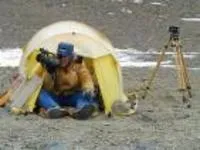
Courtesy of Dominion Post 4/3/05
By Mark Amery
Body Pulsing
Artists use their instruments to provide their own interpretations of the world - to recreate the world in their own image. But while they provide us with different ways to see and understand the world around us, they can also distance us from it.
Courtesy of Dominion Post 4/3/05
By Mark Amery
Body Pulsing
Artists use their instruments to provide their own interpretations of the world - to recreate the world in their own image. But while they provide us with different ways to see and understand the world around us, they can also distance us from it.
The approach Phil Dadson takes could almost be described as the inverse of this. Best known for his work with performance group From Scratch, through the use of film, performance, photography, drawing and, most importantly, sound Dadson is a channeler of sorts. He collaborates with others to provide actions and signs that mediate experiences of the earth's fundamental rhythms - it's movements and textures. We get to reflect on our place in the world, rather than the artist's.
Through Dadson's documented experiments with camera, microphone and self-made and found instruments, he makes us alive to our own sense of being and what is around us. These instruments are like the far-reaching antennae of an insect, making us aware of the sensory activity below and beyond our feet and hands.
Dadson's most recent body of work, Polar Projects stems from his visit to Antarctica in the summer of 2003 as an Artist to Antarctica Fellow. He camped out with teams of scientists in the remote Dry Valleys, recording video and sound, making documented performances and drawings, the latter rubbings directly off rock surfaces.
Antarctica is to us that most primordial, alien and uncontainable of spaces. Dadson's work has always tapped into sounds and signs that have an unearthly, almost alien quality, evoking the world at its most primordial. But through personal, human action he makes us aware that these in fact are the most universal and earthly sounds. While other artists in Antarctica have located signs of human habitation, and brought their own sublime poetic reactions to such a grand space, Dadson's approach is to enter quietly, listen, watch and capture.
While Earth Artists of the '70s post-object art generation were typically drawn to leave human monuments in the landscape, Dadson is interested in the kinetic experience, in ways to capture and frame the movement already inherent in the place, and in our movement through it.
In an exhibition of selected digital prints and drawings for Polar Projects at Bowen Galleries, there are several key video-still images where the figure of the artist does appear. While in 'Falconer' it is as a shadow on the land - a shape passing over, rather than something leaving an imprint - in 'Stone/Glove' at first all we see (as in most of the other images) the close-up grain of rocks. On closer inspection however Dadson's woollen-gloved hand becomes apparent, holding a rock against rock. Again he is like the insect, antennae twitching, and his skin camouflaged to merge with its environment.
Polar Projects is the latest in a remarkable investigation into the rhythmic and sonic properties of the world over thirty years. A pioneer in New Zealand in most of the media he employs, Dadson's work brings together a range of different media to explore things beyond set frames. From Scratch as an example are combined an acclaimed musical ensemble, dance company and sculptural installers, all these facets emphasised through the use of different documentary media: film, drawing, scores and recordings.
Falling between media has also meant that Dadson hasn't always received the level of recognition as a leading practitioner that he warrants, falling out on the edges of any category that is selected to be considered. When he was selected as an Arts Laureate several years ago by the Arts Foundation, it recognised how often he had previously fallen outside the boundaries when credit is based on a single discipline.
With the renewed focus in contemporary art on video, performance and installation, one would hope Dadson's work will gain increased value. Hats off then to the Film Centre in Wellington, who have organised a survey of Dadson's film-based work, running in three parts until early May. As the exhibition acknowledges, Dadson cannot be defined simply by the term filmmaker, but nor can many of the younger video artists exhibiting in the centre's most-welcome new contemporary exhibition space.
The first part of the survey 'Geography' concerns itself with Dadson's works that deal with mapping of landscapes across geographical divides through the use of technology, from 1971's seminal 'Earthworks' to last year's 'Chthonian Pulse' (from Polar Projects). In the age of the internet 'Earthworks' now seems rather prescient. Dadson constructed a 'world wide web' in an event where he conducted participants (his 'musicians') in 15 sites around the world to record the same moment in film and audio, collecting field data on the Spring/Autumn Equinox (montaged on 16mm film for the final document). Typically Dadson's own chosen site had the air of the primordial and uncontainable - the central North Island's Desert Plateau.
In 'Chthonian Pulse' ('Chthonian' from the Greek, meaning in or beneath the earth, and primal masculine and feminine forces) we are thrown disorientated into the Antarctic landscape, as if we have awoken in a snow cave to find dimensions, and up and down hard to discern. In this major new work with three screens and audio, we are guided out of the cave by the prow of a kayak, a triangular balanced symbol nosing its way out like the beak of a bird searching for home. The wings are formed on either side by flapping, twisting positive and negative sliced images of the landscape. Flight is one of many experiential sensations evoked in a dance of water, air and earth. The adventurous movement of the camera is provided by the artist as dancer (think Max Gimblett or Jackson Pollock with their Eastern-inspired gestural strokes) and emphasises Dadson's work as something to be foremost experienced as bodily and sensually based experience. The screens are at ground level, the sound above.
At Bowen Galleries the Polar Project images are hung at waist level, also encouraging a body-based relationship. I approached this exhibition at a dealer gallery with a little trepidation - what could there be with a performance-based artist but documentary morsels, studies and excerpts to sell? Instead, I was knocked over. The images vibrate with sensory echoes in a way that makes them like floating Foley trays, the crackling sound of the earth beneath your feet finding its way through its pulse to your ears.
Tapping the Pulse: Phil Dadson Works 1971-2004, Film Archive, 84 Taranaki Street, until May 8