Bespoke -Idiosyncrasy of the Body
Written by
Bespoke: the pervasiveness of the handmade at Objectspace
Idiosyncrasy of the Body - from the catalogue
by Kah Bee Chow
Earlier this year, while vegetating in the luxury of pay-TV at my parents', I had watched a documentary on National Geographic of a brutally disfigured young woman undergoing extensive facial reconstruction. Her name was Zahida Perveen and her eyes had been gouged out, her nose and ears sliced off, her tongue removed with pliers by her husband, all done to preserve his 'honour'.
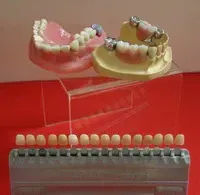
Image: Single porcelain crowns and a three-unit porcelain bridge with a 'wax-up' for a gold crown 2005, handmade by Markus Story at Objectspace (19 May - 10 June).Bespoke: the pervasiveness of the handmade at Objectspace
Idiosyncrasy of the Body - from the catalogue
by Kah Bee Chow
Earlier this year, while vegetating in the luxury of pay-TV at my parents', I had watched a documentary on National Geographic of a brutally disfigured young woman undergoing extensive facial reconstruction. Her name was Zahida Perveen and her eyes had been gouged out, her nose and ears sliced off, her tongue removed with pliers by her husband, all done to preserve his 'honour'.
Image: Single porcelain crowns and a three-unit porcelain bridge with a 'wax-up' for a gold crown 2005, handmade by Markus Story at Objectspace (19 May - 10 June).Perveen had survived this, left with a half-face of gaping wounds, intact, undefeated and determined to live. As part of her new life, Perveen was being fitted for the first time with a new 'face': the end result of painstaking weeks of work by a former CIA senior disguise specialist, Robert Barron, now putting her back together, piece by piece. In a roomful of nervous expectation, we watch Barron carefully inserting eyeballs into Perveen's hollow sockets, stretched to accommodate these large unseeing marbles. He holds up the new crafted prosthetic ear to her face and quickly adds a hand-painted hairline-vein to his satisfaction. To complete the camouflage, he fixes a sculpted silicone nose firmly onto her facial cavity. Perveen's prostheses piece back a sort of uneven jigsaw puzzle, that at once looks startlingly realistic but also concede that all the kings's men and all the king's horses may never really put Perveen back together again.
I began thinking of these prosthetic objects - their inherent strangeness in replicating something so intimate to the human body, so as to become an invisible (and visibilizing) extension of the body. In rendering Perveen's disability invisible; she becomes visible enough to blend into the normalcy of everyday life. The disguise enables her to resume a 'normal' life; to be ordinary, anonymous and invisible; one amongst a crowd. Survival on the scale of everyday; the world of difference between a face and half a face.
To say that creating such an object requires spectacular technical expertise would be understating, it takes a certain kind of perfectionist- a 'precision-ist' to thrive on the intricacies of the craft. The prosthetic object must match the specific living, breathing individual in its form, color, character, nuances so "you can't tell where it starts" . It is interesting to note that perfection, in these circumstances, exists as a kind of imperfection: not the nip/tuck worthy of a tabloid feature, the prosthetic is tailored to suit the existing 'flaws' of the individual; the "variation" that "thrives on every facet of human existence" . And this pursuit of the accurately, ordinarily human is where the object calls for the "life-giving personal touch" of the maker.
The knowing hand has, in its fingertips, memorized the feel of a lover's torso, the pinkness of a freshly shaven face, the fleshy earlobe of a precocious child - a rich vocabulary acquired through a lifetime, spent touching, and remembering these lived "intimate acquaintance(s)" . When we fall in love with someone, a childhood scar is enough to leave us mesmerized for hours; it is where the overlooked details, the secret quirks of the body are studied and loved as though you had to remember them as your own. I wonder if this is the level of 'knowing' a prosthetist would gain of each patient, without ever having touched what he has to create: the missing limbs of an amputee, the face before a fire, the wholeness that once was. In the absence of a physical reference point, how much of the process is then substituted with intuition, guesswork, or lifted from experience; that generous inventory of references? And to what extent does it operate as a collaboration between the prosthetics-maker and the patient, the object's eventual user?
Tobin Siebers suggests that the handmade object:
" - simultaneously embodies the physical actions of its maker and the physical characteristics of its user; it reaches backward and forward, forming a physical link between the hand of the artisan and the hand of the connoisseur."
There is a closeness that exists in this relationship that one could be forgiven for fetishizing: the difference between six degrees and one degree of separation. Barron, the object-maker and Perveen, the object-user come closer, in a room together, like two friends, one to gift the other with a present. The object in this case, necessitates touch, contact, proximity and dialogue between user and maker: two human beings/bodies. A transaction that stands in stark contrast to the usual multi-levels of intermediaries which deny a simple communication between user and maker - much more familiar are the market researchers, test screenings, call centre surveys for which there are no polite refusals. Every possible obstacle stands between user and maker(s) - six degrees multiplied exponentially to infinity.
While researching for this piece, I went through a number of prosthetics websites advertising their services online and inevitably, viewing an assortment of before-after prostheses images. There is something decidedly hard to swallow about the eyeless, the noseless, and in some cases, the faceless, removed from their usual context of B-grade horror. The cause for my own revulsion would seem to be the same reason for its common appropriation in horror movies - the face as the most immediately visible, most communicative part of your body could be so severely, irretrievably damaged is the kind of horror Zahida Perveen did not wish for her children to see. As a tool, the prosthetic object restores the public visibility of the individual. As an artifact, it records what a highly-visual culture will deem visible; the disfigured face is otherwise invisible perhaps because it is an inescapable reminder of the fallibility and vulnerability of our bodies; conceding to age and disease, violence and tragedy.
Joan Didion remarked on her own fixation, after her husband's death, with the slew of "health" stories on the Internet and pharmaceutical advertising on TV,
"I realize how open we are to the persistent message that we can avert death. And to its punitive correlative, the message that if death catches us, we have only ourselves to blame."
Our bodies are always aware of death; governed by its own truths and cycles; the teeth rots away, the memory will trip and falter, the fingernails clipped will grow back. The body knows this automatic language of death and regeneration, ever ready to survive and ever ready to die. If the hand offers the "life-giving touch" to the objects it makes, perhaps it is because it understands what it is to die. And these objects in turn, present our strategies of survival, intimations and imitations of the body; relating us to one another.
1. The documentary was Michael Davie's Honour Among Men: The Killing of Women In Pakistan (2002). Pakistan has one of the world's worst records of 'honour crimes', an ancient tradition of killing women and girls who are believed to have shamed their family or husband by dishonourable conduct. Zahida Perveen's husband was prosecuted in one of the few honour crimes cases that has ever resulted in a substantial conviction - he was jailed for 14 years.
'A voice breaks brutality's silence' (26 September 2002) www.theage.com.au Retrieved 7/3/06
2. www.huntsmancancer.org/group/prosthesis/home.jsp Retrieved 7/3/06
3. Siebers, Tobin, "Disability as Masquerade" in Literature and Medicine. Baltimore: Spring 2004. Vol. 23, Issue 1; pg 1, 22 pages. (Siebers:2004:7)
4. Swift, Samuel (July1903) 'American Garden Pottery' in House and Garden (p33-34)
5. "Only the worked surface - reflects an individual touch - contains the swirls and nubs and nuances, the improvisations and irregularities, that allow for intimate acquaintance - "
Otten, Thomas J, "The Spoils of Poynton and the Properties of Touch" in American Literature, Durham: June 1999 Vol.71 Issue 2 p 263, 28 pages. (my brackets)
I found Otten's tactile reading of Henry James' The Spoils of Poynton (1897) inspiring, and owe much in this text to his unraveling of the relationship between the object and the properties of touch.
6. "Objects - imply a specific body, one that has been trained to match itself to their specifications and attributes. When the touch of the artisan comes together with the touch of the user, the user replicates the precision and delicacy of the motions that went into the making of the object." (Otten:1999:2-3)
7. Didion, Joan (2005) The Year of Magical Thinking New York: Alfred A Knopf (p 205-206)
Kah Bee Chow
Auckland-based artist who also writes.
**************************************************
Bespoke is curated by Anna Miles
Anna Miles
Lecturer in Visual Arts at AUT
In 2003 she established Anna Miles Gallery
www.annamilesgallery.com
Markus Story
Markus Story completed an apprenticeship as a plumber and gasfitter but rapidly regarded this as a mistake he could not live with. He was interested in engineering and encouraged by a dental technician friend, he set out to attain a place to study. The test set for the potential apprentice was to carve a tooth out of a rectangular piece of plaster and pumice. He was taken on and subsequently worked for a top German dental laboratory where he extended his expertise by taking a large number of specialist courses. There are nine to ten stages in the making of a porcelain crown, the final consists of approximately seven firings.
Courtesy Apollonia Dental Laboratory Ltd
Thanks to Objectspace for allowing us to republish this great essay from the Catalogue of Bespoke